Evaporative Cooler vs Split AC in Panama — Why Humidity Changes Everything
It's 2 PM in Costa del Este. The sun is hammering concrete at 91°F and humidity is sitting at 87%. You walk into your apartment, spot that evaporative cooler your neighbor swore was "the budget-friendly option," flip it on, and wait. Ten minutes later the room feels exactly the same. Maybe worse — a little stickier, if anything.
That's not a coincidence. That's physics.
The problem millions of people in tropical climates discover too late is that evaporative cooling was not designed for Panama. It was designed for Arizona. Confusing those two climates when buying cooling equipment can cost you hundreds of dollars a year — on top of the heat you'll be sweating through. From our tips and guides section (https://24clima.com/consejos-y-guias/), here's what the real climate data and actual local electricity costs tell you.
What People Assume — and What Actually Happens
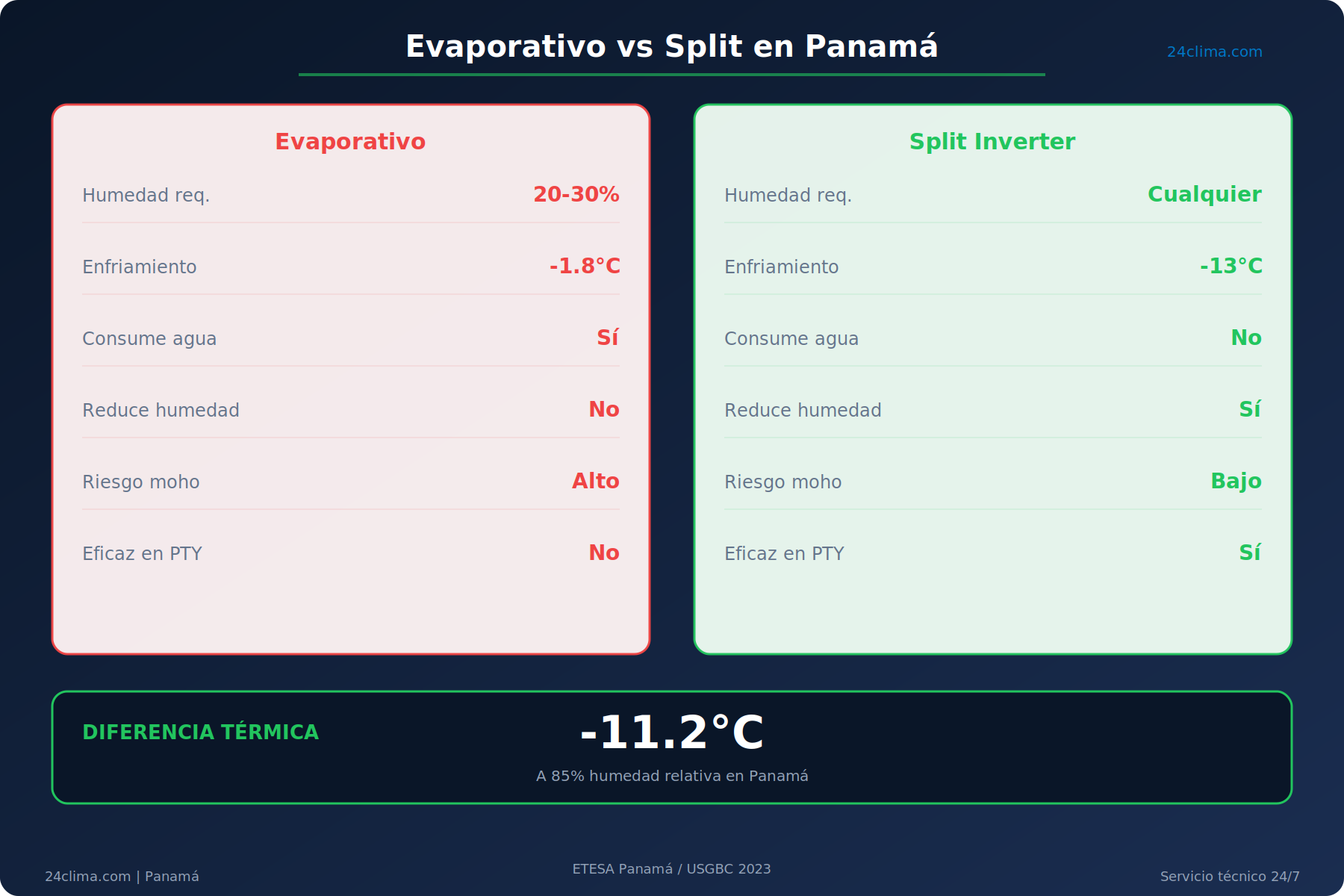
The popular story goes like this: evaporative coolers use less electricity, so they're cheaper to run. Split ACs are expensive to buy and expensive to operate. For a small room, why spend the money?
That logic holds in Sonora, Mexico, or in the dry interior of Spain during summer. In those places, relative humidity drops to 20–30%, and evaporative cooling delivers real thermodynamic efficiency — water evaporates, pulls heat out of the air, and room temperature drops 9–18°F. The principle is sound.
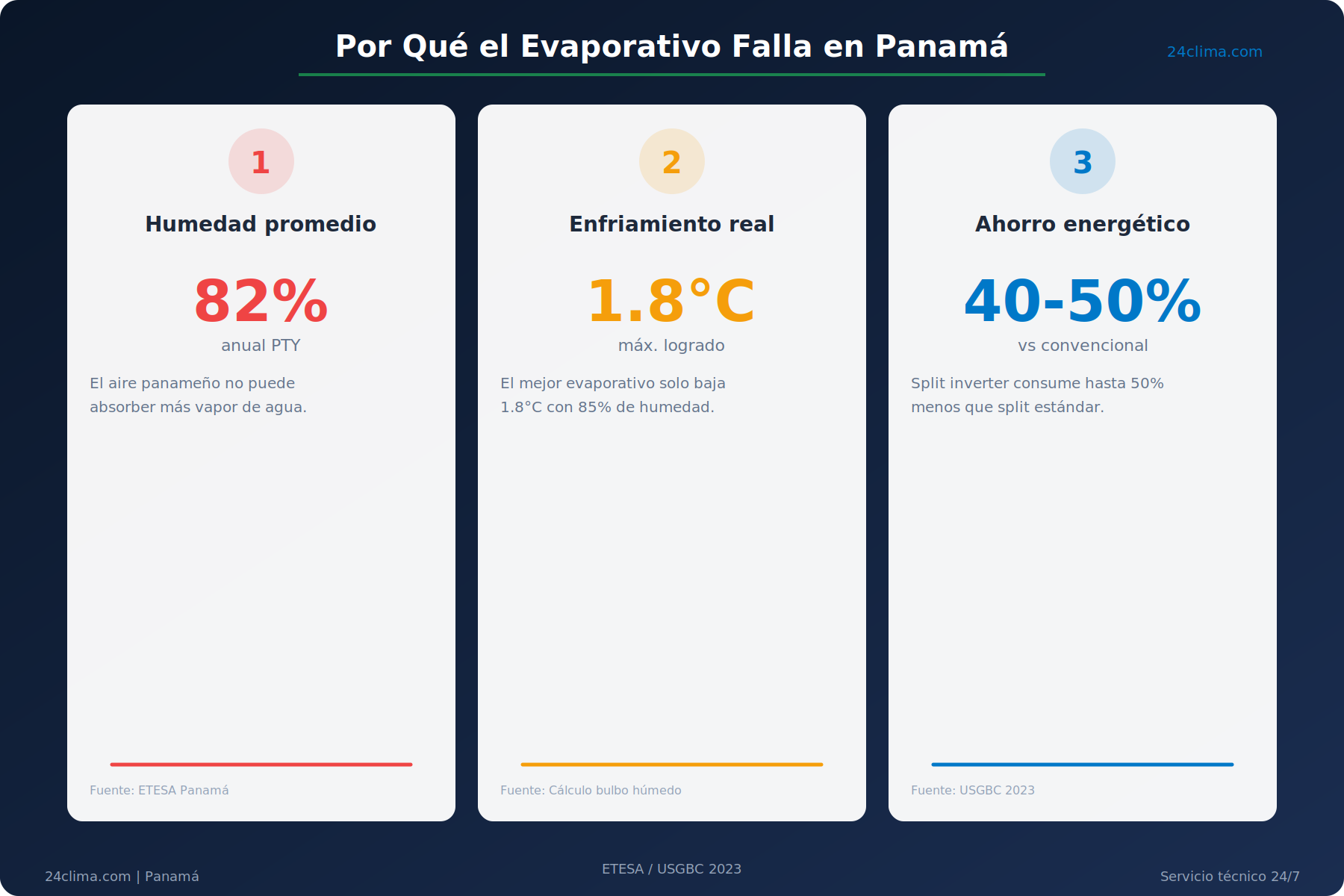
Panama City is another story entirely. Average annual relative humidity here runs 82%, according to historical records from ETESA (Empresa de Transmisión Eléctrica, S.A.). During the rainy season — May through November — it climbs to 88–92% on a sustained basis. At those levels, the air is already so saturated with water vapor that it can barely absorb any more. The evaporative effect shuts down almost completely. Not poorly. Just not at all.
Why Panama's Climate Kills the Evaporative Advantage
Evaporative coolers need ambient air with remaining capacity to absorb additional water vapor. Above 70% relative humidity, that capacity is minimal. Above 80%, it's essentially zero. The cooler ends up doing nothing more than pushing warm, humid air around a room that stays just as hot.
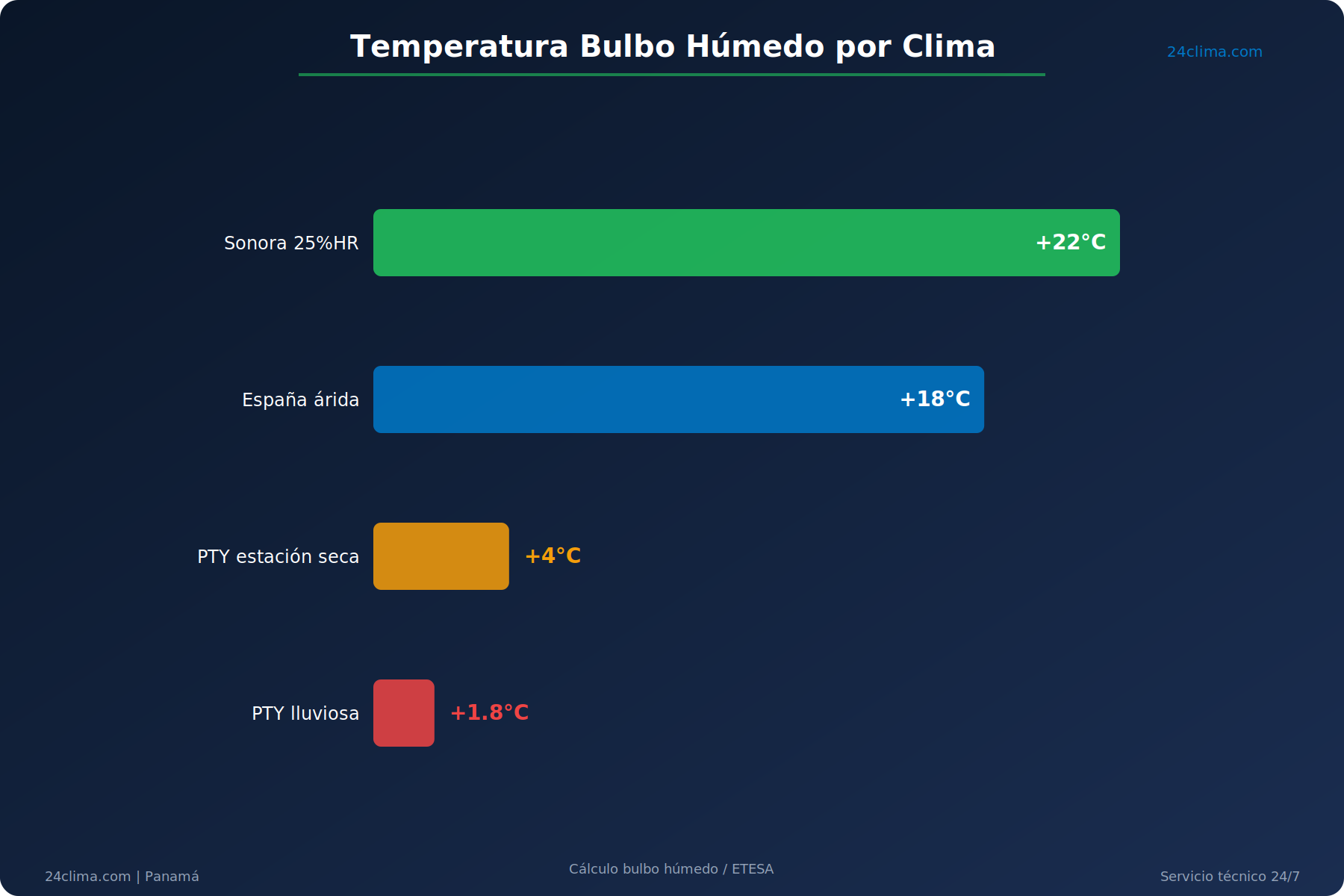
The thermodynamic principle behind this is called wet-bulb temperature. An evaporative cooler can, in theory, bring the ambient temperature down to approximately the wet-bulb temperature of the outdoor air. In Sonora at 25% humidity and 104°F, that wet-bulb temperature is around 64°F — a drop of 40 degrees. Impressive.
In Panama at 85% humidity and 88°F, the wet-bulb temperature is approximately 84.6°F. The best evaporative cooler on the market achieves a drop of about 3.4°F. That's less cooling than a ceiling fan running on high.
There's a second problem almost nobody mentions: an evaporative cooler actively pumps additional water vapor into the interior space. In an environment already saturated, that pushes the perceived heat index higher — and it encourages mold growth on walls, furniture, and clothing. Several technicians working in Panama City have documented drywall damage directly linked to prolonged evaporative cooler use in apartments in Marbella and San Francisco.
How a Split Inverter Works in Tropical Conditions
A split inverter extracts both heat and moisture from interior air simultaneously, through a compression refrigeration cycle that has nothing to do with outdoor humidity. Unlike an evaporative cooler, its efficiency doesn't shift whether outdoor humidity is 40% or 95%. The variable-speed compressor adjusts output between 30% and 130% of nominal capacity to hold your target temperature without constantly cycling on and off.
The cycle is precise: refrigerant — R-32 in current LG, Samsung, and Panasonic models sold in Panama — circulates through the indoor evaporator coil, where it pulls heat and moisture from the room air. That heat transfers outside through the condenser. The air returning into the room comes back at 61–64°F and noticeably drier. That cool, non-clammy sensation is what separates a split AC from everything else.
According to the U.S. Green Building Council (USGBC, 2023), a properly sized split inverter consumes 40–50% less energy than a conventional non-inverter split of the same capacity. Comparing it to an evaporative cooler in a tropical climate doesn't really work — because the evaporative cooler doesn't achieve the same thermal result. Comparing 200 watts that don't cool to 900 watts that do isn't an apples-to-apples comparison.
Monthly Operating Cost Comparison in Panama (USD)
The figures below use the Naturgy/Gas Natural Fenosa residential tariff for consumption between 300 and 500 kWh/month in Panama City (2024), approximately $0.16 per kWh including the distribution charge.
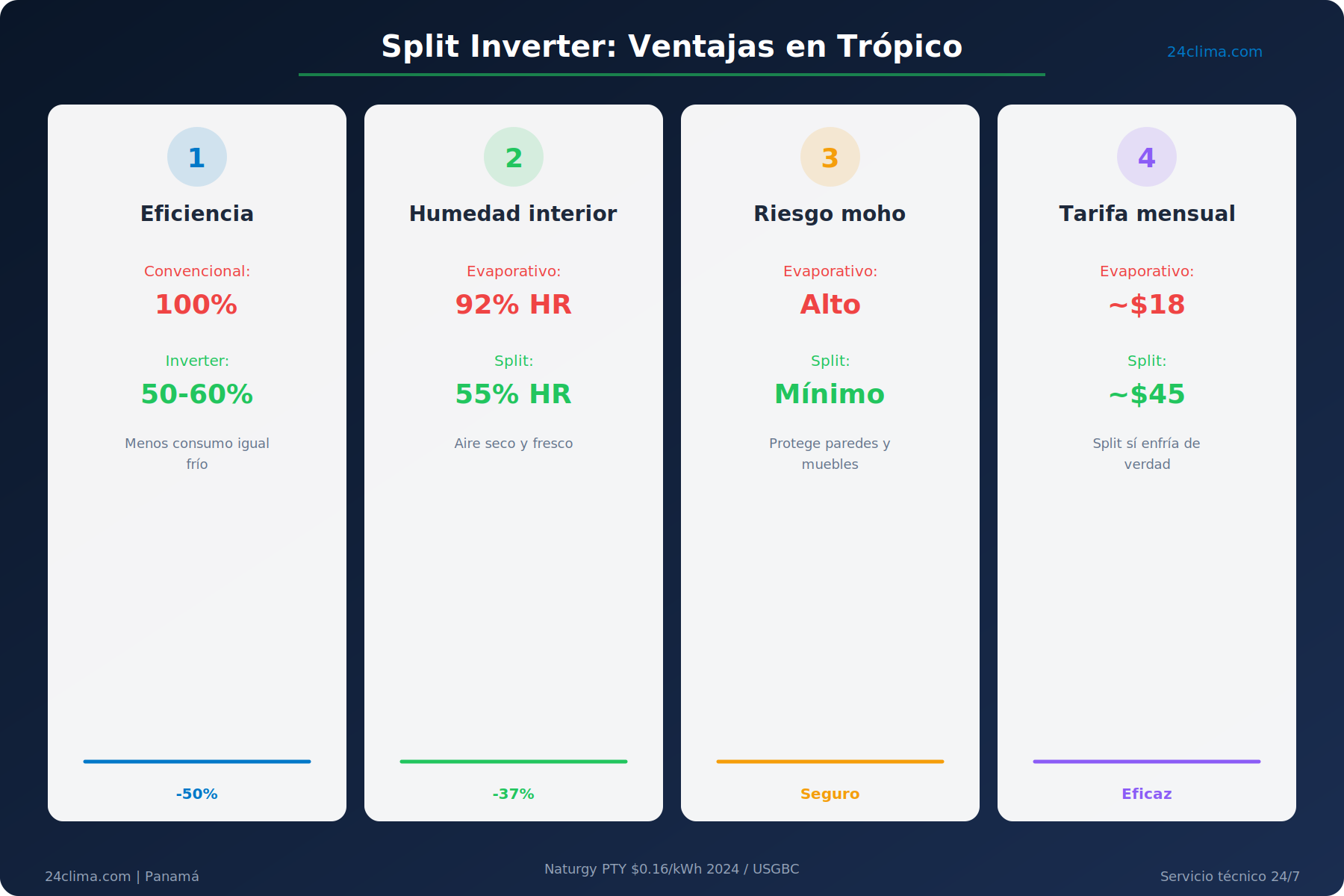
Portable evaporative cooler (200W, 8 hours daily): — Estimated monthly consumption: 48 kWh — Monthly cost: $7.68 — Interior temperature achievable in Panama: 84–86°F (unacceptable) — Interior humidity: increases by 5 to 12 percentage points — Real result: fails at its primary function
12,000 BTU split inverter (LG Dual Inverter or Samsung WindFree, 950W peak, real average ~600W in stable mode): — Estimated monthly consumption: 144 kWh — Monthly cost: $23.04 — Interior temperature achievable: 68–75°F adjustable — Interior humidity: reduced to 50–60%, within the comfortable range — Real result: delivers on its core function with measurable efficiency
12,000 BTU conventional split (non-inverter, 1,200W constant draw): — Estimated monthly consumption: 288 kWh — Monthly cost: $46.08 — The split inverter saves $23/month versus the conventional unit, or $276 per year
The monthly gap between the split inverter and the evaporative cooler is roughly $15. But the evaporative cooler doesn't cool. Paying $7.68 a month for no actual thermal comfort in Panama isn't saving money — it's throwing money away.
Brands Available in Panama and What to Look For
The three brands with the strongest presence in Panama's residential and commercial market are LG, Samsung, and Panasonic. Each offers inverter lines with ENERGY STAR certification and R-32 refrigerant, which carries a global warming potential of 675 — significantly lower than the 1,430 of the older R-410A.
LG Dual Inverter: dual-rotor compressor technology that cuts vibration and operating noise. A solid choice for bedrooms in apartments in Punta Pacífica or Obarrio, where nighttime noise is a recurring complaint. Compressor warranty runs 10 years in Panama.
Samsung WindFree: disperses cold air through 23,000 micro-perforations with no direct airflow stream. Recommended for offices in Costa del Este and workspaces where a cold draft blowing directly on people causes discomfort. Available through distributors including Melo and Casa Fastlich.
Panasonic Nanoe-X: incorporates air purification using active OH ions — relevant in areas with construction dust, which is constant in Clayton and the expanding zones of Panama Oeste. The Econavi compressor adjusts output based on occupancy detected by onboard sensors.
For all three, professional cleaning service (https://24clima.com/servicios/limpieza/) every 4 to 6 months is non-negotiable in Panama: humidity and airborne dust clog filters fast, and a dirty filter can push electricity consumption up by 15%, according to U.S. Department of Energy data (DOE, 2022).
Choosing the Right Unit for Your Space
Capacity depends on the space, not just your budget. A 12,000 BTU split inverter covers bedrooms of roughly 130–195 square feet with standard 8-foot ceilings in Panama. For living rooms of 215–320 square feet, the minimum recommended capacity is 18,000 BTU, factoring in solar heat gain and internal heat loads from people and electronics.
High-rise apartment (Marbella, Avenida Balboa, San Francisco): a wall-mounted mini-split is the only practical option. Installation typically means running copper refrigerant lines through the exterior wall, and many buildings have condo rules about where the outdoor condenser can be placed. Twice-yearly preventive maintenance (https://24clima.com/servicios/mantenimiento/) matters especially in coastal buildings, where salt-laden sea breeze accelerates corrosion on the outdoor coil.
Single-family home (Albrook, Clayton, Howard, La Chorrera): more installation flexibility. Multi-split systems work well here — one outdoor unit connected to two or three indoor heads, which cuts total installation cost. A three-bedroom home fully cooled with inverter units runs approximately $65–80 per month at 8 hours of daily use, based on 24Clima project data from those areas.
Commercial office (Costa del Este, Marbella): ceiling cassette units or centralized ducted systems with zone control are the right call. A wall-mounted split doesn't distribute air evenly across open-plan spaces larger than about 430 square feet.
Frequently Asked Questions
Does an evaporative cooler work in Panama at 85% humidity?
Not effectively. At 85% relative humidity, the air has almost no remaining capacity to absorb additional water vapor. Evaporative cooling needs relative humidity below 60% to operate at a minimally acceptable level, and below 40% to perform well. Those conditions simply don't occur in Panama — except at elevation in places like El Valle de Antón or Boquete, where humidity occasionally drops to 55–65% during the dry season.
How much does a split inverter save compared to an evaporative cooler on electricity?
The question starts from a flawed premise: a split inverter doesn't compete with an evaporative cooler on electricity consumption — it competes on results. The evaporative cooler costs $7–10 a month and fails to cool the space in tropical conditions. The split inverter costs $20–25 a month and keeps the space at 72°F with controlled humidity. Compared to a conventional non-inverter split, the inverter saves $20–30 per month, recovering the equipment price difference in 18 to 24 months.
What type of air conditioner is best for apartments in Panama City?
A wall-mounted split inverter, correctly sized in BTU for the space. In Panama City apartments, heat load includes solar gain through windows — especially on north- and west-facing exposures — heat from electronics, and infiltration of humid outdoor air. A practical sizing rule for Panama: 600 BTU per square meter for spaces with windows in direct sun, 500 BTU per square meter for shaded spaces or rooms with small windows. Oversizing is also a mistake: a unit that's too large short-cycles frequently without adequately dehumidifying.
The Heat Isn't the Problem — the Humidity Is
Back to that Costa del Este apartment. The difference between that evaporative cooler humming away uselessly and an LG split inverter running at 73°F isn't just temperature — it's humidity. At 73°F with 55% relative humidity, the human body experiences genuine comfort. At 82°F with 90% humidity, the heat index climbs above 95°F and the body can no longer regulate its temperature efficiently.
At 24Clima, we've spent years installing and maintaining equipment in apartments, homes, and offices across the city — from the high floors of Punta Pacífica to the neighborhoods of Arraiján and La Chorrera. If you're not sure which unit to install, if your current split isn't cooling the way it should, or if you want to calculate the correct BTU for your space, contact us on WhatsApp (https://24clima.com/contacto/) and a certified technician will get back to you the same day — no charge for the consultation.
Last updated: May 2025