HEPA Filters for Air Conditioners — Are They Worth It in Panama?
It's 2 p.m. in Costa del Este. The sun is hammering the concrete with the kind of intensity that makes the horizon shimmer. Inside the apartment, the split unit has been running non-stop since 9 in the morning. The cool air coming out of the indoor unit has a strange smell — not exactly mildew, not exactly dust, but something between the two that never quite goes away. You've been ignoring it for months.
Today you decide to check the filter. You slide it out, and what you find isn't an ordinary gray dust filter. It's a dark panel, almost black at the corners, with green patches that can only be one thing: live mold, growing inside the unit that's been cooling the air you and your family breathe for months.
The most common mistake isn't failing to clean the filter. The mistake is assuming that a basic plastic mesh filter is good enough for Panama's climate. It isn't. Here's the technical explanation of why — and what to do about it. For a broader look at keeping your system running well, our guides and tips at https://24clima.com/consejos-y-guias/ cover the most common questions from homeowners across Panama.
What You Think AC Filters Do — and What They Actually Do
Most people assume an air conditioner filter exists to keep the inside of the unit from getting dirty. That's part of it — but only half the story.
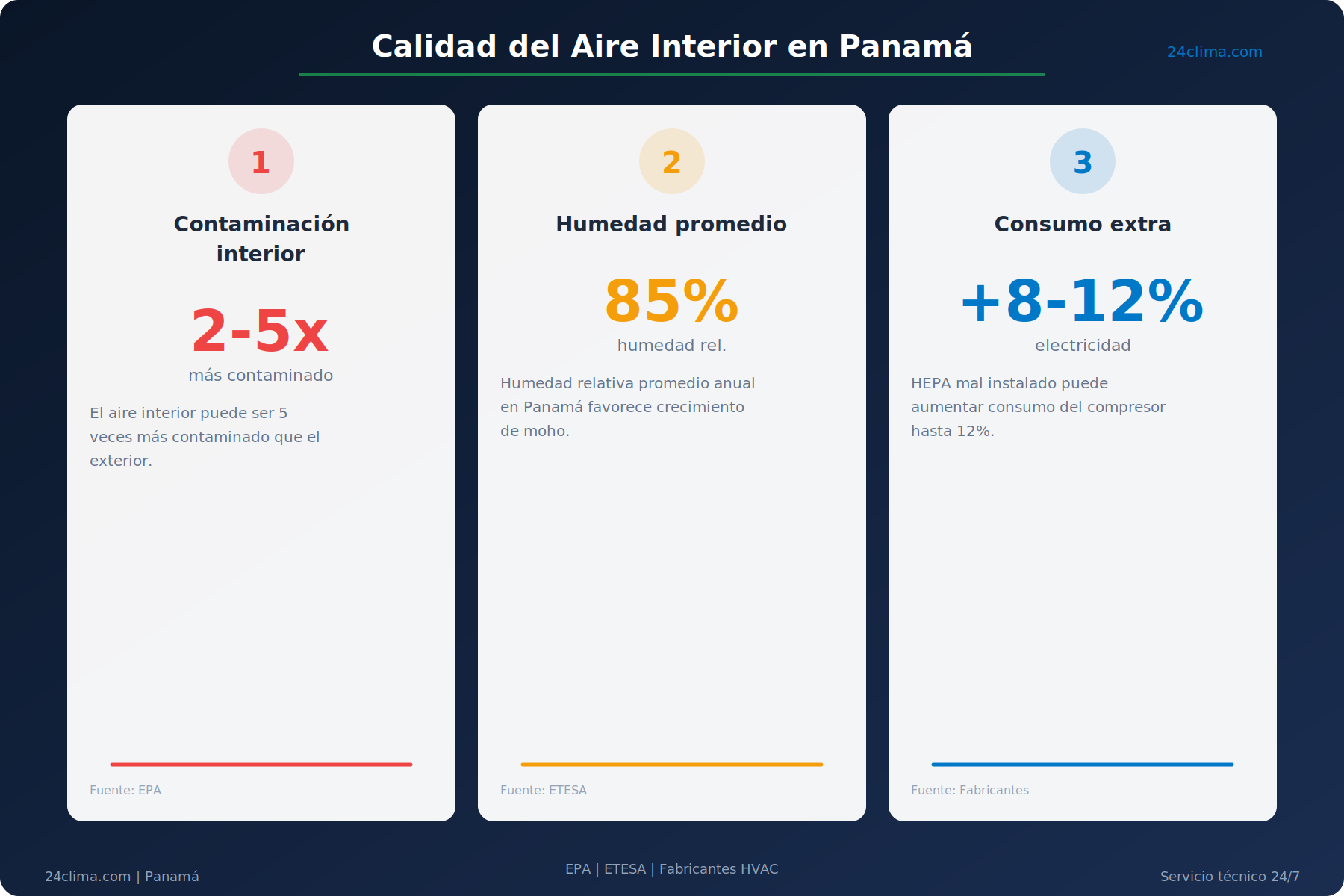
What rarely gets mentioned is that the same filter also determines the quality of the air entering your lungs every time the unit runs. In Panama, where average relative humidity hovers around 85% for most of the year, the filter isn't a passive component. It's the first and nearly only barrier between the room air and a microscopic ecosystem of mold, bacteria, dust mites, and particles that thrive in exactly these conditions.
The U.S. Environmental Protection Agency (EPA) puts indoor air pollution at 2 to 5 times worse than outdoor air in a typical home. In Panama, with windows closed and AC running all day, that multiplier gets worse. Your apartment isn't a clean bubble — it's a sealed space with air circulating constantly across a damp surface coated in accumulated organic matter.
The technician who installed your unit probably never mentioned this. Most don't.
The Three Types of AC Filters Available in Panama — and What They Actually Do Differently
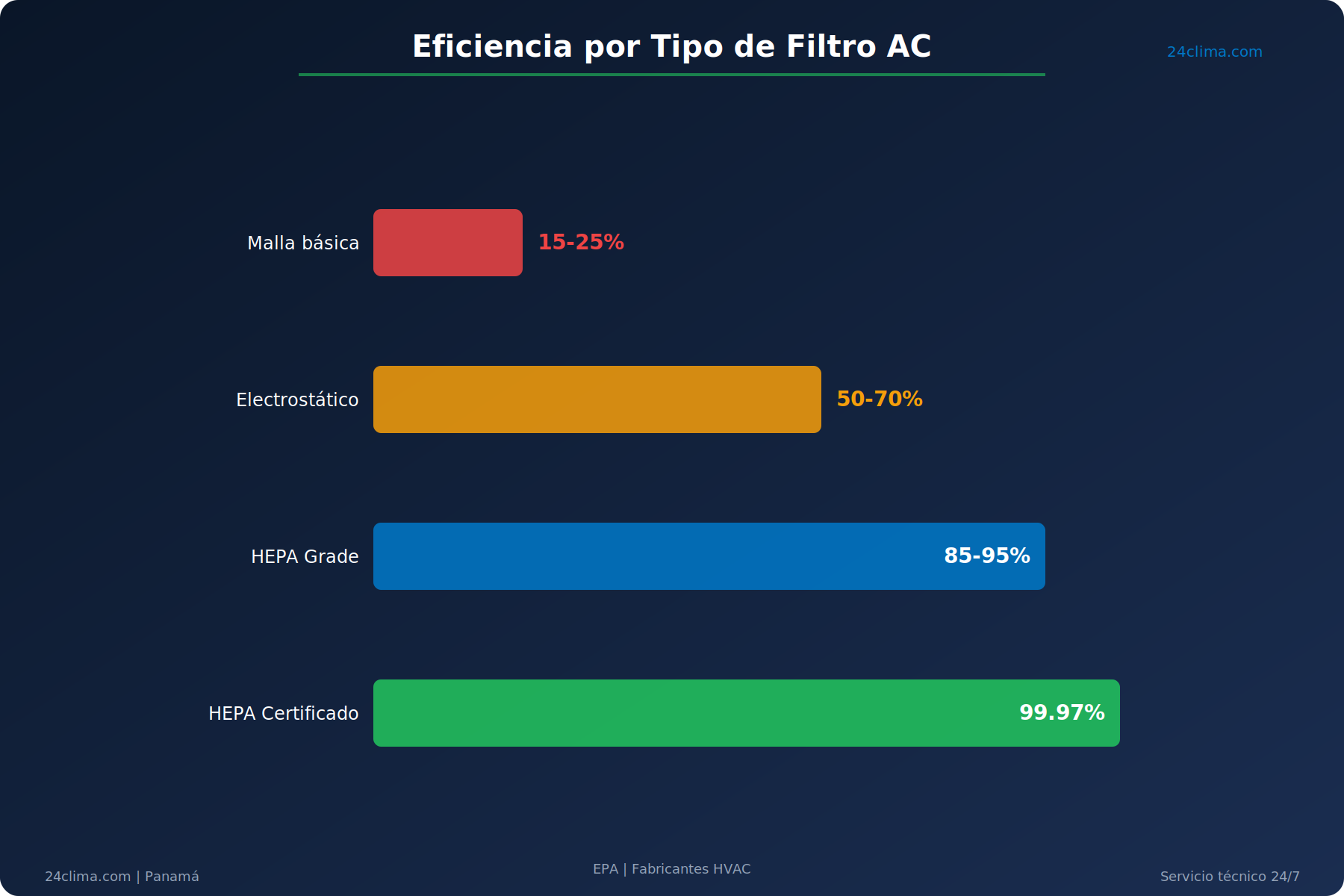
There are three main filter categories available for residential split units in Panama: standard mesh filters, electrostatic filters, and high-efficiency HEPA-type filters. Each has a different filtration rating measured by percentage of particles captured, and in a tropical climate that difference matters — both for your health and for equipment performance.
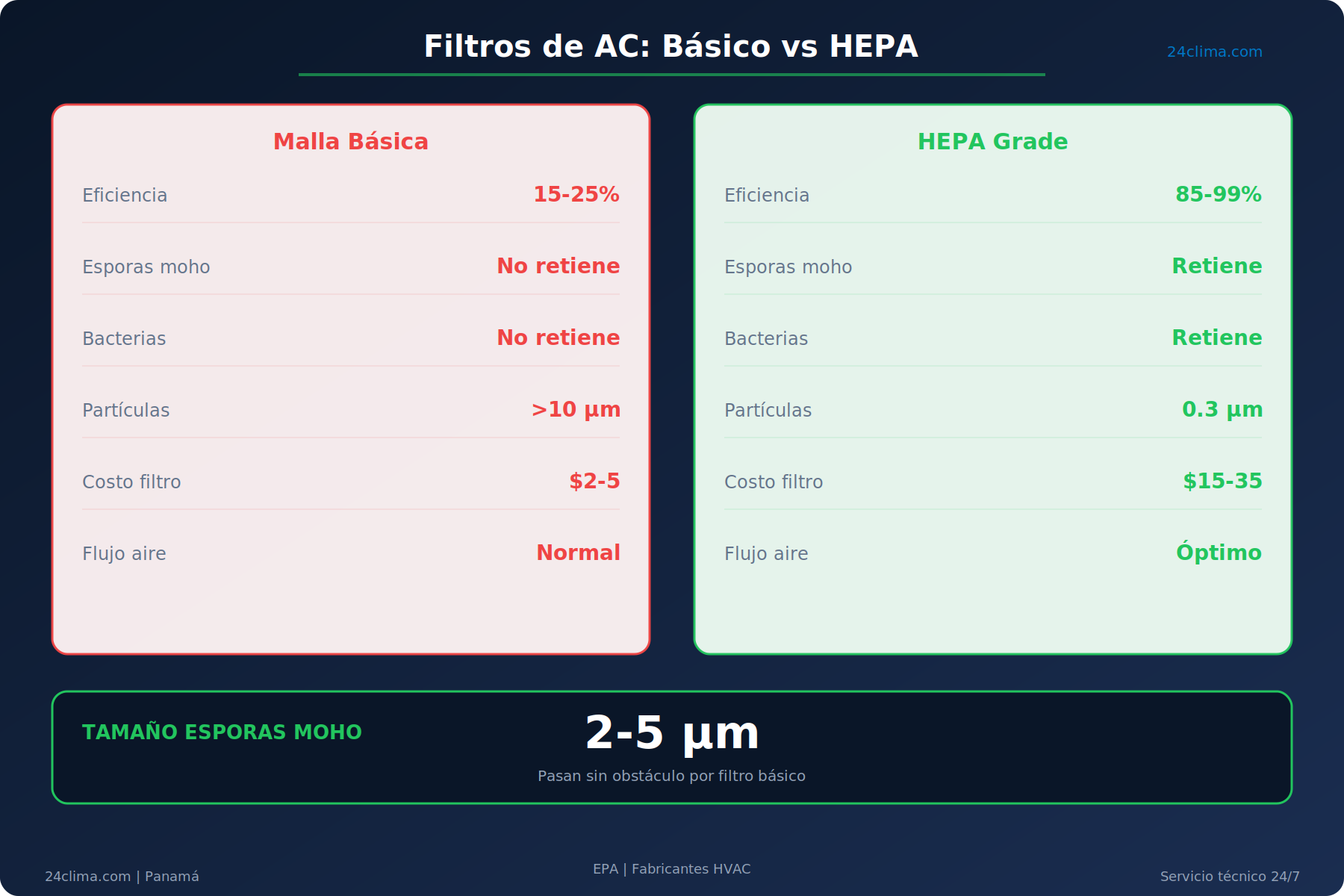
Standard Mesh Filter (efficiency: 15–25%)
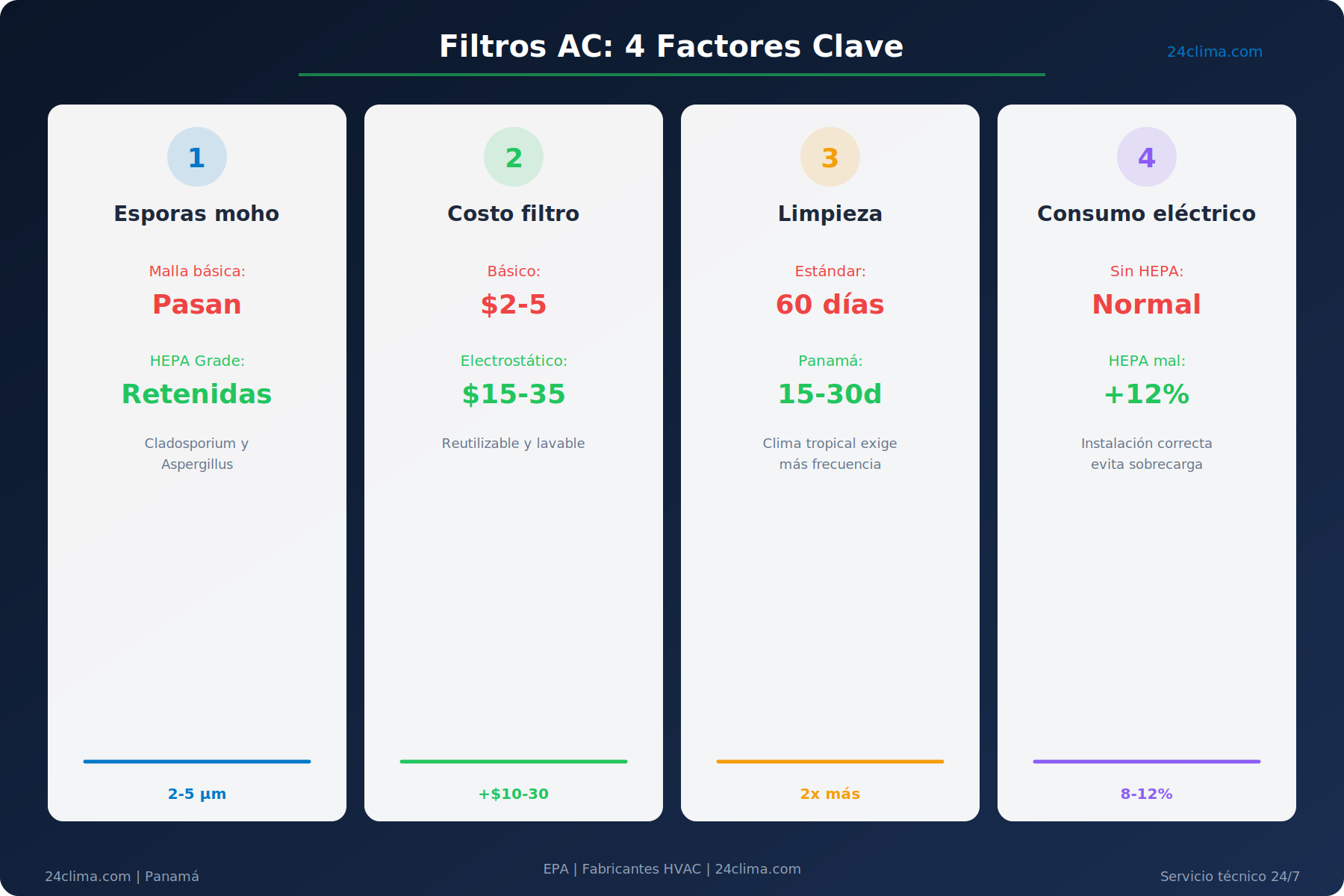
This is the filter that comes factory-installed in most residential splits. It's a washable polypropylene grid that captures coarse dust, pet hair, and visible particles. Cheap and easy to rinse — but it doesn't capture mold spores, bacteria, or fine particles smaller than 10 microns. In an environment with 85% humidity, spores from Cladosporium and Aspergillus — the two most common mold genera found in Panama — measure between 2 and 5 microns. They pass straight through this type of filter without any resistance.
Electrostatic Filter (efficiency: 50–70%)
This works through static charge that attracts oppositely charged particles, similar to how freshly dried laundry attracts lint. It captures finer particles than the standard filter, including some allergens and bacteria. Reusable and washable. In Panama these are available as accessories at stores like Cochez or through brand distributors such as Daikin and LG, with replacement costs running between $15 and $35. It doesn't reach HEPA efficiency levels, but it's a meaningful upgrade over the basic filter — especially for households with children, elderly residents, or anyone with allergies.
HEPA or High-Efficiency Filter (efficiency: 95–99.97%)
A certified HEPA filter captures 99.97% of particles 0.3 microns or larger — mold spores, dust mites, bacteria, aerosol-carried viruses, and virtually every known allergen. The catch is a technical one: standard residential split units were not designed for the pressure differential generated by a full HEPA filter. Installing one directly can restrict airflow and force the compressor to work harder, raising electricity consumption by 8 to 12% if the installation isn't done correctly.
The approach used by certified technicians is to install HEPA-grade filters or activated carbon filters combined with an electrostatic layer, which achieve 85–95% efficiency without blocking airflow across the evaporator coil. Some brands — including Mitsubishi Electric and Panasonic — now offer models with integrated filtration systems (nanoe-X or Plasmacluster) that deliver high efficiency without airflow restriction.
How Often Should You Clean an AC Filter in Panama? The Answer Might Surprise You
In Panama, the filter on a residential split unit needs to be cleaned every 15 to 30 days. That contradicts what most imported equipment manuals say, because those manuals were written for temperate climates with low dust loads and moderate humidity.
In countries like Germany, Canada, or northern Spain, manufacturers recommend cleaning every 60 to 90 days. That makes sense when average relative humidity sits at 50–60% and the air carries a lighter biological load. In Panama, at 85% humidity, the filter becomes a damp substrate where spores land, attach, and start growing within 10 to 14 days if nothing is done.
A study published in Indoor Air (Wiley, 2019) documented that in tropical climates with more than 80% relative humidity, AC filters without regular cleaning accumulate 3 to 7 times more microbial load than the same filters in temperate climates over the same period.
Recommended cleaning frequency by use and location in Panama:
— Apartment with AC running 8–12 hours/day, urban area (Panama City): every 15 days — House with AC running 4–6 hours/day, residential zone: every 20–25 days — Office with central air system: every 10–15 days — Coastal properties (Punta Pacífica, Amador, Casco Viejo): every 10–15 days due to additional salt exposure
If you notice an odor from the vents, the unit taking longer than usual to cool the room, or dark spots appearing on the air outlet grille, the filter has already reached its limit. Don't wait for the next scheduled cleaning — those are signs the problem has already started.
Real Cost-Benefit Analysis: Is Upgrading the Filter Worth It?
Upgrading the filter in your split unit costs between $20 and $80 depending on the type, and in most cases in Panama it pays for itself within 6 months.
Here are the concrete numbers:
— Basic electrostatic filter: $15–$35, lasts 2–3 years with regular maintenance, reduces allergens by 50–70% — HEPA-grade filter for split units: $40–$80 depending on model, captures 85–95% of fine particles — Combined activated carbon filter: $25–$50, eliminates odors and volatile organic compounds in addition to particles
On energy savings: a dirty filter increases resistance to airflow, which forces the compressor to work harder. According to Daikin technical data for tropical climates, a filter obstructed at 40% capacity can raise the unit's electricity consumption by 10 to 15%. For a 12,000 BTU split running 10 hours a day in Panama, that's between $8 and $14 extra per month on your ENSA or EDEMET bill — or $96 to $168 a year, just from not cleaning the filter.
The health side is harder to put a dollar figure on, but the data is clear. The World Health Organization estimates that indoor air pollution causes approximately 3.8 million premature deaths per year globally (WHO, 2021), with respiratory disease, cardiovascular conditions, and lung cancer as the leading causes. In a tropical environment with elevated biological load like Panama, upgrading your AC's filtration is one of the highest-impact, lowest-cost things you can do for your household.
For a deep clean of the entire system — not just the filter but the evaporator coil, condensate drain pan, and fan coil assembly — the professional cleaning service at https://24clima.com/servicios/limpieza/ includes a full inspection of every component that accumulates mold in tropical climates.
Does a HEPA Filter Eliminate Mold and Allergens in Tropical Environments?
Yes, a high-efficiency HEPA-type filter removes mold spores and allergens from the air circulating through the unit — but it does not eliminate mold that has already grown inside the system. If there are active mold colonies on the evaporator coil or the condensate drain pan, the filter only intercepts the spores coming out. It doesn't address the source. Solving the root problem requires professional cleaning of the full unit combined with installation of an upgraded filter.
What Type of Filter Does My Air Conditioner Need in Panama's Humid Climate?
For the average home in Panama City, an electrostatic filter combined with an activated carbon layer is the most practical upgrade: it improves capture of fine particles and allergens, eliminates odors caused by humidity and organic compounds, and doesn't restrict airflow through the unit. For households with allergy sufferers, asthma, or respiratory conditions, a HEPA-grade filter installed by a certified technician is the right choice — with an equipment inspection first to confirm compatibility with the specific split model.
How Often Should I Clean or Replace the Filter in My Split Unit in Panama?
In Panama, the minimum recommended frequency is every 15 to 30 days for standard residential use. Mesh filters get rinsed with water and a soft brush, dried completely before reinstalling — a wet filter accelerates mold growth rather than preventing it — and replaced when the mesh shows warping or physical damage. Electrostatic and activated carbon filters have longer service lives but still require monthly cleaning in this climate.
How to Clean Your AC Filter in Panama — Step by Step
Cleaning the filter on a residential split takes less than 15 minutes and requires no special tools. It's the highest-impact, lowest-effort maintenance task you can do for a tropical-climate AC system.
Turn off the unit and wait 5 minutes before opening the front panel of the indoor unit.
Slide the filter out carefully — if it's heavily loaded with dust, do it slowly to avoid dispersing particles into the room.
Take the filter to the bathroom or patio. Tap it gently against a surface to knock loose the coarser dust before getting it wet.
Rinse with lukewarm water and a soft-bristle brush. Avoid harsh detergents — bleach degrades the polypropylene mesh of standard filters over time.
Dry completely in the shade, air only. Never reinstall a wet filter. Panama's ambient humidity is already high — a damp filter inside the unit creates ideal conditions for Aspergillus and Penicillium growth within 48 hours.
Reinstall the filter, close the panel, and power the unit back on.
If you remove the filter and notice black or green patches on the plastic housing behind it, or the unit still smells stale even with a clean filter, the problem is in the evaporator coil or the condensate drain pan — not the filter itself. That requires professional cleaning of the full unit. For that situation, the preventive maintenance service at https://24clima.com/servicios/mantenimiento/ includes evaporator coil cleaning with antibacterial products formulated for tropical climates.
Back to That Costa del Este Apartment
The filter you pulled out this afternoon isn't a sign that your equipment is failing. It's the expected result of a climate that pushes any basic filtration system to its limits. The good news is that the fix isn't expensive or complicated: a $25 electrostatic filter, cleaned every 15 days, eliminates 60–70% of the problem. A professionally installed HEPA-grade filter eliminates 90–95%.
The air you breathe inside your home isn't an abstract concept. In Panama, with the biological load that tropical humidity generates, the filter in your split unit is literally what stands between filtered air and a humid room circulating mold spores. It's worth getting right.
At 24Clima we assess the right filter type for your specific unit, your split model, and your actual usage pattern — whether it's a home, an office, or a rental property. If you want a technical recommendation with no sales pressure, contact 24Clima at https://24clima.com/contacto/ and a certified technician will respond via WhatsApp.
Last updated: June 2025