Air Conditioning and Humidity in Panama — How to Control the 85% Nobody Talks About
Last updated: May 2025
It's 2 a.m. in San Francisco (the Panama City neighborhood, not California). The AC has been running for three hours. The remote says 22°C (72°F). And yet the sheets feel sticky. The room has that faint closed-up smell — like laundry that never quite dried. You get up, touch the wall near the window: cold, but slightly damp. The unit is working fine. So what's going wrong?
Almost never BTUs. Almost never temperature. It comes down to 85%.
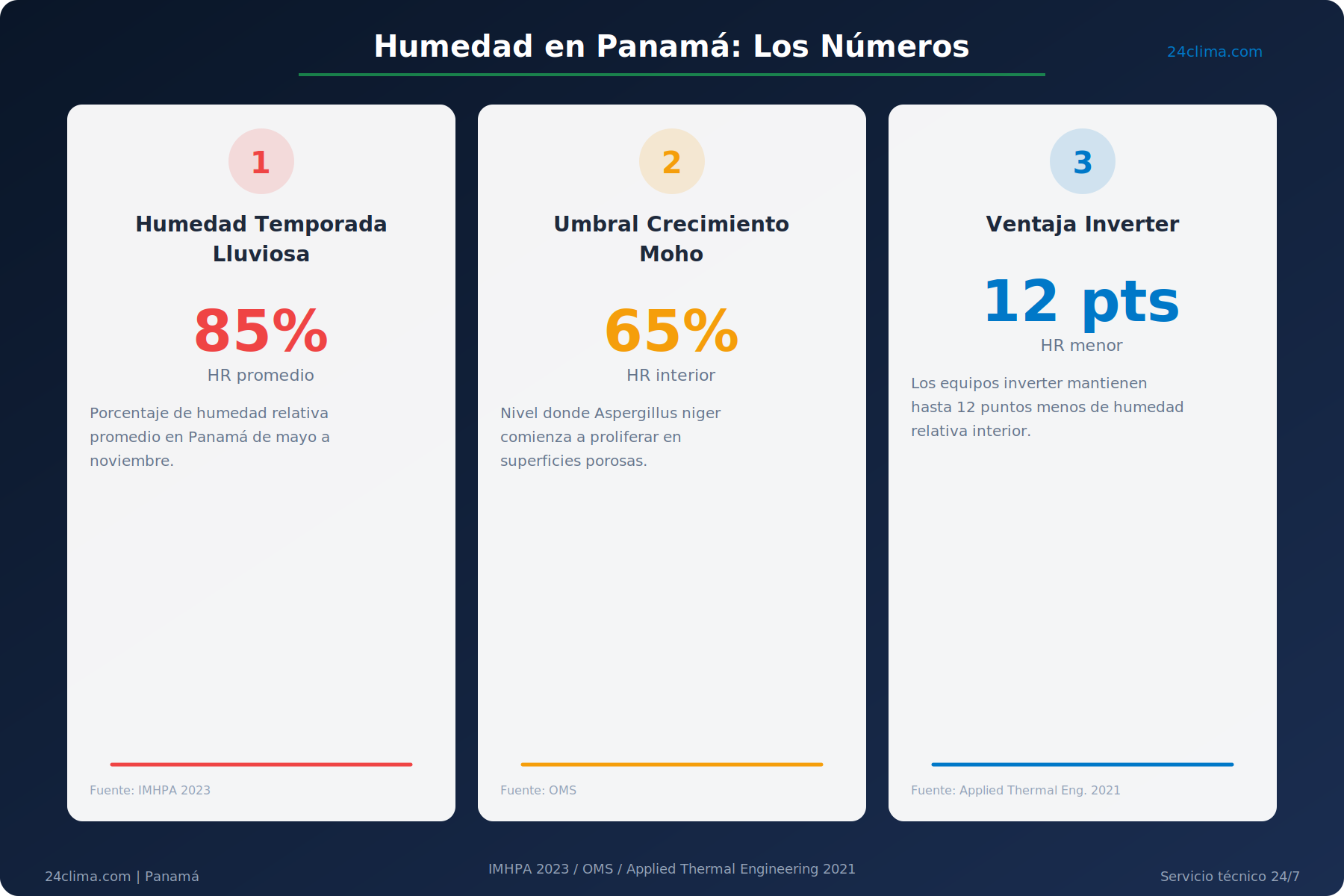
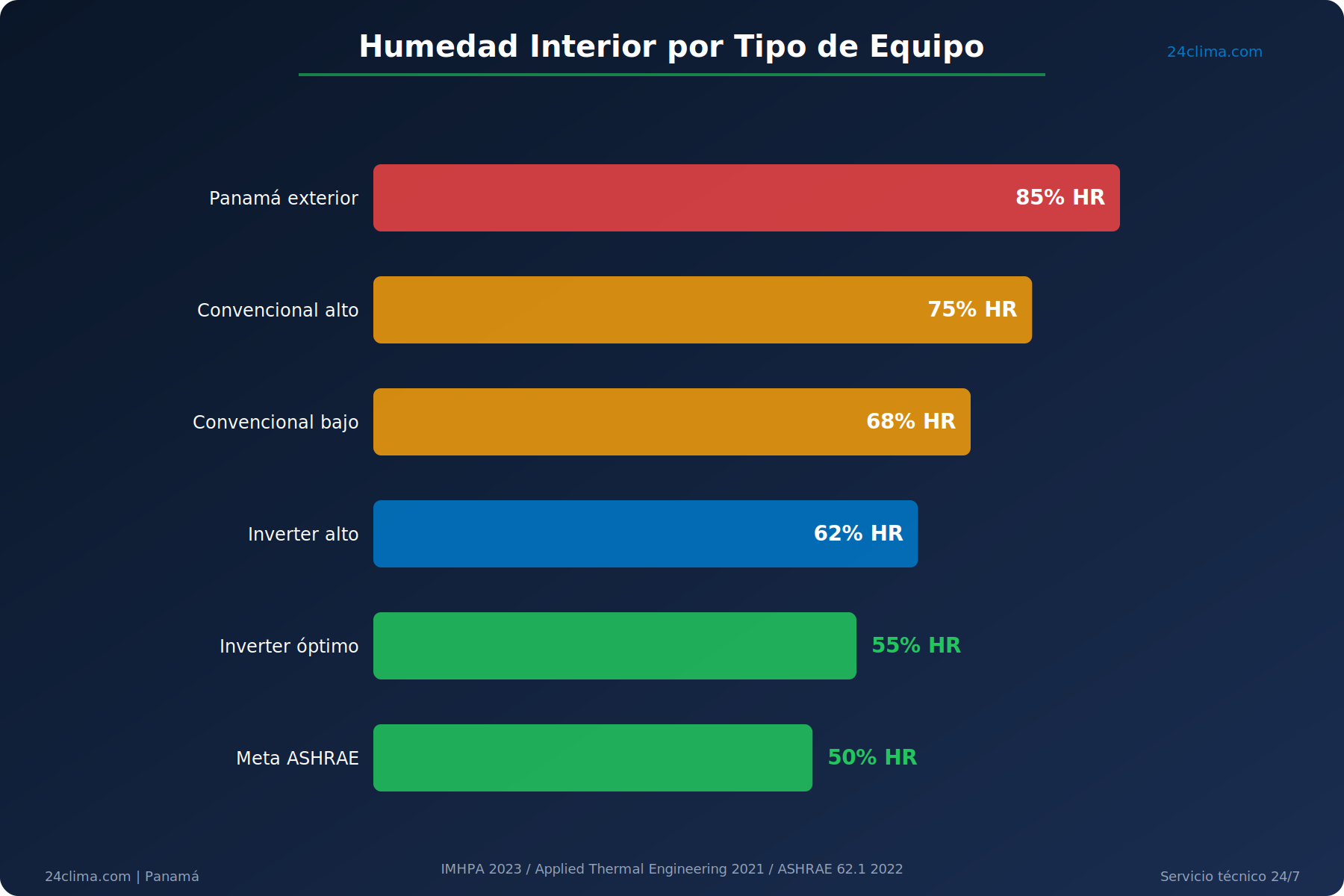
That's the average relative humidity in Panama during the rainy season — May through November — according to data from Panama's Institute of Meteorology and Hydrology (IMHPA, 2023). Most people shopping for an air conditioner never think about that number. They look at price, brand, BTU capacity. But in a country where humidity beats heat as the primary enemy of comfort, buying the wrong unit can mean three years of bad sleep even when the thermostat reads exactly what you set it to.
What Almost Everyone Believes (And Why It's Wrong)
There's a widespread assumption in Panama — among locals and expats alike — that a cold room is a comfortable room. It makes intuitive sense. But it's a technical mistake with real consequences: mold in the corners, dark stains on walls, respiratory issues, a persistent heaviness in the air that no temperature setting will fix.
An air conditioner has two separate physical functions: cooling the air and dehumidifying it. Both happen in the same process, yes — but not with the same efficiency. It depends on the type of unit, how you configure the operating mode, and how the equipment manages its run cycles. A unit that constantly cycles on and off can cool a room down to 20°C (68°F) and still leave relative humidity above 65% — the threshold at which the fungus Aspergillus niger begins proliferating on porous surfaces, according to the World Health Organization.
Cold air is not the same as dry air. In Panama, the second one matters just as much as the first.
How an Air Conditioner Actually Removes Humidity
An air conditioner removes moisture by cooling air below its dew point. When warm, humid air passes over the evaporator coil — which operates between 4°C (39°F) and 10°C (50°F) — water vapor condenses into liquid droplets. Those droplets run down into a condensate tray and drain out through the drain line to the exterior. The longer the air stays in contact with that cold coil, the more moisture gets extracted.
That contact time is what separates equipment that works in Panama from equipment that just blows cold air.
A conventional (non-inverter) unit operates in binary mode: 100% power when on, 0% when off. When the thermostat detects the room has reached the set temperature, the compressor shuts down. At that moment, the evaporator coil starts warming up and the condensation process stops. Indoor air keeps circulating but no moisture is being removed. When the unit kicks back on — 8 to 15 minutes later, depending on outdoor heat — it takes several additional minutes for the coil to drop back down to the point where it can condense vapor again.
The result: intermittent dehumidification, with windows of time where room humidity climbs back up before the unit acts again.
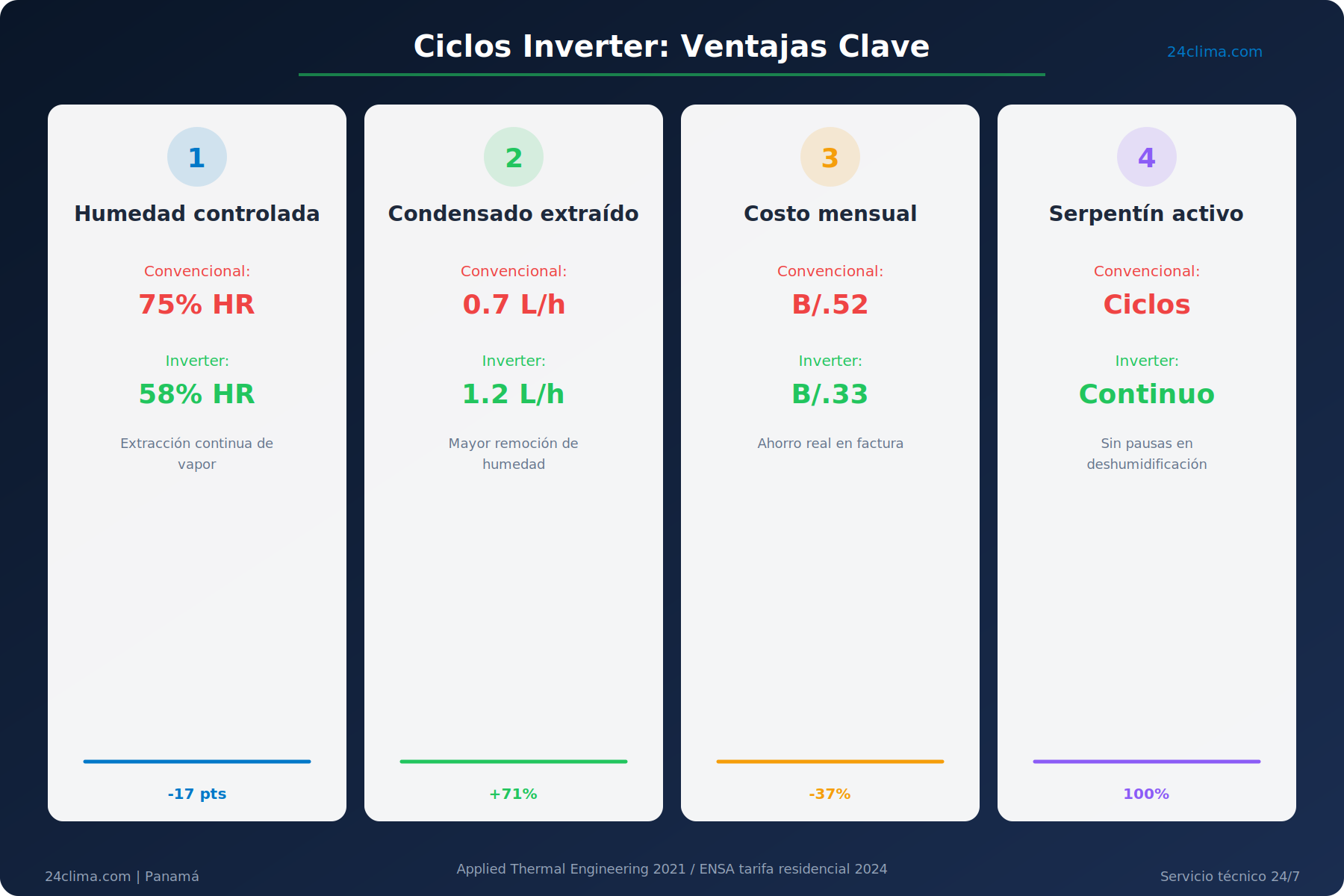
An inverter unit modulates compressor speed instead of shutting off. It drops to 30–40% power to maintain temperature without interrupting contact between the air and the cold coil. The coil stays cold continuously. Moisture extraction is ongoing, not stop-and-start.
A study published in Applied Thermal Engineering (Liu et al., 2021) found that inverter systems maintain indoor relative humidity up to 12 percentage points lower than conventional systems of equal capacity under tropical humid climate conditions. In practical Panama terms: the difference between 58% and 70% relative humidity in your bedroom is the difference between sleeping well and waking up feeling like it rained inside.
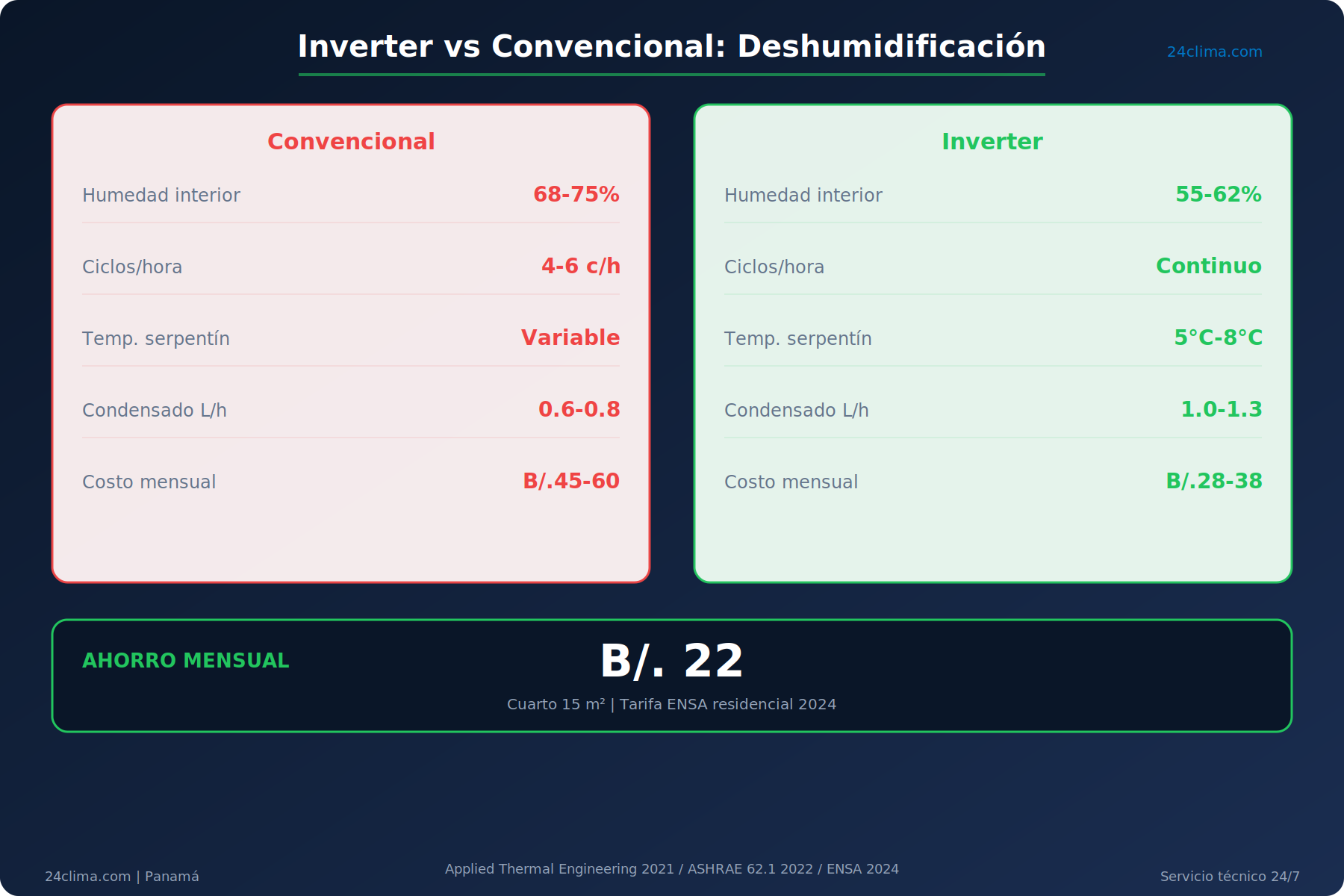
Inverter vs. Conventional in Panama — Dehumidification Comparison
Indicator — Conventional Unit — Inverter Unit
Average relative humidity maintained in room — 68–75% — 55–62% Compressor cycles per hour — 4–6 on/off cycles — Continuous modulated operation Evaporator coil temperature — Rises between cycles — Sustained between 5°C (41°F) and 8°C (46°F) Condensate extraction (liters/hour, 12,000 BTU) — 0.6–0.8 L/h — 1.0–1.3 L/h Estimated monthly electricity cost (15 m² room) — B/. 45–60 — B/. 28–38
Sources: Applied Thermal Engineering (2021), ASHRAE Standard 62.1 (2022), consumption estimates based on ENSA residential zone tariff Panama (2024).
Recommended Humidity Levels by Room Type in Panama
The ideal indoor humidity isn't a single number. It varies by how the space is used, how many people are in it, and how much natural ventilation it gets. ASHRAE Standard 62.1 (2022) sets a comfort band of 30% to 60% relative humidity for occupied spaces.
In Panama, where outdoor humidity exceeds 80% for most of the year, hitting below 55% in every room simultaneously is difficult without a centralized system or an auxiliary dehumidifier. What a properly sized inverter split unit can realistically achieve:
Master bedroom — Target: 50–58%. The resting body breathes more deeply during sleep, and high humidity promotes dust mites and nighttime respiratory issues. A 9,000 or 12,000 BTU inverter sized correctly for the room gets there consistently.
Living room — Target: 55–62%. Larger air volume, more occupants, more activity. Air exchange with unconditioned areas makes dropping below 55% harder. The real priority here: stay under 65%.
Home office or study — Target: 50–60%. High humidity affects electronics and causes cognitive fatigue. The U.S. National Institute for Occupational Safety and Health (NIOSH) recommends staying below 60% in spaces with continuous desk work.
Children's room — Target: 45–55%. Children are more susceptible to mold spores and dust mites. This is the room where an inverter with a dry mode or active dehumidification function pays for itself.
Dry Mode and Fan Speed — The Settings That Actually Matter
How you configure your remote control directly affects how much humidity your unit extracts. This is one of the least-discussed details in Panama, and one of the most consequential.
Dry Mode (the water droplet symbol): The unit reduces the internal fan to minimum speed and keeps the compressor running in short cycles. More contact time between air and the cold coil means more condensation. Use it on rainy nights when you don't need aggressive cooling — just humidity control.
Fan speed in Cool mode: Low or medium speed extracts more moisture than high speed. At higher speeds, air rushes past the coil with less contact time. At low speed, each cubic meter of air spends more seconds against the cold surface. During rainy season (May through November), set the fan to "Low" or "Auto" and skip "Turbo" for nighttime hours.
Target temperature: Setting 24°C (75°F) instead of 18°C (64°F) might look like a smart energy move, but with a conventional unit it can backfire on humidity — the room hits target temperature faster, the compressor shuts off before enough moisture has been extracted. With an inverter, this matters less because the unit doesn't stop, it just modulates down.
Our preventive maintenance service includes drain line inspection, evaporator cleaning, and operating parameter adjustments calibrated for each season. Details at 24clima.com/servicios/mantenimiento/.
Signs Your AC Is Not Dehumidifying Properly
A unit can cool a room and still fail at humidity control. These are the specific signs to watch for:
Musty or stale smell when you enter a room with the AC running. This indicates sustained humidity above 65%.
Condensation on the inside surface of glass windows at night. This happens when the glass drops below the dew point of the indoor air — a clear sign of elevated relative humidity.
Dark spots in ceiling corners or around the edges of the indoor unit. Early-stage mold colonization requires relative humidity above 70% for more than 48 continuous hours (WHO).
Walls that feel slightly tacky or damp to the touch. Indicates moisture migrating through the wall toward cooler surfaces.
Water dripping from the front face of the indoor unit, not from the drain line. The drain is likely blocked and condensate isn't exiting correctly — condensation is happening but ending up in the wrong place.
You feel cold but still uncomfortable. The thermostat reads 22°C (72°F) but there's no clean relief. Expats used to well-controlled AC from back home recognize this immediately. It's a consistent signal.
If two or more of these apply, the problem is likely a dirty evaporator coil — a layer of dust or biofilm reduces condensation capacity by up to 30%, per AHRI (2022) — a refrigerant issue, or a unit that's incorrectly sized for the space. Use our online diagnostic tool at 24clima.com/diagnostico/ to identify the most likely cause before calling a technician.
Frequently Asked Questions
Does an inverter air conditioner dehumidify better than a conventional one in Panama?
Yes, and the difference is technically significant given Panama's climate. An inverter keeps the compressor running continuously at modulated power, which holds the evaporator coil at a constant temperature and allows uninterrupted moisture extraction. A conventional unit cycles on and off, interrupting the condensation process multiple times per hour. In conditions of 85% outdoor humidity — typical of Panama's rainy season — that difference can translate to up to 12 percentage points of relative humidity inside your room.
What is the ideal indoor humidity for an apartment in Panama with air conditioning?
ASHRAE Standard 62.1 sets the comfort band at 40% to 60% relative humidity for indoor spaces. In Panama, a realistic target with a properly sized inverter split is 50% to 60% in bedrooms and 55% to 65% in living areas. Above 65% sustained, the risk of mold and dust mite growth increases significantly. Below 40%, mucous membrane irritation can occur — though that scenario is uncommon in Panama without an active dehumidifier running.
Why does my AC cool the room but humidity is still high?
Three main causes. The unit is conventional and its on/off cycles don't allow sustained moisture extraction. The evaporator coil is dirty — a layer of dust or biofilm reduces condensation capacity by up to 30% (AHRI, 2022). Or the unit is oversized for the space, hits the temperature target too quickly, shuts off, and never runs long enough to properly dehumidify. BTU sizing matters just as much for humidity as for cooling. You can review selection criteria in our tips and guides section at 24clima.com/consejos-y-guias/.
It's 6 a.m. Same apartment in San Francisco. But this time the air smells different — clean, dry, that quiet you recognize when a room is genuinely well-conditioned. The sheets aren't sticky. The wall near the window is dry. The remote reads 24°C (75°F), fan on "Low," and the unit — a 12,000 BTU inverter installed eight months ago — has been running silently all night, modulating between 40% and 70% of capacity, extracting between 18 and 22 liters of water from the indoor air over those hours.
That's what it should feel like. And it's completely achievable in Panama if you choose the right equipment, have it installed correctly, and maintain it at the frequency a tropical climate demands.
At 24Clima we assess your space, calculate the specific humidity load for your environment, and tell you exactly which unit and which settings will get you that result — not promises, but numbers. If your current unit isn't dehumidifying the way it should, or you're evaluating a new purchase before rainy season hits, contact us on WhatsApp at 24clima.com/contacto/ and a certified technician will get back to you the same day.