Ceiling AC Installation in Panama — The Guide Your Installer Won't Give You
It's 2 p.m. in Costa del Este. The sun hammers the glass facade of the building and the indoor temperature sits at 84°F despite the AC "working fine." The technician who installed the unit two years ago shrugged: "The drop ceiling has enough space." What he didn't mention is that this space — no acoustic insulation, no proper condensate drainage, improvised ductwork — turns your apartment ceiling into an oven and a mold nursery in the making.
This plays out every day in San Francisco, Marbella, Punta Pacífica, and virtually every modern residential tower or office building in Panama City. Drop ceilings are the dominant architectural reality in these neighborhoods, and deciding which AC system goes inside that cavity is one of the most technical — and most poorly executed — decisions in the local market.
At 24clima.com we've documented hundreds of failed installations across Panama. What follows is what we've learned firsthand: the three systems that actually work, their real costs, their specific risks in Panama's climate, and the questions you need answered before signing anything.
What Most People Believe — And Why They're Wrong
The assumption most owners make goes like this: "if there's a drop ceiling, you stick the unit up there and you're done." It sounds reasonable until you factor in three things that are specific to Panama.
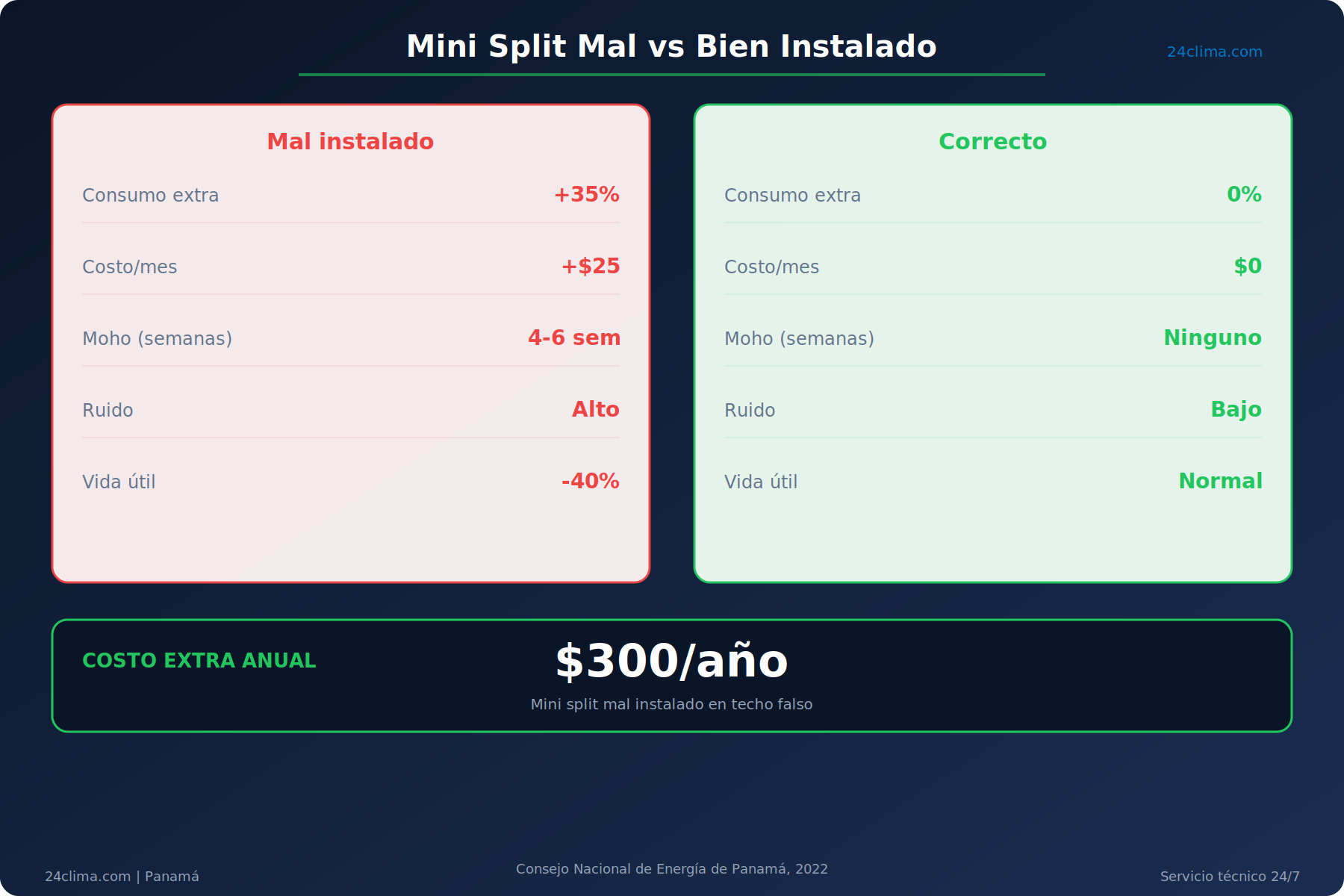
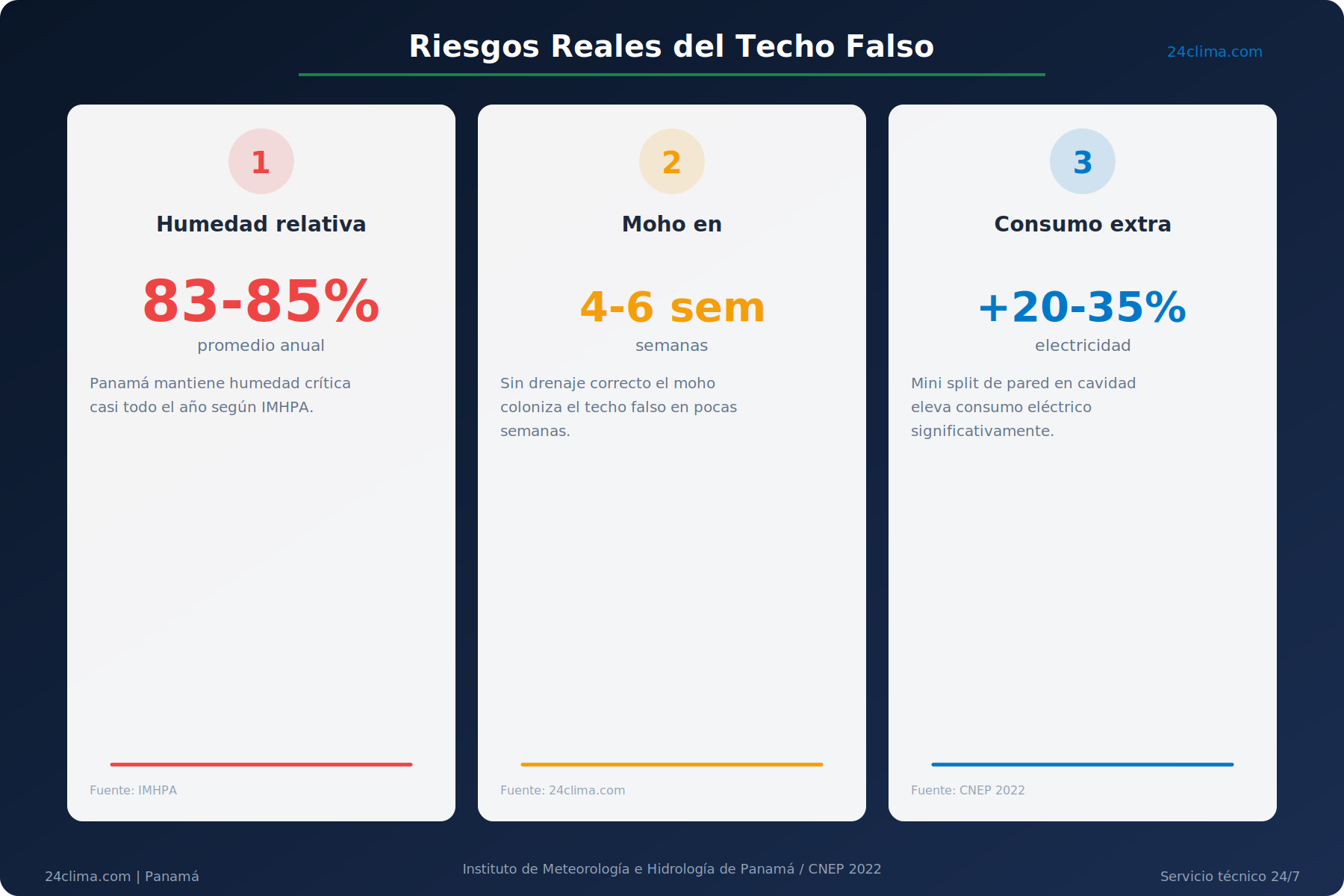
First, Panama averages 83–85% relative humidity for most of the year, according to the Institute of Meteorology and Hydrology. That humidity doesn't stop at the building envelope — it migrates toward cooler spaces, including the cavities inside drop ceilings. Without active moisture control in the system design, water condenses on internal surfaces, saturates the ceiling material, and mold colonies appear within 4 to 6 weeks.
Second, a standard wall-mounted mini split cannot be adapted to work inside a ceiling cavity. A wall unit is built for direct front-discharge into the living space. Put it in a ceiling cavity without proper modifications and you've built a cavity heater with restricted airflow — one that raises electricity consumption by 20–35%, according to energy efficiency data published by Panama's National Energy Council in their 2022 report.
Third, noise. Vibrations from a poorly mounted compressor or fan travel straight through drywall-on-metal-framing ceiling structures like a resonance chamber. In Marbella or San Francisco apartments this effect is especially bad. The result is sleepless nights and complaints from neighbors below.
The Three Systems That Actually Work in Drop Ceilings in Panama
Three systems are technically appropriate for drop ceiling spaces in Panama's climate. Each has its own logic, cost range, and ideal use case.
Ceiling Cassette
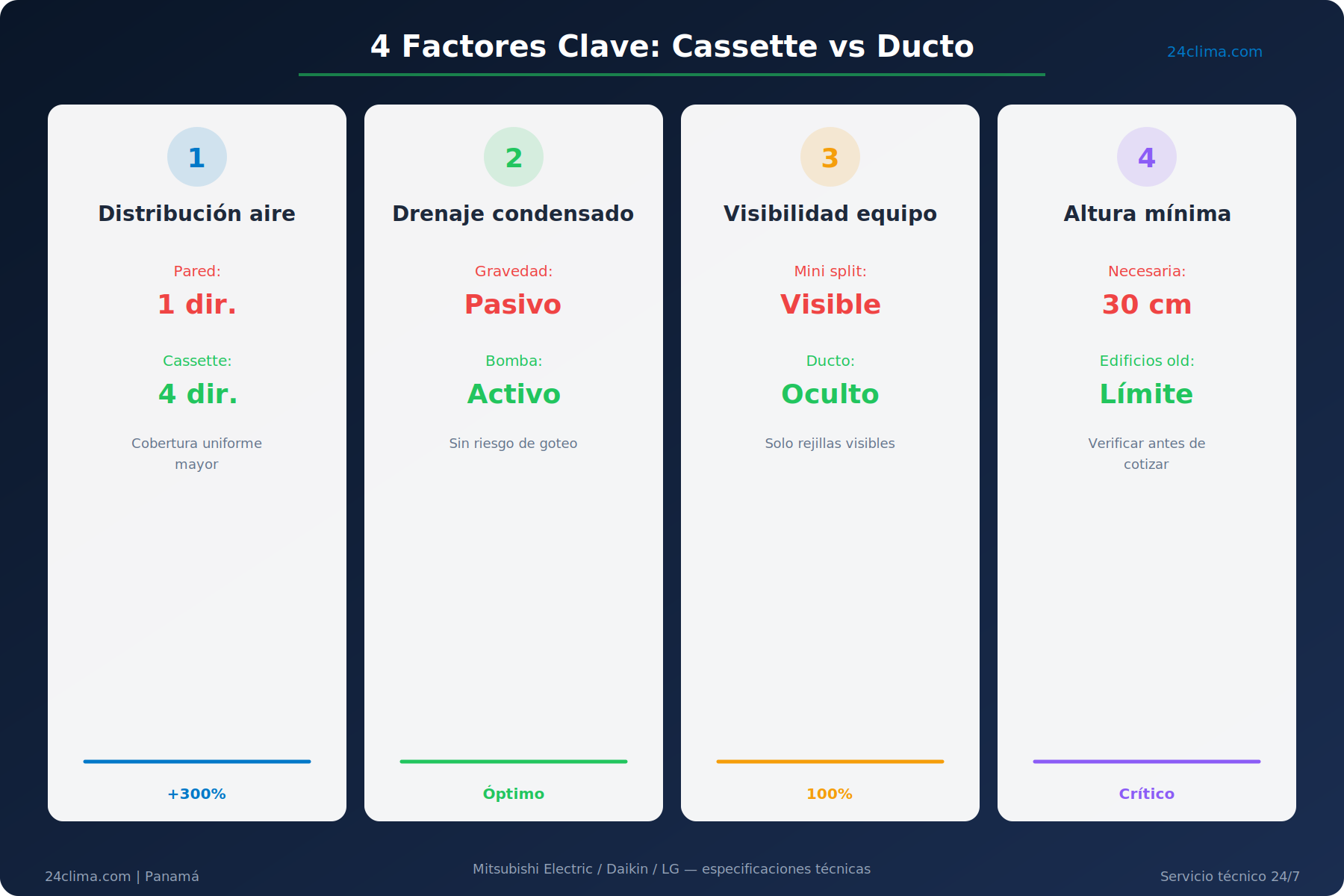
A ceiling cassette mounts flush inside the drop ceiling with a square or rectangular grille visible from below. It discharges air in four directions simultaneously, creating uniform temperature distribution — which makes it especially effective for living rooms, open-plan offices, and rooms with square or broadly rectangular geometry.
Its primary technical advantage in Panama is the integrated condensate tray with active drainage. Most modern models from Mitsubishi Electric, Daikin, and LG include a mini condensate pump that lifts water to the drain without relying on gravity — critical in buildings where natural drainage slope is minimal or nonexistent.
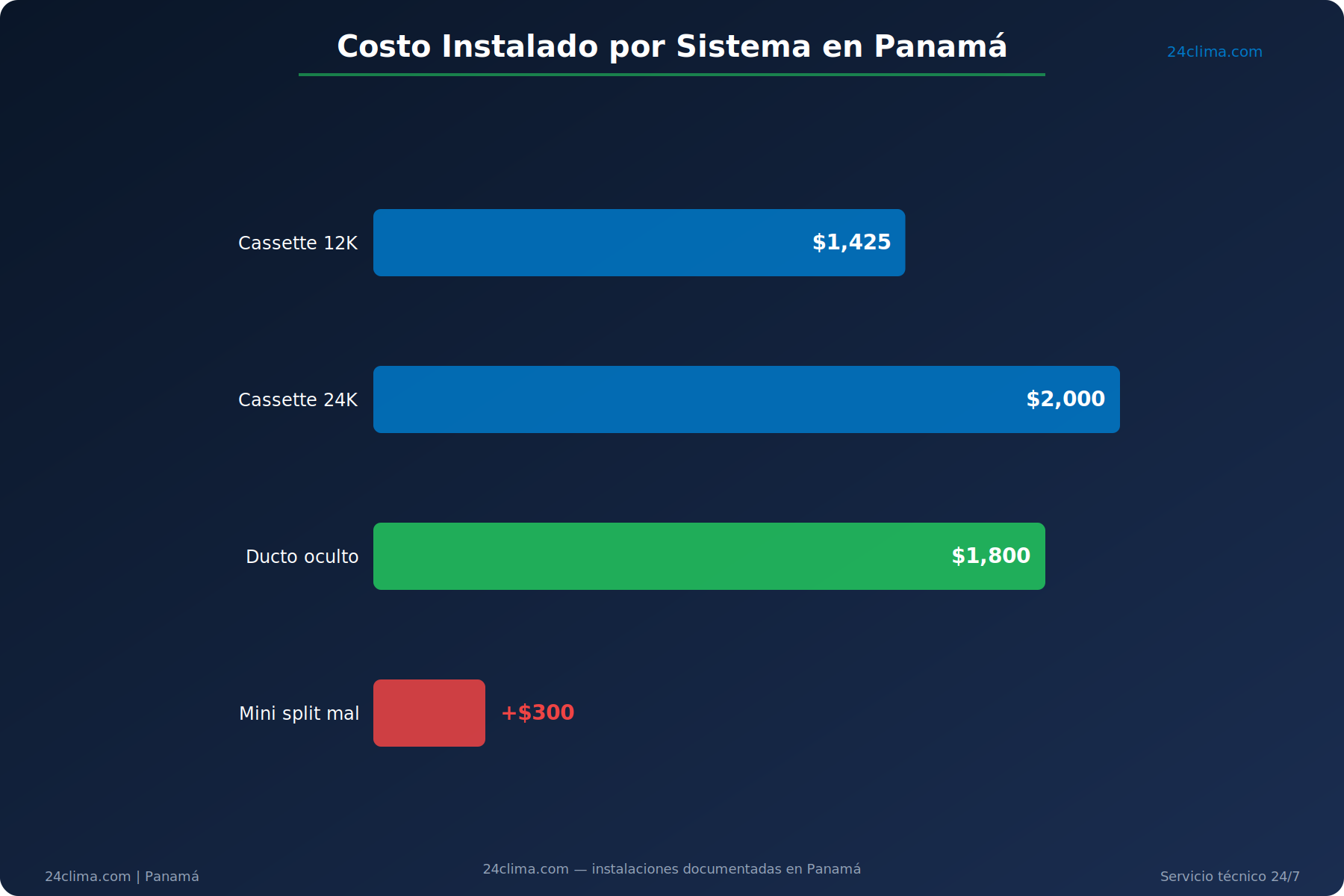
Installed cost in Panama — unit, labor, drainage, and electrical connection — runs $1,200 to $2,200 depending on capacity. A 12,000 BTU cassette for a 215–270 sq ft bedroom lands at roughly $1,350–$1,500. A 24,000 BTU unit for a living room or conference room of 430–540 sq ft reaches $1,800–$2,200.
One real constraint to know upfront: a cassette needs a drop ceiling cavity with at least 12–14 inches of clearance for the air handler plus drainage lines. In older buildings in San Francisco or Bella Vista where total ceiling height is around 8 feet, that clearance simply may not exist.
Concealed Duct Mini Split
The concealed duct mini split is the most versatile option for drop ceilings in Panama. The air handler installs horizontally inside the ceiling cavity — completely hidden — and distributes air through short duct runs to two or three supply grilles in the drop ceiling. From below, all you see are the grilles.
This system works well in apartments where multiple rooms share a continuous ceiling cavity, in offices where aesthetics matter, and in commercial spaces in Marbella or Costa del Este where the look of the space is as important as the temperature.
The efficiency gains with modern inverter concealed duct units are real and measurable. According to Daikin's data for their SkyAir series, an 18,000 BTU unit consumes approximately 1.3 kWh in continuous partial-load operation — which translates to $22–$30 per month at ENSA's average residential rate of $0.18–$0.20 per kWh. A comparable cassette without inverter technology consumes 35–50% more, so the savings add up fast in Panama's year-round cooling climate.
Installed cost for a concealed duct mini split runs $900 to $1,800 for 12,000–18,000 BTU units, with the difference coming mainly from duct complexity and distance to the outdoor condenser. Multi-zone projects can reach $2,500–$3,500.
A Panama-specific risk worth knowing: if the ducts aren't thermally insulated with polyethylene foam at least 3/4 inch thick, the duct surface becomes a condensation point inside the ceiling cavity. This produces water stains on the drop ceiling that many owners mistake for a plumbing leak from the building's water system.
Central Duct System (AHU with Ductwork)
A central system with an air handling unit and duct network is the solution for large spaces: corporate floors, restaurants, penthouses over 1,600 sq ft. The AHU installs in a mechanical room or in a section of the drop ceiling, distributing air through a network of galvanized or fiberglass ducts.
When properly designed, this system delivers the most uniform temperature and the best humidity control. In Panama, where 85% humidity causes real discomfort even at 73°F, humidity control isn't a comfort upgrade — it's the core technical objective.
Installed cost starts at $3,000 for basic configurations in 1,000–1,300 sq ft apartments and can exceed $8,000–$12,000 for full corporate installations with zone control, return air systems, and particle filtration. Maintenance is demanding: ducts need professional cleaning every 12–18 months in Panama's climate.
The real downside is spatial. In many residential buildings here, the available ceiling cavity is insufficient for properly dimensioned galvanized ducts. When installers force undersized ducts to fit, air velocity climbs above 8 ft/s and noise becomes unacceptable. It's one of the most expensive and most common mistakes we see in this market.
Critical Considerations for Panama's Climate
The drop ceiling in Panama isn't just an architectural space — it's a microclimate. With outdoor temperatures of 88–91°F and humidity at 83–85%, the ceiling cavity can hit 100–104°F if there's no adequate insulation between it and the roof or slab above. That creates three concrete problems every owner needs to understand before any installation begins.
Condensate Drainage
A 24,000 BTU air handler in Panama's climate can produce 15 to 25 liters of condensate water per day during the high-humidity months from May through November. If the drain line has insufficient slope or the P-trap isn't correctly installed, water backs up and overflows the drain pan. The result is a stain on the drop ceiling that slowly becomes a structural problem.
The fix is straightforward and not expensive: a backup condensate pump, drain line pitched at a minimum of 1 cm per linear meter, and a water level alarm in the drain pan. Adding these elements costs $80–$150. Repairing water-damaged drop ceiling runs $500–$2,000.
Acoustic Insulation
An air handler mounted directly on drywall structure with no isolation vibrates at 50–60 Hz — a frequency that cuts straight through standard building materials. Anti-vibration mounts and a mass-loaded vinyl sheet of 3–5 kg per square meter beneath the air handler tray solve this. The complete kit costs $120–$200 and drops noise by 8–12 dB, which is the difference between an irritating low hum and near silence.
Mold Risk
A study published in Building and Environment (2021) found that poorly designed HVAC systems in tropical climates with relative humidity above 80% increase the probability of Aspergillus and Cladosporium colonization in ceiling cavities by 340% compared to correctly sized systems. In Panama, this isn't academic. Our technicians regularly find mold colonies during preventive maintenance visits in ceiling cavities the owner had no idea about.
Prevention requires three things: properly insulated ducts to stop surface condensation; adequate return air volume — many designs account only for supply and completely ignore return; and filter changes every 30–45 days rather than the 90-day intervals on manuals written for temperate climates.
If you want to know what's actually happening inside your ceiling cavity right now, our preventive maintenance service includes cavity inspection, condensate pan review, and airflow analysis.
Real Cost Comparison in Panama (2024–2025)
For a typical bedroom or living room between 215–430 sq ft, these are realistic total investment ranges covering unit, materials, and labor:
— Ceiling cassette 12,000–24,000 BTU: $1,200 to $2,200 — Concealed duct mini split 12,000–24,000 BTU: $900 to $1,800 — Central duct system (full apartment): $3,000 to $8,000+
Monthly operating cost depends heavily on technology:
— Older non-inverter unit (12,000 BTU, 10 hours/day): $55–$70 per month — Modern inverter cassette (12,000 BTU, 10 hours/day): $28–$38 per month — Inverter concealed duct mini split (12,000 BTU, 10 hours/day): $22–$30 per month
The gap between inverter and non-inverter equipment pays for itself in 18–24 months in Panama — where AC systems run practically every day of the year.
To learn about 24Clima's installation service with documented warranty on labor and components, visit our air conditioning installation page.
Frequently Asked Questions
What type of air conditioning is best for a drop ceiling installation in Panama?
For bedrooms and spaces up to 430 sq ft, the inverter concealed duct mini split offers the best combination of cost, efficiency, and aesthetics in the Panamanian context. For open-plan offices or large living areas where uniform distribution is the priority, the ceiling cassette is the stronger technical choice. Central duct systems make sense in spaces over 1,000 sq ft with multiple control zones.
How much does it cost to install AC ductwork in a drop ceiling in Panama?
Drop ceiling AC installation in Panama ranges from $800 to $3,500+ depending on the system. A concealed duct mini split for a single room costs $900–$1,800 installed. A central duct system for a complete 1,000–1,300 sq ft apartment starts at $3,000 and can exceed $8,000 for complex configurations. The ductwork itself typically represents 25–35% of the total project cost.
Can you install a mini split in a room with a low drop ceiling?
Yes, but with specific conditions. A concealed duct mini split needs a minimum cavity height of 10–11 inches for the horizontal air handler. A standard cassette needs 12–14 inches. If the cavity is shallower, low-profile models from Mitsubishi Electric and Fujitsu operate with as little as 8–9 inches of clearance. Either way, a technician needs to evaluate the space in person before you select any unit.
Back to the Costa del Este Apartment
The problem in that apartment wasn't the equipment. It was the installation. The drop ceiling had space — but no duct insulation, no active drainage, and no designed return air path. The system worked twice as hard to cool half as effectively. The fix wasn't a new unit. It was redesigning the air distribution, adding 3/4-inch insulation to the existing ducts, and installing a condensate pump. The electricity bill dropped $45 per month. The noise disappeared entirely.
At 24Clima we evaluate your drop ceiling, size the right system for your specific space, and execute the installation with documented warranty. If you're in Costa del Este, San Francisco, Marbella, or anywhere in Panama City, contact us on WhatsApp at 24clima.com/contacto/ for a no-cost, no-obligation technical visit.
Last updated: June 2025