Inverter Air Conditioner — How Much Does It Really Save on Your Electric Bill in Panama?
Last updated: June 2025
2 p.m. in Costa del Este. The sun hammers the concrete like a stadium floodlight. Inside, the air conditioner has been running four hours and the room has finally cooled to something livable. That feeling lasts until the ENSA bill arrives at the end of the month.
That's when people — expats and Panamanians alike — start asking the same questions. Is this unit burning through too much electricity? Is it worth paying $150 or $200 more for an inverter model? Or is that just the salesperson talking up a pricier ticket?
The answer is a calculation. Run it yourself below — with real Panama electricity rates, real watt figures, real dollars.
What Most People Get Wrong
The most common mistake is treating "inverter" as a brand name or a luxury category. Some buyers assume the savings are marginal — maybe 10% or 15% — and not worth the higher upfront cost. Others swing the opposite direction and expect an inverter to cut their bill in half from day one.
Both are wrong.
The real difference is in how the compressor works. A conventional AC unit runs like an on/off switch — full power, cool the room, shut off, kick back on. That constant start-stop cycle is where most of the electricity goes. An inverter continuously adjusts the compressor speed, like the accelerator pedal on a modern car. It ramps up when needed, then cruises at lower power to hold the temperature. That's the entire difference — and in Panama, that difference puts between $25 and $45 back in your pocket every month.
For more on choosing, using, and maintaining your equipment, check out our guides at 24clima.
How Electricity Consumption Works for Each Technology
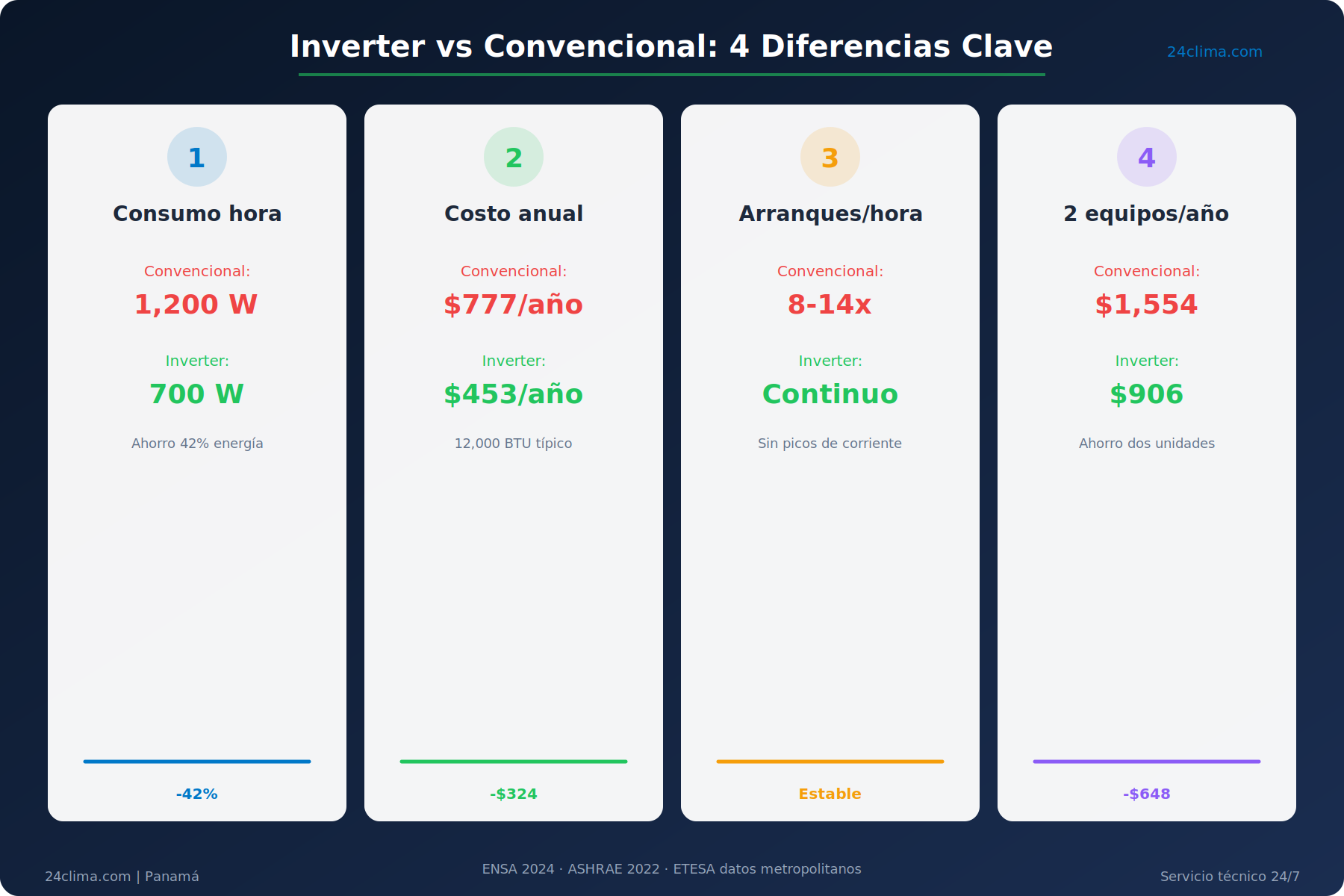
A conventional 12,000 BTU air conditioner runs a fixed-speed compressor drawing approximately 1,200 watts. Every startup sends a current spike that can briefly double that figure. In Panama's climate — outdoor temperatures averaging around 88°F (31°C) with 75% relative humidity, according to ETESA data for the metropolitan region — that compressor cycles on and off 8 to 14 times per hour during the stabilization phase.
The result: even though the conventional unit is technically "off" part of the time, its real average consumption runs between 1,000 and 1,200 watts per hour during active operation.
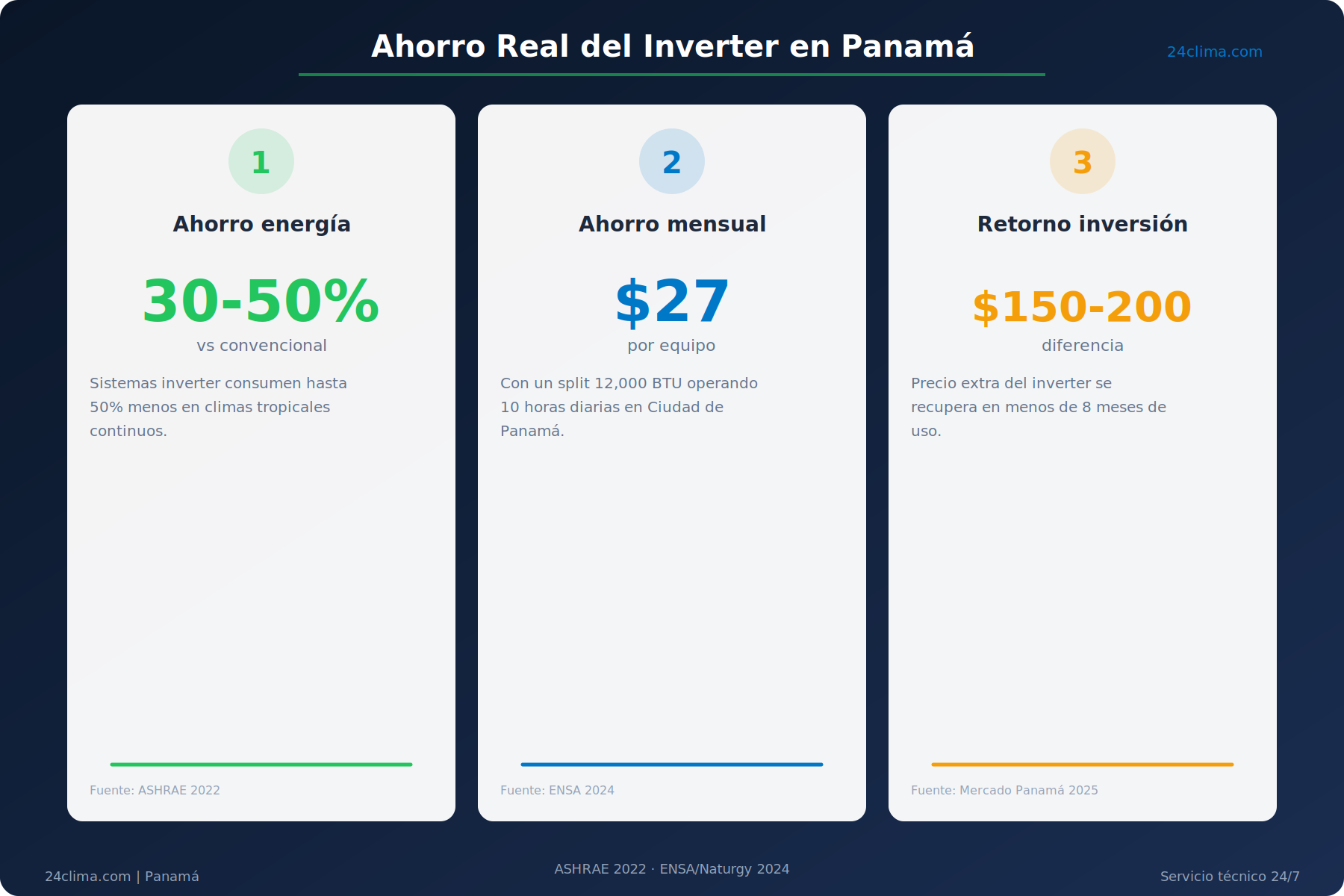
An inverter unit of the same size — 12,000 BTU — has a similar startup draw, but its sustained average drops to 600 to 750 watts per hour. A 2022 study published by the American Society of Heating, Refrigerating and Air-Conditioning Engineers (ASHRAE) found that variable-speed systems consume 30% to 50% less energy than fixed-speed systems in tropical climates with consistently high temperatures. That's exactly the operating condition in Panama City, twelve months a year.
The Real Calculation: kWh and Dollars in Panama
Using the average residential rate of $0.18 USD per kWh from ENSA/Naturgy (2024 figures) and running a unit 10 hours a day for 30 days, the numbers get concrete fast. A conventional 12,000 BTU unit costs between $64 and $78 per month in AC electricity alone. The same cooling capacity in inverter technology costs between $32 and $45 per month.
Here's the full step-by-step so you can run it for your own unit.
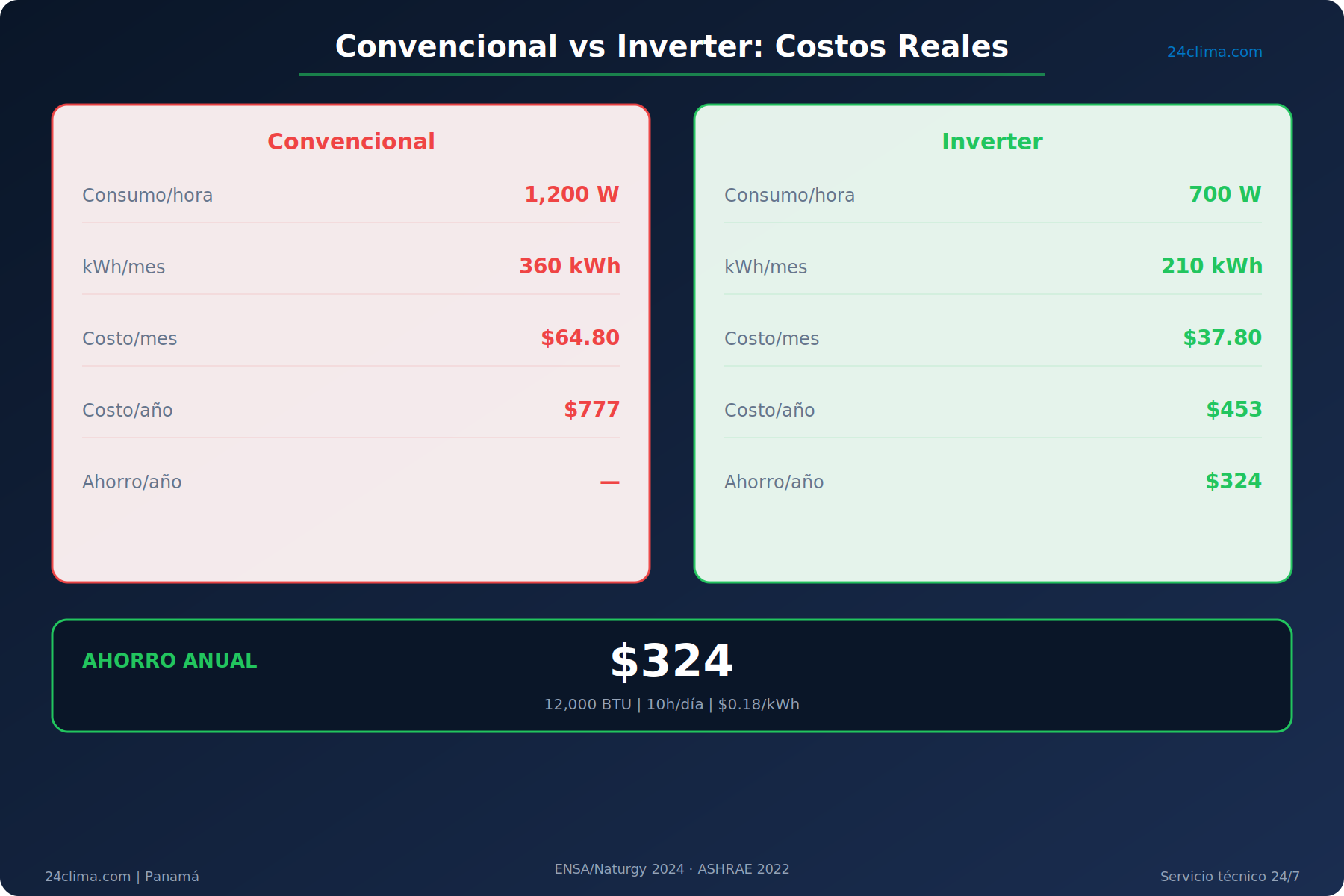
Monthly consumption — conventional 12,000 BTU: Average power draw: 1,200 W (1.2 kW) Daily use: 10 hours Days per month: 30 Monthly consumption: 1.2 x 10 x 30 = 360 kWh Monthly cost at $0.18/kWh: $64.80
Monthly consumption — inverter 12,000 BTU: Average operating power: 700 W (0.7 kW) Daily use: 10 hours Days per month: 30 Monthly consumption: 0.7 x 10 x 30 = 210 kWh Monthly cost at $0.18/kWh: $37.80
Monthly savings: $64.80 - $37.80 = $27.00 Annual savings: $27.00 x 12 = $324
That's for a single 12,000 BTU unit running 10 hours a day. Two units in your home and those savings double to $648 per year.
Annual Savings by Unit Size
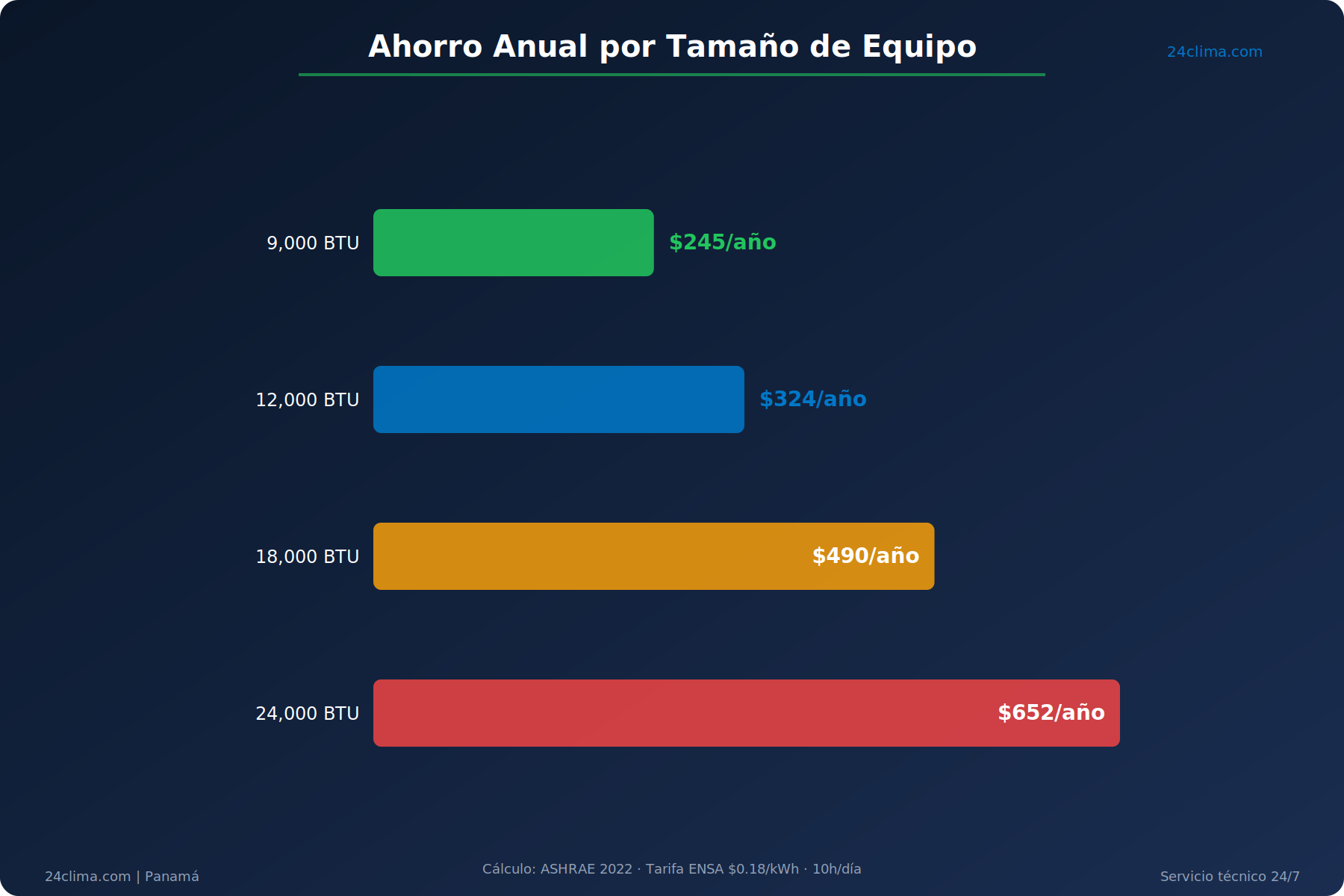
The figures below assume 10 hours of daily use, 30 days per month, $0.18/kWh, and a 42% consumption reduction for inverter vs. conventional — the midpoint of the ASHRAE range for tropical climates.
9,000 BTU conventional: ~270 kWh/month — $48.60/month — $583/year 9,000 BTU inverter: ~157 kWh/month — $28.20/month — $338/year Annual savings at 9,000 BTU: $245
12,000 BTU conventional: ~360 kWh/month — $64.80/month — $777/year 12,000 BTU inverter: ~210 kWh/month — $37.80/month — $453/year Annual savings at 12,000 BTU: $324
18,000 BTU conventional: ~540 kWh/month — $97.20/month — $1,166/year 18,000 BTU inverter: ~313 kWh/month — $56.34/month — $676/year Annual savings at 18,000 BTU: $490
24,000 BTU conventional: ~720 kWh/month — $129.60/month — $1,555/year 24,000 BTU inverter: ~418 kWh/month — $75.24/month — $903/year Annual savings at 24,000 BTU: $652
Note: inverter figures use 58% of conventional consumption as the baseline, derived from the ASHRAE 2022 average for continuous tropical operation.
How Long Before the Inverter Pays for Itself?
The payback period comes down to two things: how much more the inverter costs upfront, and how much you save each month.
In the Panama market in 2024-2025, the price gap between a conventional 12,000 BTU split and its inverter equivalent from the same brand runs about $150 to $200 USD. That holds for entry- to mid-range models from brands like LG, Midea, and Carrier.
With monthly savings of $27 on a 12,000 BTU unit:
Price difference of $150 — Payback period: 150 ÷ 27 = 5.6 months Price difference of $200 — Payback period: 200 ÷ 27 = 7.4 months
The inverter pays for itself in under 8 months. And if the unit lasts 10 to 15 years — which is typical for a well-maintained split system in Panama — accumulated savings can exceed $3,000 USD over the equipment's lifetime.
For 18,000 BTU units, with monthly savings of $40.86 and a similar price gap of $150 to $200, the payback drops to 4 to 5 months.
Step-by-Step Calculator: Estimate Your Own Savings
You only need three numbers.
Your current unit's power rating (in watts or BTU): If you know the BTU: 9,000 BTU ≈ 900W, 12,000 BTU ≈ 1,200W, 18,000 BTU ≈ 1,800W, 24,000 BTU ≈ 2,400W If you have the manual or the unit's label, look for "rated power input" or "consumo nominal"
Your daily hours of use: Multiply by 30 to get monthly hours
Apply the formula: Current monthly consumption (kWh) = Power in kW x daily hours x 30 Current monthly cost = Consumption in kWh x $0.18 Estimated consumption with inverter = Current consumption x 0.58 Monthly savings = Current cost - Inverter cost Payback period (months) = Price difference ÷ Monthly savings
Real example: 18,000 BTU unit running 8 hours a day. Current consumption: 1.8 kW x 8 x 30 = 432 kWh/month → $77.76/month Consumption with inverter: 432 x 0.58 = 250.6 kWh/month → $45.10/month Monthly savings: $32.66 Estimated price difference: $175 Payback: 175 ÷ 32.66 = 5.4 months
Why Panama's Climate Makes Inverter Savings Even Greater
In cities with significant temperature swings between day and night — New York, Madrid, most of Europe — conventional units get natural breaks during cooler hours. That limits their total consumption. Panama City doesn't work that way. Nighttime temperatures rarely drop below 75°F (24°C) and humidity stays high around the clock. Air conditioners run almost without interruption for 8 to 12 hours a day in most homes.
Continuous operation is exactly where the inverter earns its keep. The Ministry of Energy of Panama (MICI, 2023) reports that the residential sector accounts for 38% of national electricity consumption, and air conditioning represents 50% to 60% of the average household electricity bill. That makes AC efficiency the single biggest lever on your monthly costs.
The inverter doesn't only deliver savings under ideal lab conditions. It saves under Panama's real conditions: steady heat, high humidity, extended operation, cycles that never fully stop.
Frequently Asked Questions
How much does an inverter air conditioner actually save compared to a conventional unit in Panama?
A 12,000 BTU inverter running 10 hours a day saves approximately $27 per month compared to a conventional unit of the same size, using ENSA's residential rate of $0.18/kWh. In percentage terms, that's 38% to 45% less compressor electricity consumption, based on the range documented by ASHRAE for tropical climates. Your exact savings depend on hours of use, unit size, and the efficiency rating of the specific model.
How long does it take to recover the extra cost of an inverter unit in Panama?
With a price gap of $150 to $200 USD between a conventional and an equivalent inverter model, and monthly savings of $25 to $40 depending on unit size, the payback period runs between 5 and 8 months of normal use. For units of 18,000 BTU or larger, that drops to 4 to 5 months. Over a useful life of 10 to 15 years, the accumulated difference can exceed $3,000 USD.
How much does running the AC 8 hours a day add to my electricity bill in Panama?
A conventional 12,000 BTU unit running 8 hours a day consumes approximately 288 kWh per month. At $0.18/kWh, that's $51.84 added to your bill from that unit alone. With an equivalent inverter, that cost drops to around $30 per month. If you're running a conventional AC and your bill is higher than you'd expect, that $21 gap is exactly what you're paying extra — every single month.
Your Bill Doesn't Lie — But It Can Surprise You
Back to 2 p.m. in Costa del Este. The unit is still running. The difference now is that you know exactly what each hour is costing you, and whether replacing it makes sense.
Inverter technology isn't a marketing gimmick. It's a variable-speed compression cycle that, in Panama's climate, generates documented savings of $25 to $65 per month depending on unit size. The extra upfront cost pays itself back in under 8 months. Over the following 10 to 14 years of useful life, those savings keep compounding.
If you want a concrete look at which unit fits your space, what you're currently spending, and which model gives you the best return on your actual usage, reach out on WhatsApp at https://24clima.com/contacto/ — we'll run the numbers with you, no commitment required.