AC Capacitor in Panama — Warning Signs and What to Do When Your Unit Won't Start
It's 2 in the afternoon in Costa del Este. The sun is hammering the concrete at 91°F (33°C) and the humidity is pushing 85%. You walk into your apartment, hit the AC button, and hear something you've never heard before — a deep, steady hum, like the unit is trying to start but something is holding it back. The fan on the outdoor unit spins slowly, or doesn't spin at all. You wait. Nothing happens.
Your first instinct is to assume the worst: the compressor is shot, the unit is dead, time to buy a new one. You call a technician, he quotes you $300 in parts and labor — and before you hand over that money, you should know the truth. In most of these cases, the problem is a failed capacitor. A part that costs between $8 and $25 in Panama.
This guide explains what a capacitor is, why it fails so often here, how to recognize it as the reason your unit won't start, and when you can safely replace it yourself — and when you shouldn't. For other common AC problems, check out our guides at https://24clima.com/consejos-y-guias/.
What You Think Happened vs What Actually Happened
When an air conditioner won't start or struggles to kick on, most homeowners assume the compressor failed. It's the most expensive component, the most dramatic failure, the one everyone's heard of. That fear leads to bad decisions: replacing the entire unit, paying for unnecessary diagnostics, or sweating it out convinced there's no affordable fix.
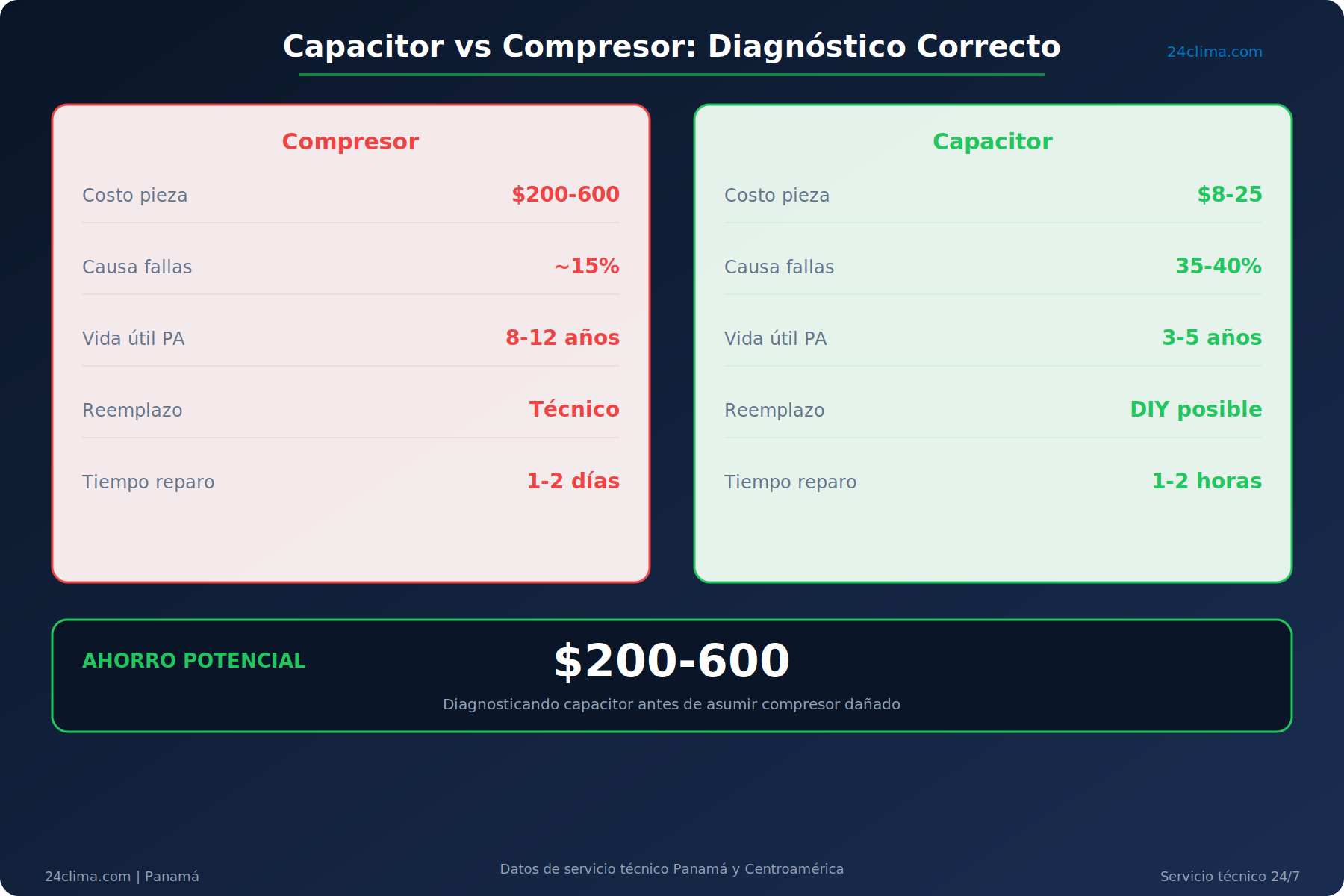
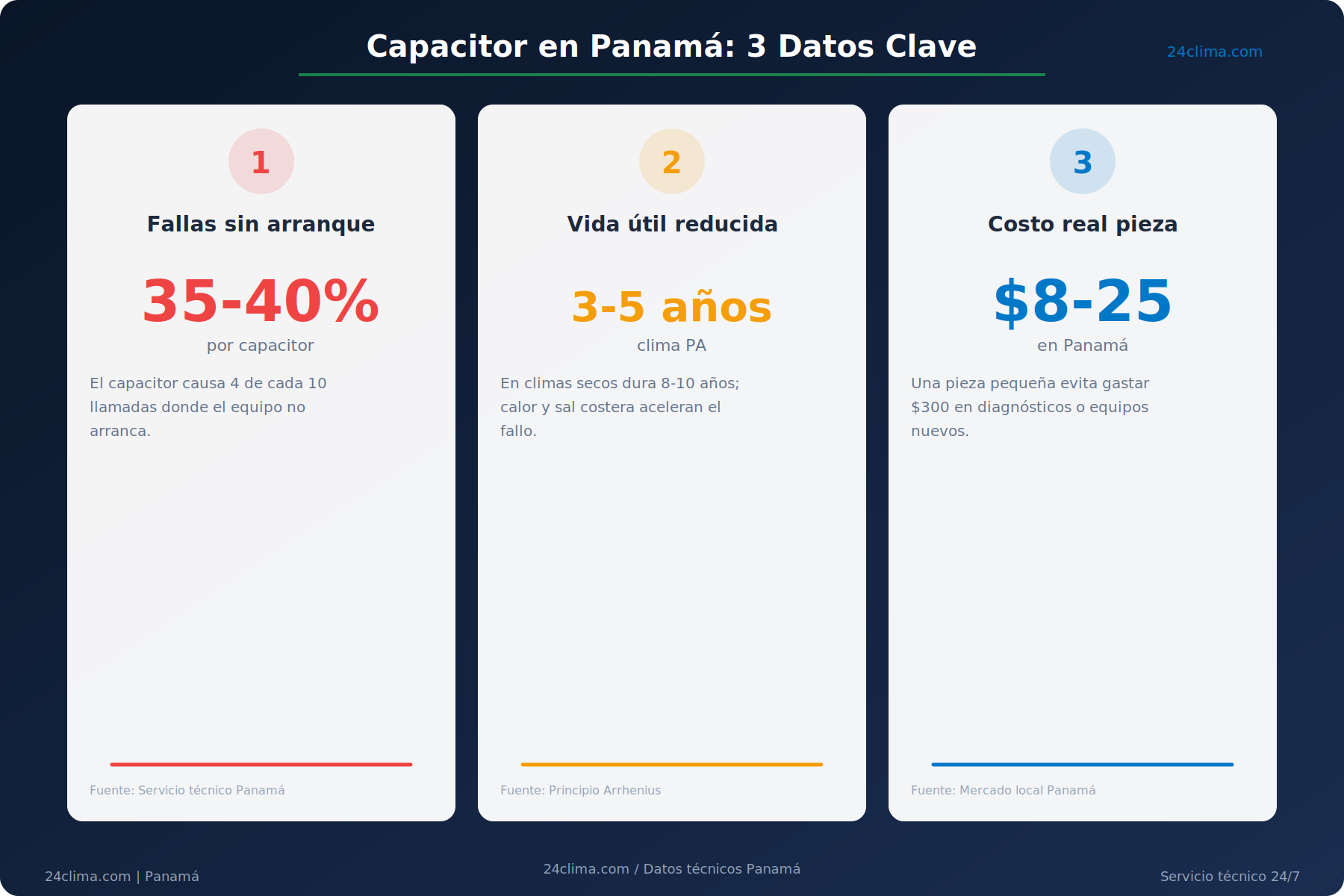
The reality is different. Based on service call data collected across Panama and Central America, the capacitor is responsible for approximately 35-40% of calls where a unit won't start or has difficulty starting. Not the compressor. Not the refrigerant. An electronic component roughly the size of a small soda can, tucked inside the outdoor condenser unit.
The problem is that a failed capacitor and a failed compressor produce nearly identical symptoms from the outside. Both result in a unit that "tries to start but can't." The difference is in the details — and knowing how to read them can save you between $200 and $600 on an unnecessary repair.
What a Capacitor Is and Why Your AC Needs It
A capacitor stores electrical energy and releases it in a burst to give the compressor motor and fan motor the jolt they need to start. Without that surge, the motors can't overcome their own inertia. Once running, the capacitor keeps working to stabilize the electrical current throughout the cycle.
There are two main types: the start capacitor, which only operates during the first few seconds of startup, and the run capacitor, which works continuously while the unit is on. Most residential units in Panama use a dual capacitor — one component that handles both functions for the compressor and the fan.
Capacitance is measured in microfarads (µF) and voltage rating in volts (V). A typical 12,000 BTU unit uses a 35/5 µF capacitor rated at 370V or 440V. A 24,000 BTU unit may require 45/5 µF or 50/5 µF. Using a capacitor with the wrong specifications — even slightly off — can destroy the motor within weeks.
Why Capacitors Fail Faster in Panama
In Panama, capacitors wear out significantly faster than in temperate climates. Three factors hit the component at the same time.
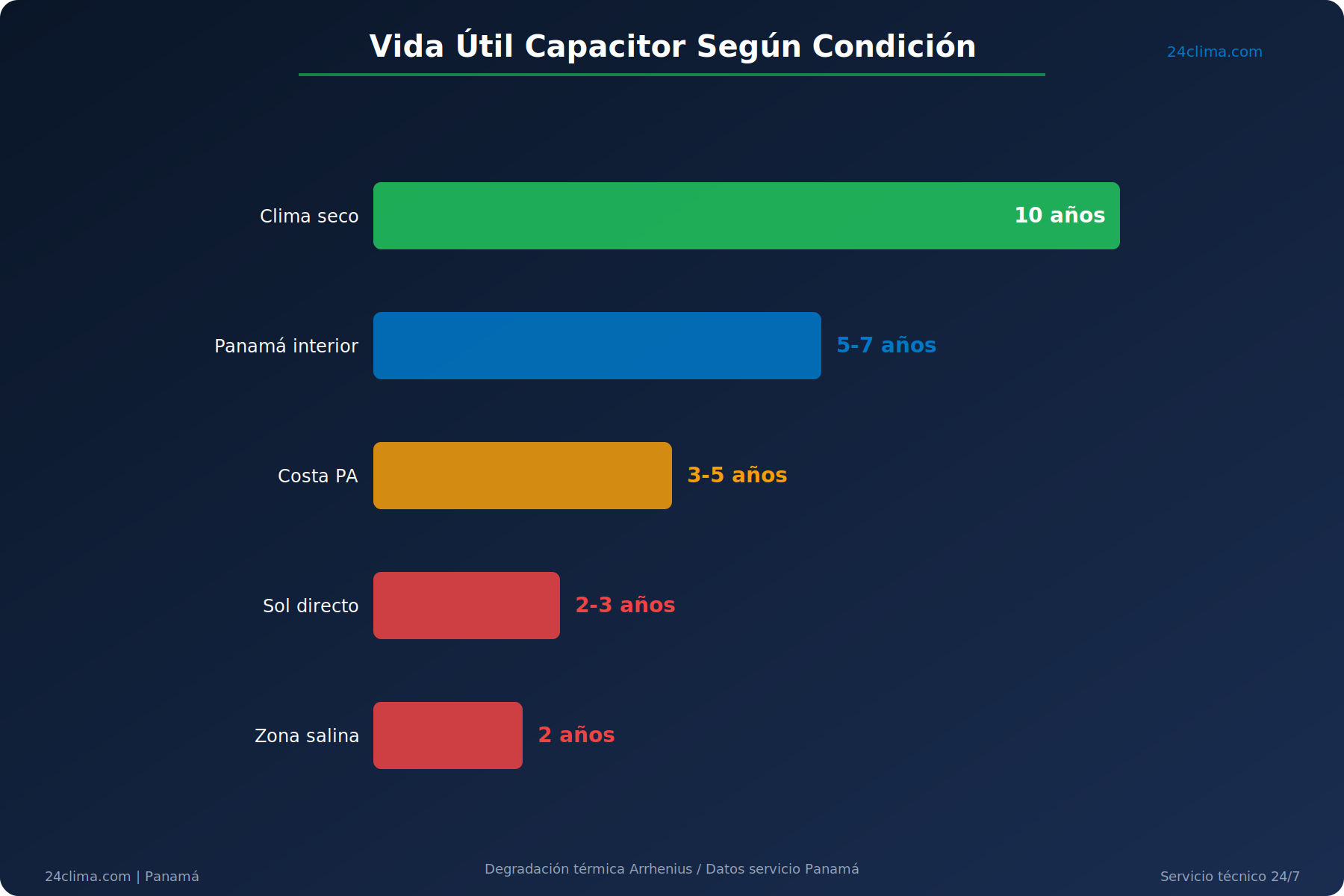
Heat is the first. The internal temperature inside an outdoor condenser unit on a full-sun Panama afternoon can exceed 131°F (55°C). Capacitors have a maximum operating temperature rating — generally between 158°F (70°C) and 185°F (85°C) depending on component quality — and for every 18°F (10°C) above their rated range, their lifespan is cut in half, according to established thermal degradation principles in electronics (the Arrhenius equation applied to capacitive components).
Then there's the sheer volume of operating hours. In New York or Madrid, a residential AC unit runs maybe three to four months a year. In Panama, units in apartments and offices run ten to fourteen hours a day, year-round. That multiplies the number of startup cycles the capacitor absorbs — accelerating internal wear at a pace those components were never designed for.
Finally, humidity and salt corrosion. In coastal areas like Punta Pacífica, Casco Antiguo, or any building near the bay, salt suspended in the air attacks the capacitor's terminals and connections. A capacitor that might last eight to ten years in a dry climate can fail in three to five years under these conditions.
Clear Symptoms of a Failed Capacitor
A failed capacitor produces specific symptoms you can identify without being a technician. Knowing them helps you have a more informed conversation with whoever shows up — and avoid inflated quotes.
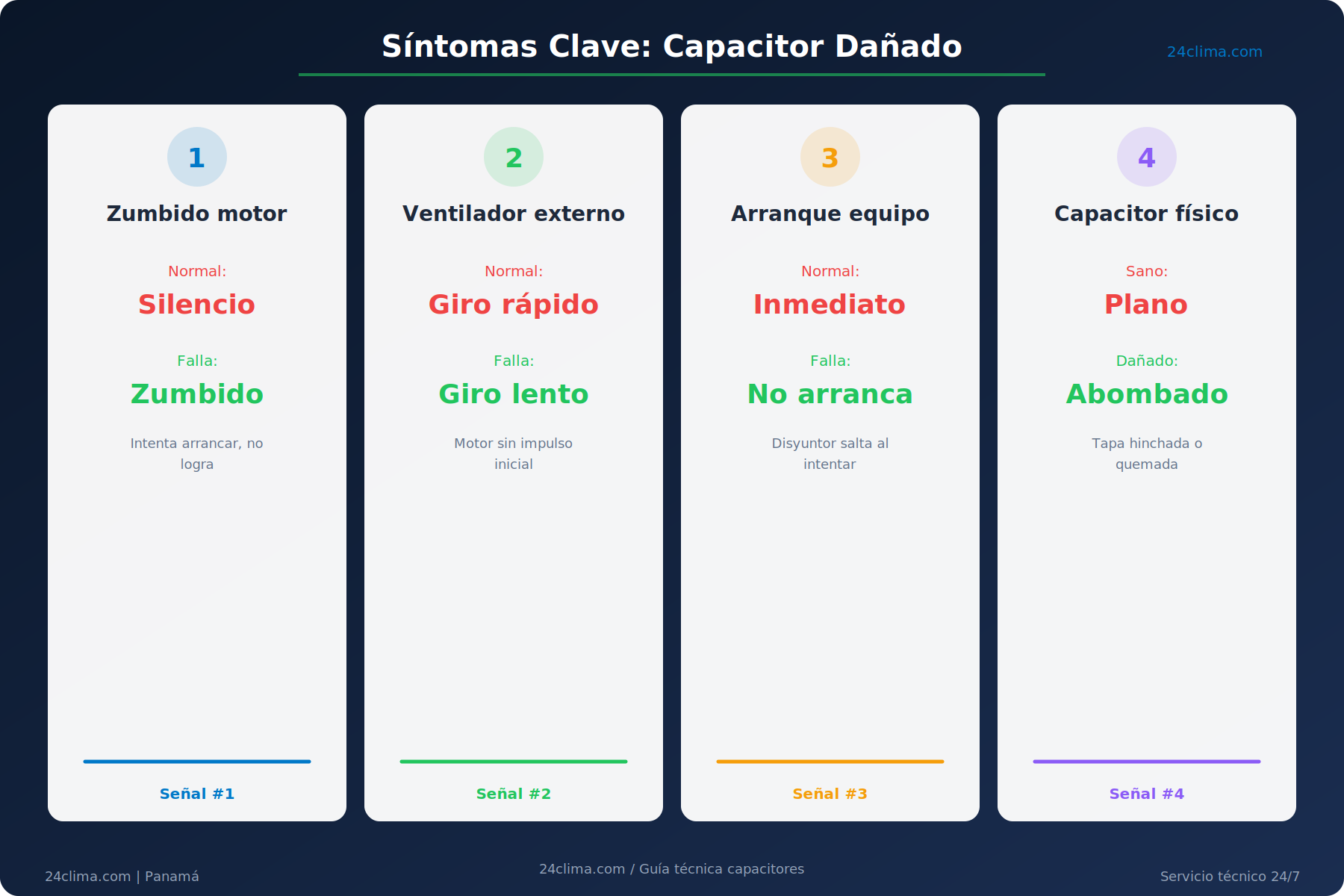
Continuous humming without startup: The unit receives the on signal, the compressor tries to start, but without the capacitor's boost it can't get moving. You hear a deep, steady hum — like a motor straining — that lasts several seconds before the unit shuts off on thermal protection.
The outdoor fan spins slowly or needs a manual nudge: If you give the outdoor fan blade a gentle push with a thin rod while the unit is trying to start, and the unit fires up and runs normally, that's nearly a definitive diagnosis. The motor doesn't have enough energy to start on its own but can maintain rotation once it's initiated.
The unit shuts off after a few minutes: A deteriorated capacitor allows irregular current to reach the motor. The motor overheats, triggers thermal protection, and the unit shuts down. You wait thirty minutes, turn it back on, and the cycle repeats.
The capacitor is visibly deformed: With the unit off and disconnected, look at the top of the capacitor inside the outdoor unit. A failed capacitor will often show a bulging or swollen top — exactly like a failed cell phone battery. If you see that, the diagnosis is definitive.
The AC runs but doesn't cool: Sometimes the compressor won't start but the fan will. The unit moves air without cooling it because the refrigeration cycle never began. The room stays warm, the unit appears to be running, and you can't figure out why.
Failed Capacitor vs Failed Compressor — How to Tell Them Apart
This distinction is where you either save money or spend it unnecessarily. The symptoms overlap, but the details separate them.
Capacitor failure: the unit tries to start — you hear that straining hum — current spikes momentarily, and the unit may run if you manually nudge the fan. Repair costs between $55 and $105 including part and labor.
Compressor failure: the unit may produce no straining sound at all, or you hear a loud click followed by complete silence. The compressor casing may be hot to the touch even though it hasn't been running. Replacement costs between $250 and $500 — and on units over seven years old, it rarely makes financial sense.
A technician can confirm which problem you have with a multimeter by measuring capacitance in µF. If the reading is more than 10% below the nominal value printed on the component, the capacitor is out of spec and needs to go.
What It Costs to Replace a Capacitor in Panama
The capacitor itself costs between $8 and $25 depending on specifications (µF and voltage) and whether it's a generic or branded component (Turbo, Packard, GE). Capacitors for higher-BTU units — 36,000 BTU and above — run $30 to $40.
A standard service call in Panama runs $45 to $80 in labor, plus the part. Total cost for a capacitor replacement: between $55 and $105 depending on your area and provider. Through our maintenance service at https://24clima.com/servicios/mantenimiento/, capacitor inspection is part of our standard diagnostic process.
Typical capacitor values by unit size:
— 9,000 BTU unit — 25/5 µF — 370V — 12,000 BTU unit — 35/5 µF — 370V or 440V — 18,000 BTU unit — 40/5 µF — 440V — 24,000 BTU unit — 45/5 µF or 50/5 µF — 440V — 36,000 BTU unit — 55/5 µF or 60/5 µF — 440V
Always verify the exact values on the original capacitor label or your unit's specification plate before buying a replacement.
Can You Replace It Yourself? Safety First
A capacitor can store a lethal electrical charge even after the unit has been turned off and unplugged. That's not a disclaimer — it's basic physics. A charged 440V capacitor can cause severe burns and cardiac arrest. Before touching any internal component of the outdoor unit, you must discharge the capacitor.
If you decide to do it yourself, follow these steps in order — no shortcuts:
Turn off the unit from the remote control and from the circuit breaker. Wait a full five minutes. Not two, not three. Five minutes.
Disconnect the main power supply to the outdoor unit — the disconnect switch near the unit or at the main panel.
Use a screwdriver with an insulated handle rated for 1,000V and touch the metal tip — connected to ground via the chassis or a grounding wire — across both capacitor terminals for ten seconds. You may hear a click or small spark if residual charge was present. Repeat the procedure.
With the capacitor discharged, photograph all connections before disconnecting any wires. The terminals are labeled HERM (compressor), FAN (fan), and COM (common). Connecting a wire to the wrong terminal will damage the motor.
Replace the capacitor with one of identical µF rating and equal or higher voltage rating. Never use a capacitor with a lower voltage rating even if the µF values match.
That said — if you have no experience with electrical components, if the unit is at height, if it's more than fifteen years old, or if the symptoms don't clearly point to the capacitor as the only problem, call a technician. Saving $45 to $80 in labor is not worth a wrong diagnosis or a wiring mistake.
Common Questions About AC Capacitors in Panama
How do I know if my AC capacitor is bad in Panama?
The clearest signs are a continuous hum when trying to start, an outdoor fan that spins slowly or needs a manual push, and a unit that shuts off on its own within a few minutes of running. If you can look inside the outdoor unit and the capacitor top is bulging or swollen, the diagnosis is definitive. A technician can confirm it with a multimeter — if the reading is more than 10% below the value printed on the component, it needs to be replaced.
How much does AC capacitor replacement cost in Panama?
The part costs between $8 and $25 depending on your unit's specifications. Labor from a certified technician in Panama runs $45 to $80. Total — diagnosis, part, and replacement — typically falls between $55 and $105. It's one of the most affordable AC repairs there is, and a fraction of what compressor replacement ($250-$500) or a new unit would cost you.
Can I replace the AC capacitor myself or do I need a technician?
You can, if you have basic electrical experience and follow the discharge protocol before touching anything — that step is non-negotiable. The capacitor holds dangerous charge even with the unit off. If you've never worked with electrical components, if the unit is mounted at height, or if the symptoms don't clearly confirm the capacitor is the only problem, call a certified technician. At $45-$80 for labor, the cost is reasonable when you weigh it against the risk of a wrong diagnosis or an incorrect wiring connection.
That Hum Has a Name — and a Fix
Back to that apartment in Costa del Este. Two in the afternoon, 91°F outside, and your unit is humming without starting. Now you know what that hum means: a capacitor that's lost its ability to store and release energy at the exact moment the motor needs it. It's not the compressor. It's not the end of your unit. It's a $15 part that wears out faster in Panama than almost anywhere else — because it works harder, in more heat, with more humidity, for more hours per year than it was ever designed to handle.
At 24Clima, we deal with this failure every day across Panama City — from Miraflores to Clayton, San Francisco to Tocumen. If you recognize the symptoms described here and want a technician to confirm the diagnosis before spending money on anything, reach out to us on WhatsApp at https://24clima.com/contacto/ — we'll tell you exactly what's wrong and what it costs to fix it, straight to the point.