How to Clean an Air Conditioner From the Inside — A Step-by-Step Guide for Panama
Last updated: May 2025
It's 2 in the afternoon in Costa del Este. The sun hammers straight down on the concrete and the humidity wraps around you like a wet towel you can't shake off. You walk into your apartment, hit the button on the remote, and hear the split kick on. Air starts flowing. But something's off — a damp, musty smell, like clothes left in a bag too long, and the room takes nearly twenty minutes to cool down.
The unit isn't broken. It's dirty on the inside.
That's what most people in Panama figure out too late: the problem wasn't the compressor, the refrigerant, or some mysterious technical failure. It was a layer of dust, mold, and biological slime built up on the evaporator coil that nobody cleaned for months. This guide walks you through exactly what to do, step by step, without needing to disassemble the unit completely. For full preventive maintenance, 24clima.com covers everything from the basics to the more complex cases.
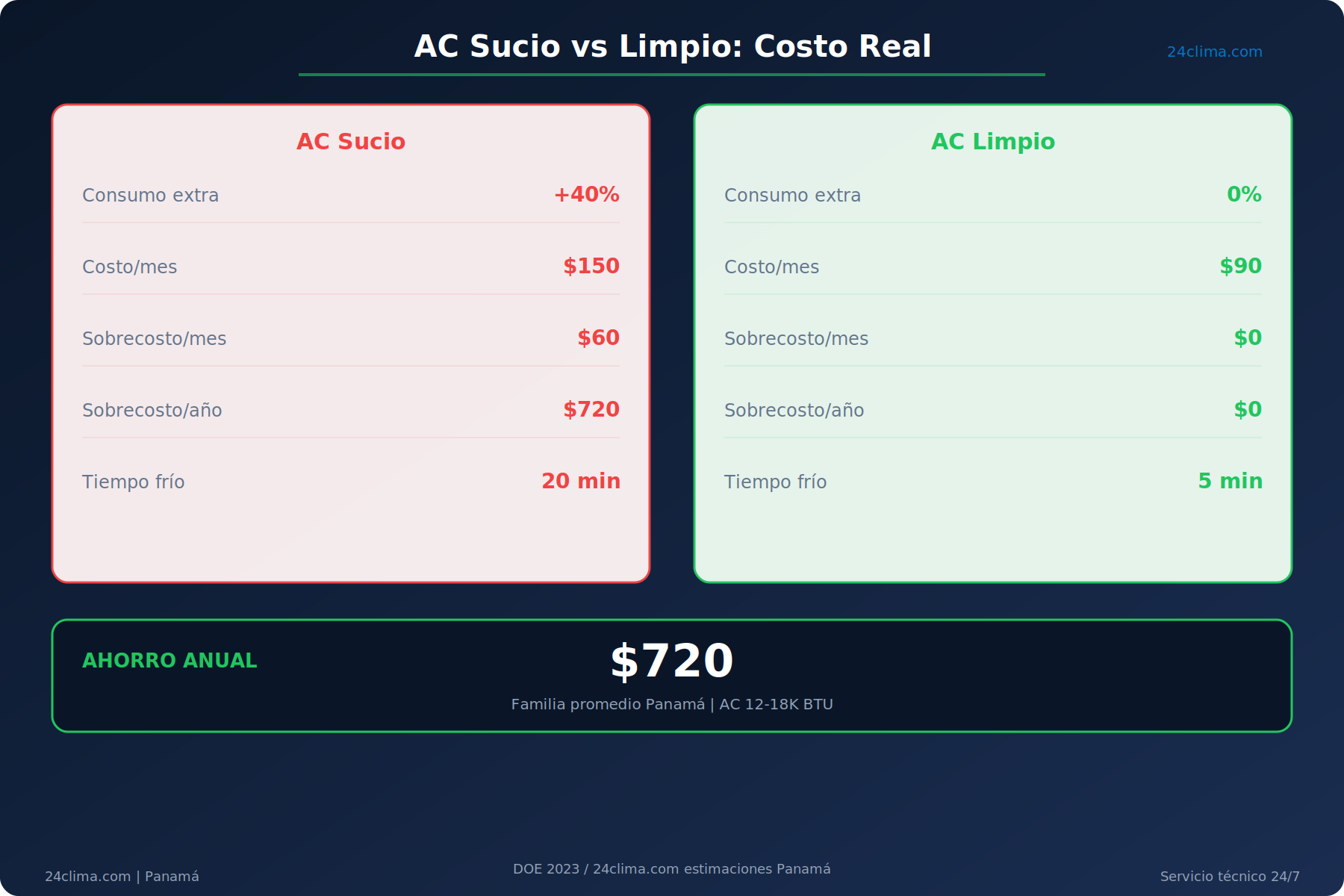
What Most People Assume — And Why They're Wrong
The most common assumption goes like this: "If cold air is coming out, the unit must be clean." Intuitive idea, but it falls apart in practice — especially in Panama.
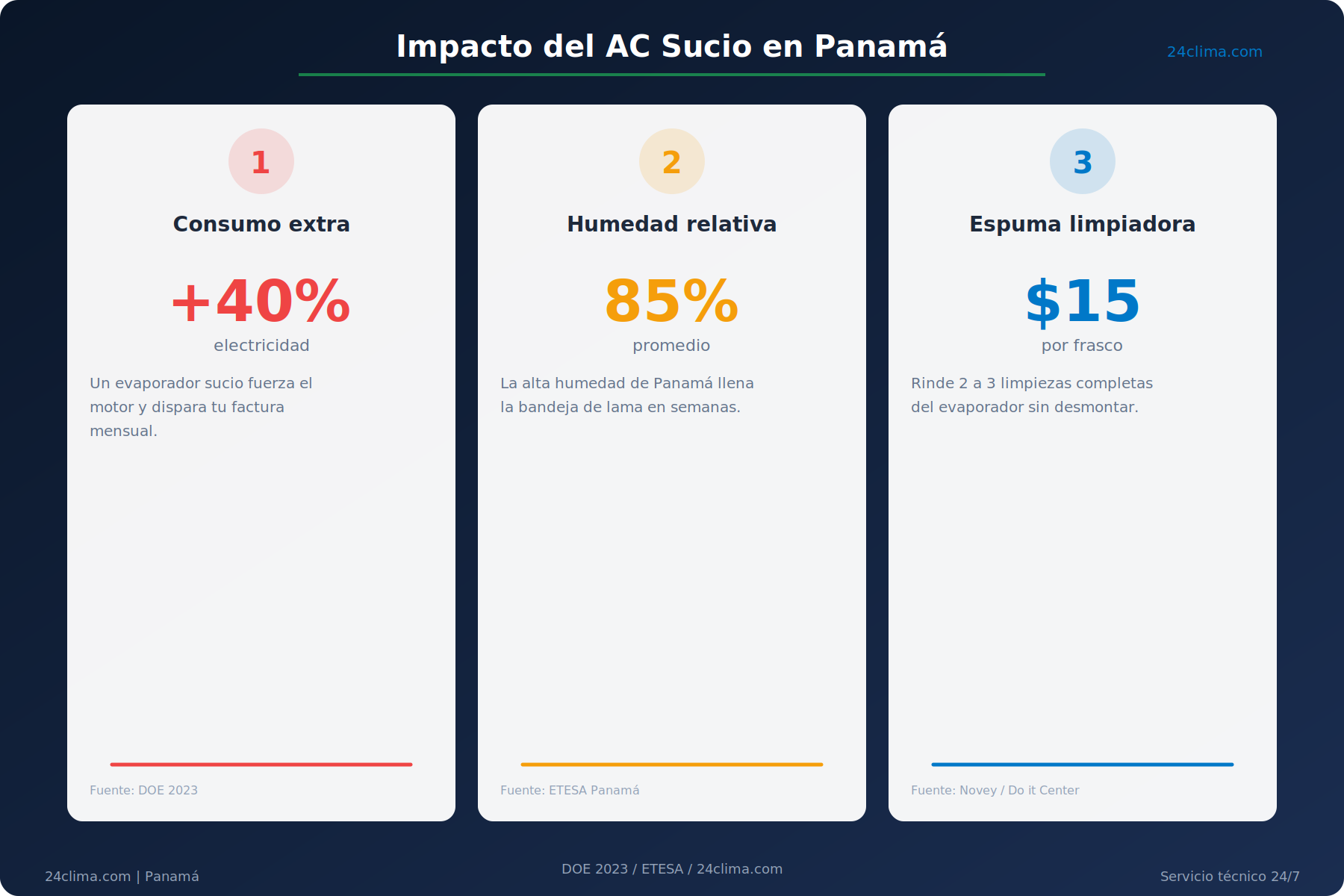
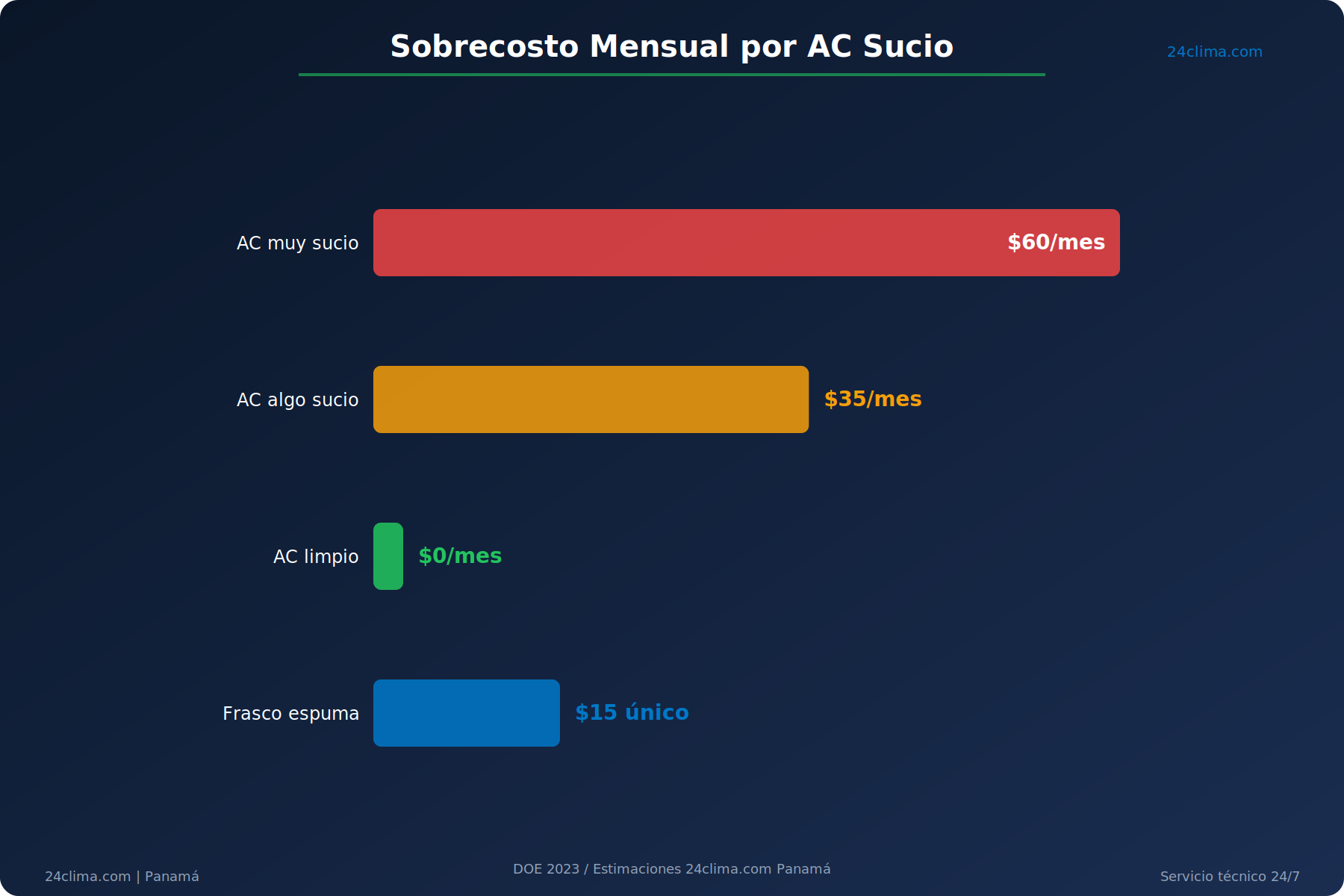
Here's what's actually happening. A split with dirty filters and a dirty evaporator coil can keep producing cold air for months, but it works significantly harder to do it. The motor forces air through an increasingly dense layer of dust and biofilm, which drives electricity consumption up by 20% to 40% according to data from the U.S. Department of Energy (DOE, 2023). In Panama, where an average household pays between $80 and $150 per month on electricity just for air conditioning, that percentage translates to $16 to $60 in extra charges every single month.
The other myth is that cleaning the inside requires taking the unit apart or calling a technician every time. Not true. There are critical interior components any homeowner can safely clean using the right products, without loosening a single screw. The key is knowing which parts those are and doing them in the right order.
What's Inside Your Split: What You Can Clean and What You Shouldn't
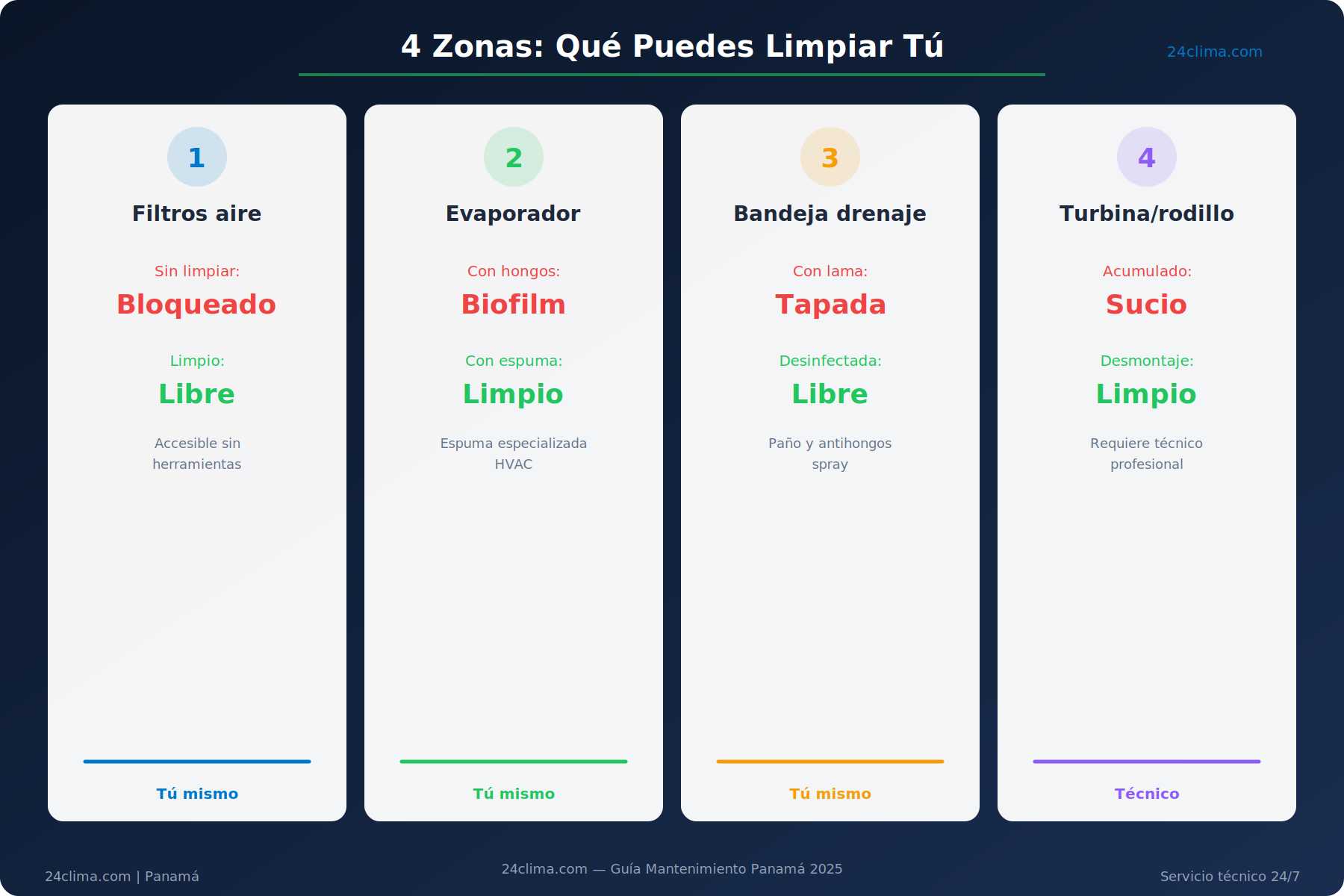
Before touching anything, you need to understand what's actually inside the unit. A standard wall-mounted split has four main zones.
The air filters are plastic mesh panels that trap dust, hair, and particles. They sit just behind the front cover — the most accessible parts, and the ones that need cleaning most frequently.
The evaporator coil is a metal structure made of thin fins where the refrigerant absorbs heat from the room. This is the component most prone to mold buildup in Panama's climate. You can clean it without removing it, using a specialized foam cleaner.
The condensate tray is the channel where water drained from the humid air collects. In Panama, with average relative humidity around 85%, this tray can build up biological slime within weeks if it's not cleaned regularly.
The blower wheel — also called the turbine or squirrel cage — is the fan that moves air through the system. Deep cleaning the blower wheel requires disassembly. Leave that to a technician when annual maintenance is due.
The first three components are accessible without any specialized tools. The fourth one, don't touch it yourself.
Tools and Products You'll Need
To clean a split air conditioner from the inside in Panama, you'll need these:
— Evaporator foam cleaner (not automotive foam or all-purpose spray) — Antifungal spray or HVAC-grade disinfectant — Microfiber cloths (two — one dry, one slightly damp) — Large plastic bag or AC cleaning bag (to cover the unit and catch dirty runoff water) — Soft-bristle brush (an old toothbrush works fine) — Small flashlight — Nitrile gloves
You can find evaporator foam cleaner at Novey, Do it Center, or specialized HVAC suppliers along Vía España. Prices typically run between $8 and $15 per can — enough for two or three cleanings.
What you should not use: pressurized water sprayed directly on the coil, undiluted bleach, industrial degreasers, or any product that doesn't specifically state on the label that it's safe for AC coils. The wrong products damage the fin coating and cause premature corrosion — a real concern in coastal areas like Punta Pacífica or Balboa, where salt air is already working against the metal components.
How to Clean the Air Conditioner From the Inside, Step by Step
Follow this sequence. The order matters: if you clean the evaporator before the filters, you'll re-contaminate what you just cleaned.
Step 1 — Turn the unit off and disconnect it from power. Don't just use the remote — cut the breaker or unplug the unit at the wall. Never work on a live unit.
Step 2 — Open the front panel. On most splits, the cover lifts upward. No tools needed. Open it slowly to avoid stressing the hinges.
Step 3 — Remove the filters. Slide them out carefully. You'll immediately see the dust accumulation. In Panama, a filter from a unit that hasn't been cleaned in six weeks can look dark gray or almost black.
Step 4 — Wash the filters. Take them to the sink or shower. Use lukewarm water and a soft brush. Skip the hot water — it warps the plastic mesh. Let them dry completely in open air before reinstalling. A damp filter going back into the unit is an invitation for mold.
Step 5 — Clean the evaporator coil with foam cleaner. With the filters out, you now have visual access to the evaporator fins. Apply the foam cleaner directly to the fins following the manufacturer's instructions. Most AC-specific foams are no-rinse formulas — they activate, dissolve the grease and biofilm, and drain on their own into the condensate tray. Apply in a smooth, top-to-bottom motion.
Step 6 — Apply antifungal spray. Once the foam has done its job — usually 5 to 10 minutes — apply the antifungal spray over the same fins. In Panama, this step isn't optional. At 85% relative humidity, mold can recolonize a freshly cleaned evaporator coil in under 30 days with no preventive treatment.
Step 7 — Clean the condensate tray. Using a damp microfiber cloth, wipe down the surface of the tray. If there's slime buildup — that gray or black viscous film — use your soft-bristle brush with a small amount of mild dish soap. Check that the drain outlet isn't blocked: a clogged drain causes water to overflow into the walls or ceiling.
Step 8 — Clean the air outlet vanes (louvers). With a dry microfiber cloth, gently wipe the directional vanes. They accumulate dust on the outside and biofilm on the interior surfaces.
Step 9 — Reinstall the filters, but only when they are completely dry to the touch.
Step 10 — Reconnect and turn the unit on. Run it in fan-only mode (no cooling) for 5 to 10 minutes to finish drying the interior before switching to cooling mode.
Airflow: Dirty Filters vs. Clean Filters
The impact of cleaning on performance is measurable. A study from the American Society of Heating, Refrigerating and Air-Conditioning Engineers (ASHRAE, 2022) documented that dirty filters reduce airflow by 15% to 45% depending on the degree of buildup. In practical Panama terms: if your 12,000 BTU unit has been running with eight weeks of Panama dust on the filters, it may be performing like a 7,000 to 10,000 BTU unit — not nearly enough to cool the same space it was handling comfortably before.
After a full cleaning, most people notice the difference within the first two hours. The room drops to temperature faster, the compressor cycles less frequently, and the musty smell on startup disappears. On inverter units, a timely cleaning can cut monthly electricity costs by $18 to $35 depending on unit size and daily usage hours.
How Often to Clean, by Zone in Panama
Not all areas of Panama put the same load on your air conditioner. Here's a realistic breakdown based on actual local conditions:
Panama City — urban core (Bella Vista, San Francisco, El Cangrejo) Filters: every 3 to 4 weeks Evaporator foam cleaning: every 2 to 3 months Condensate tray: every 2 months Main factor: urban dust, vehicle exhaust, high humidity.
Costa del Este, Punta Pacífica, Casco Antiguo — coastal zones Filters: every 2 to 3 weeks Evaporator foam cleaning: every 6 to 8 weeks Condensate tray: every 6 weeks Main factor: salt air from the ocean, accelerated corrosion, extreme humidity.
Clayton, Albrook, Ancón — Canal Zone, greener areas Filters: every 4 weeks Evaporator foam cleaning: every 2 to 3 months Condensate tray: every 2 to 3 months Main factor: organic dust (leaves, spores), moderate humidity.
Interior provinces — David, Santiago, Chitré Filters: every 3 to 4 weeks, more frequently during dry season Evaporator foam cleaning: every 3 months Condensate tray: every 2 to 3 months Main factor: dirt dust during dry season, insects.
Frequently Asked Questions
How often should I clean the inside of my air conditioner in Panama?
The minimum is cleaning the filters every 3 to 4 weeks and doing a full internal cleaning with evaporator foam every 2 to 3 months. In coastal areas or zones with heavy urban pollution, shorten those intervals. The most reliable sign that it's time: the unit is taking longer than usual to cool the room, or you notice a musty smell on startup.
Can I clean the evaporator coil myself without calling a technician?
Yes, using evaporator foam cleaner specifically designed for AC units, available at hardware and HVAC supply stores in Panama. Use the right products and make sure the unit is completely disconnected from power before you start. What you should not attempt on your own is removing the evaporator coil or cleaning the blower wheel — those require technical knowledge and can damage the system if done incorrectly.
What products are safe to use when cleaning the inside of an air conditioner?
Safe options include evaporator foam cleaners labeled for AC use (brands like Coil Clean, Nu-Brite, or similar), antifungal sprays formulated for HVAC systems, and lukewarm water with mild dish soap exclusively for the plastic filter mesh. Avoid undiluted bleach, high-concentration isopropyl alcohol, and industrial degreasers — these attack the protective coating on the aluminum fins and accelerate corrosion, especially on units exposed to salt air near the coast.
When Basic Cleaning Isn't Enough
Sometimes what you can do yourself won't solve the underlying problem. If the unit still isn't cooling properly after you've cleaned the filters and the evaporator coil, if electricity consumption stays high, or if you see water dripping from the indoor unit even though the drain appears clear — the issue may be in the blower wheel, the refrigerant level, or the deep drainage system.
For those cases, professional AC cleaning in Panama includes controlled disassembly of the blower wheel, pressure washing of the evaporator, inspection of the electrical circuit, and refrigerant recharge if needed. It's the full service a certified technician performs once a year to get the unit running like new again.
Back to that apartment in Costa del Este at 2 in the afternoon. This time, when you press the button on the remote, the air comes out clean — no smell — and the room hits a comfortable temperature in eight minutes instead of twenty. Not because you bought a new unit. Because you spent forty minutes on a proper cleaning three weeks ago.
That's what makes the difference in Panama: not the equipment itself, but keeping up with maintenance on time.
If you'd prefer to have a certified technician handle the full internal cleaning — including the blower wheel and deep drainage system — 24Clima can coordinate that with flexible scheduling across Panama City and surrounding areas. Reach out via WhatsApp at https://24clima.com/contacto/ and we'll get back to you the same day.