AC Compressor in Panama — Warning Signs, Real Costs, and When It Actually Makes Sense to Repair
2 PM in Costa del Este. The sun is hammering the pavement, the thermometer reads 91°F (33°C), humidity at 85%. You turn on the AC like you do every day — but something is off. The unit starts, makes a dull metallic thud, and within a minute the circuit breaker trips. Silence. Heat. And the question nobody wants to face: did something happen to the compressor?
That moment of uncertainty is exactly where homeowners in Panama make expensive decisions without the right information. They call the first available technician, hear "you need a new compressor," and pay whatever they're charged — or they buy a brand-new unit without knowing whether they actually needed one. Neither move makes sense when you don't have the right data in front of you.
Here's that data: what the compressor does, how to spot it failing before it dies completely, what replacement actually costs in Panama in 2025, and how to decide — with logic, not panic — whether repair makes sense or whether you're better off with new equipment. You can also check our guides at https://24clima.com/consejos-y-guias/ for other topics on keeping your system running.
What Most People Assume — And Why They're Wrong
The most common mistake is thinking the compressor fails suddenly, without warning. "It was working fine yesterday and now it won't turn on" — that's what we hear constantly. But the compressor has been sending signals for weeks, sometimes months. The noise that seemed normal. The electricity bill that climbed and got blamed on ENSA. The bedroom that "took longer to cool down" because it was the hot season.
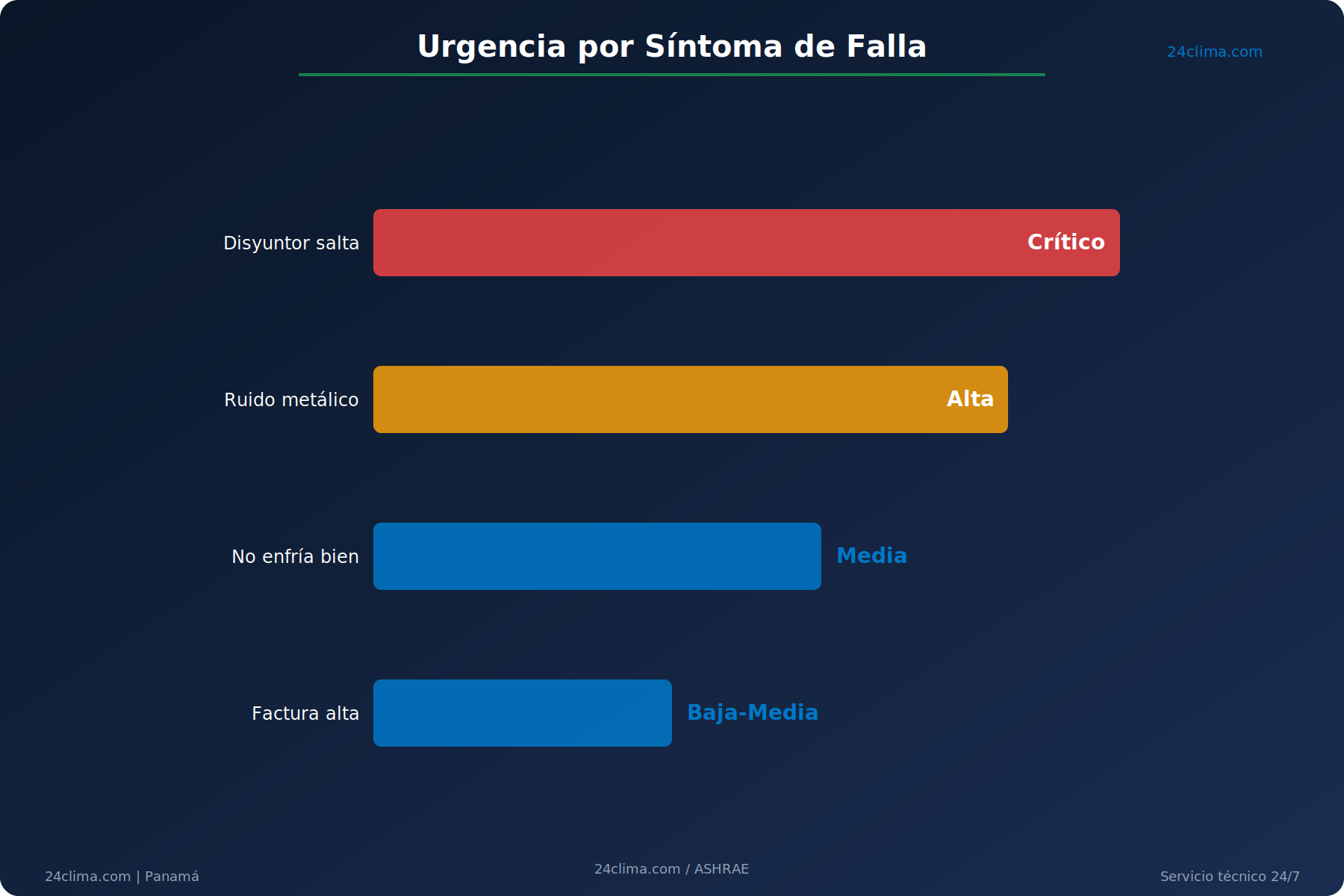
The second wrong assumption is that repairing is always cheaper. Sometimes it is. But replacing the compressor on a 9-year-old unit can run $550 — and a new 12,000 BTU inverter unit in Panama costs between $480 and $650 installed. In that scenario, repairing is a bad financial call. Getting to the right answer, though, depends on four variables that nobody stops to explain when you're stressed and sweating.
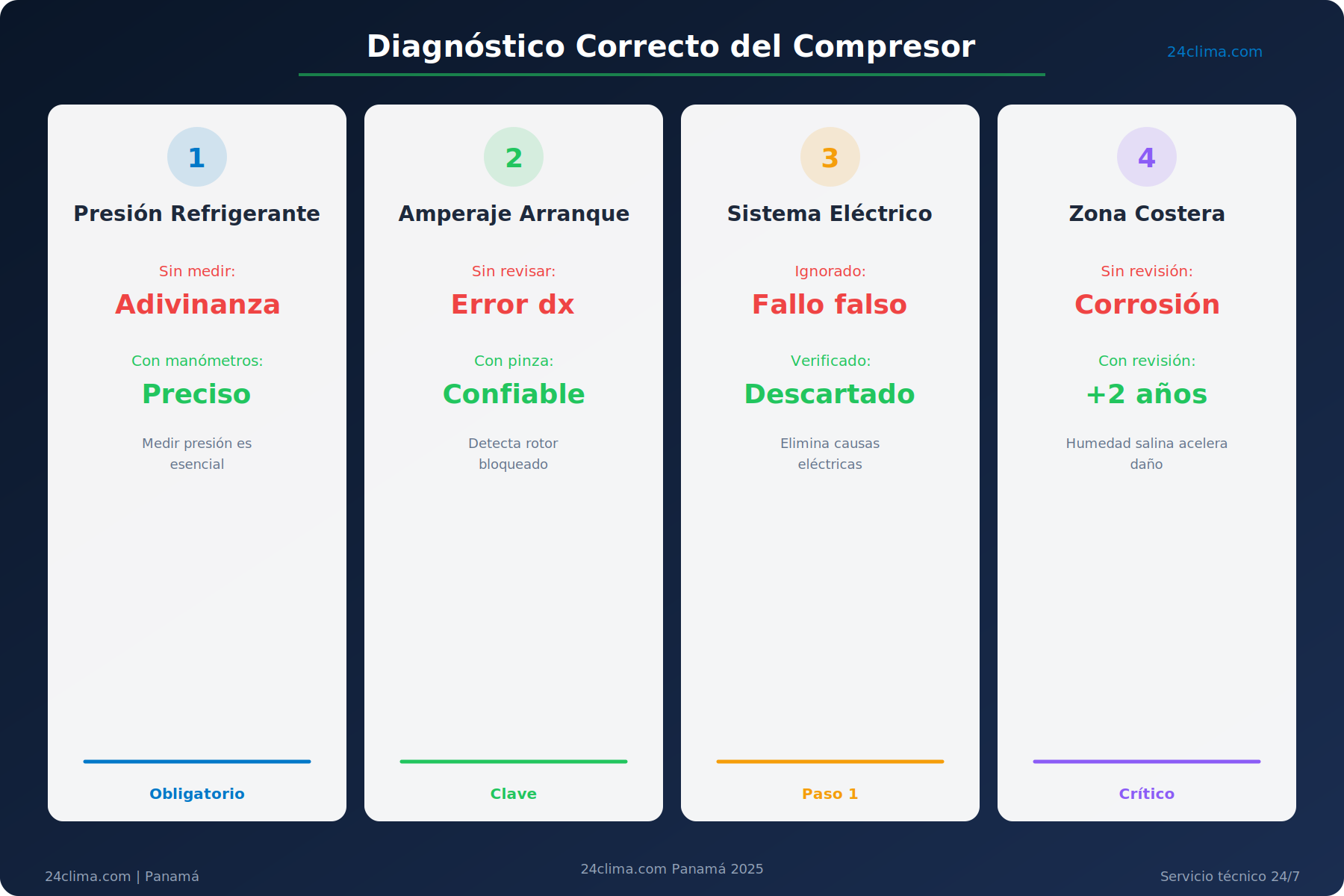
Third misconception: if the technician says the compressor is bad, it must be. A proper diagnosis requires measuring refrigerant pressures with gauges, checking startup amperage, and ruling out electrical problems that mimic compressor failure. A technician who diagnoses without measurement equipment is guessing — and you're the one paying for that guess.
What the Compressor Does and Why It's the Most Critical Component
The compressor is the heart of the refrigeration cycle. Its job is to compress refrigerant from a gaseous state into a high-pressure liquid — that pressure difference is what drives the entire heat transfer process. Without a functioning compressor, the unit moves air but pulls out no heat and no humidity. It's just an expensive fan.
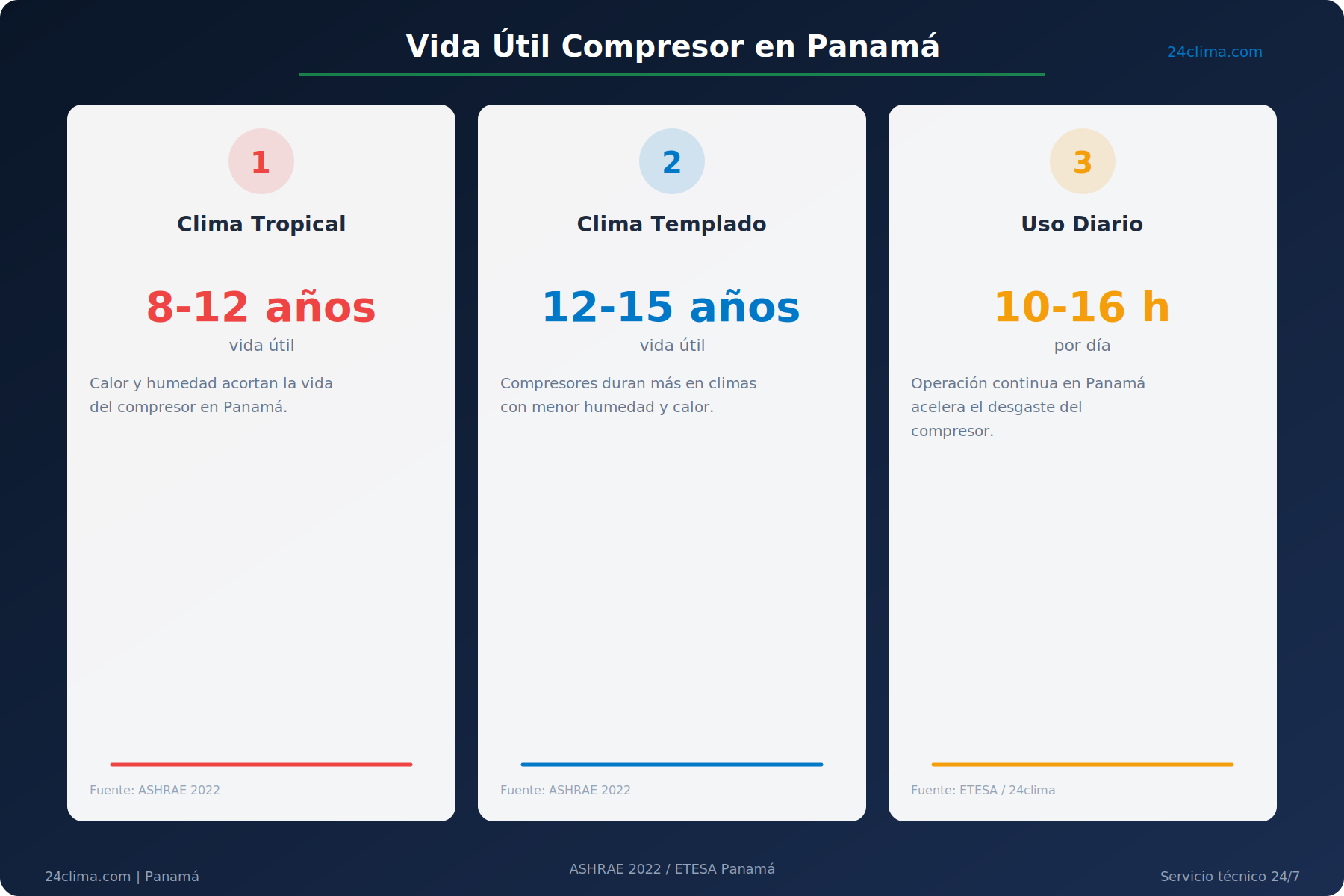
To understand why it fails, you need to understand what it endures. In Panama, a residential unit runs 10 to 16 hours a day. Outdoor temperatures hover around 88–91°F (31–33°C) with relative humidity of 75–85%, according to ETESA (Empresa de Transmisión Eléctrica S.A.) data for Panama City. Those conditions force the compressor to work harder than it would in a temperate climate — the temperature differential it has to overcome is greater, and the start-stop cycling in non-inverter compressors creates repeated amperage spikes that accelerate wear with every cycle.
A 2022 study published by the American Society of Heating, Refrigerating and Air-Conditioning Engineers (ASHRAE) puts compressor lifespan in tropical climates with continuous operation at 8 to 12 years — compared to 12 to 15 years in temperate climates. In Panama, add salt-laden humidity in coastal areas like Punta Pacífica and Amador, plus irregular maintenance, and that range trends firmly toward the lower end.
7 Symptoms That Your Compressor Is Failing
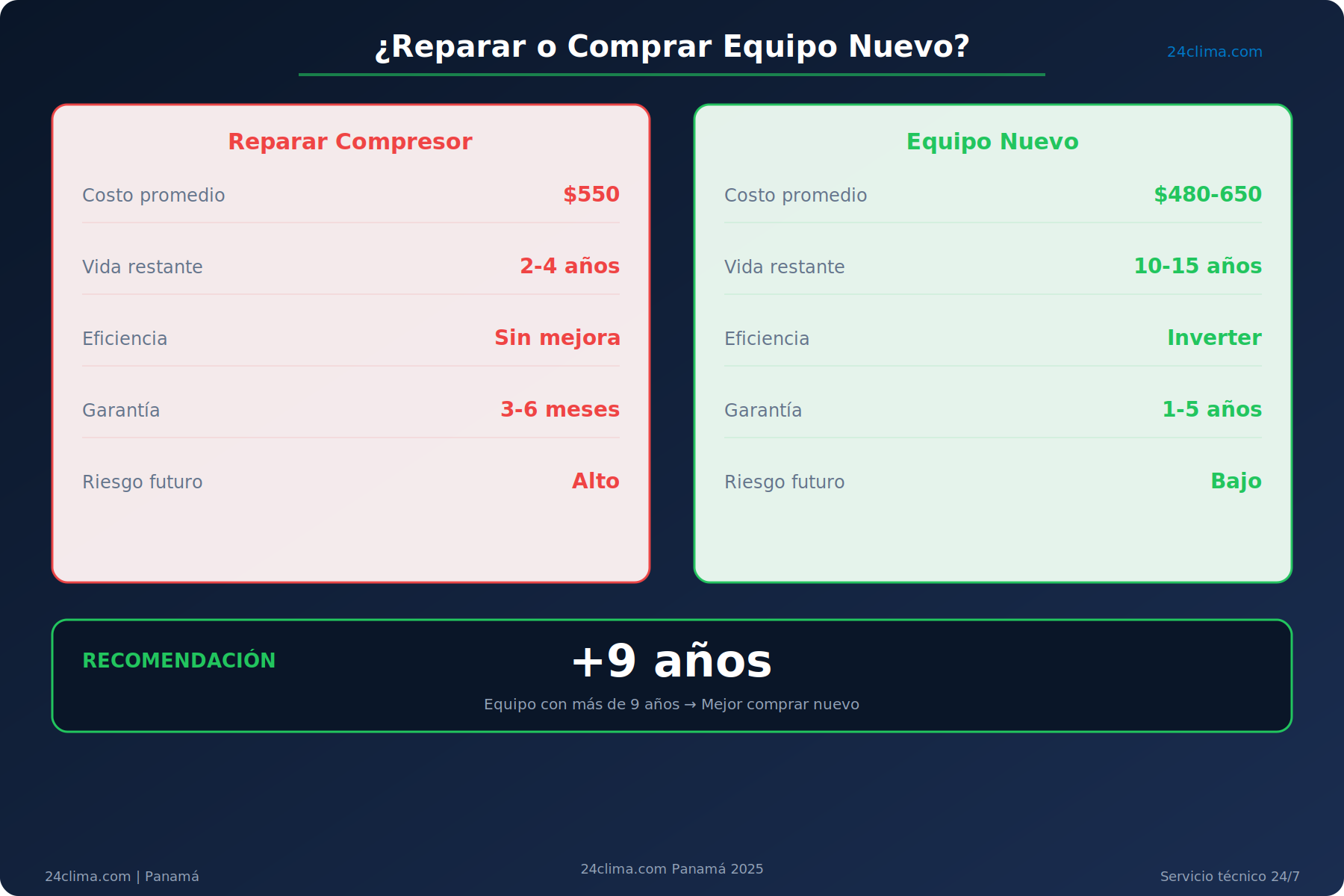
The compressor almost always gives warning before it dies. What follows are the symptoms ordered from least to most urgent, with the level of action each one calls for.
- The AC is cooling noticeably less than it used to
A direct signal: if the unit has been running more than 45 minutes and the room hasn't dropped below 79°F (26°C) under normal conditions — doors closed, blinds down — the compressor may be losing compression capacity. Low refrigerant can also cause this, but both scenarios point to the compressor as the right place to start the investigation. Urgency: medium. Schedule a checkup within the next 7 days.
- Metallic noise when starting or during operation
A sharp thud on startup, an internal rattling, or an unusually loud hum signal internal mechanical wear — pistons, valves, or bearings. In scroll compressors, the most common type in inverter units, unusual noise points to damage in the internal scrolls. Urgency: high. Turn the unit off and call a technician before running it again.
- The circuit breaker keeps tripping
A failing compressor draws more amperage than normal during startup — a phenomenon known as locked rotor amperage — and the breaker trips as a protection mechanism. If your AC breaker trips more than once in a week with no other electrical explanation, the compressor is a serious suspect. Urgency: very high. Don't force the unit back on.
- Your electricity bill went up without changing your habits
A compressor struggling to work consumes more energy while producing less cooling. If your ENSA bill jumped $20–40 a month, nothing else in the house changed, and the unit is over 6 years old, include the compressor in the diagnosis. According to AECO (Asociación de Empresas de la Construcción de Panamá), air conditioning accounts for 45–60% of residential electricity consumption in Panama's warmer zones. A degraded compressor can push that cost up another 15–25%.
- The unit starts but shuts itself off within minutes
Short cycling — that's the technical term — happens when the compressor detects abnormal pressures or temperatures and the protection system shuts it down automatically. It can be a refrigerant issue or a compressor that can no longer hold working pressures. Urgency: high.
- Excessive vibration from the outdoor unit
The outdoor unit should not vibrate in any perceptible way. If you can feel strong vibration by placing your hand on the casing, or if the unit starts shifting on its base, the compressor's internal mounts or anti-vibration supports are damaged. Urgency: medium-high.
- The unit runs but room temperature doesn't change at all
Terminal symptom. The compressor spins, the fan works, but refrigerant isn't circulating with enough pressure. The unit moves air and transfers no heat. Either a dead compressor or total refrigerant loss. Urgency: immediate.
What It Actually Costs to Replace an AC Compressor in Panama in 2025
The real cost has two components: the part and the labor. These are actual price ranges by capacity, brand, and compressor type, based on pricing from local distributors and shops in Panama City.
Compressors for 9,000 BTU units (typical for small bedrooms) — LG rotary non-inverter: part $120–$180, labor $80–$120. Total: $200–$300. — Samsung rotary non-inverter: part $130–$190, labor $80–$120. Total: $210–$310. — Carrier scroll non-inverter: part $180–$250, labor $100–$140. Total: $280–$390.
Compressors for 12,000 BTU units (standard bedrooms, the most common size in Panama) — LG inverter: part $250–$350, labor $100–$150. Total: $350–$500. — Samsung inverter: part $270–$380, labor $100–$150. Total: $370–$530. — Panasonic inverter: part $290–$400, labor $120–$160. Total: $410–$560. — Carrier inverter: part $320–$450, labor $120–$160. Total: $440–$610.
Compressors for 18,000–24,000 BTU units (living rooms, open spaces, offices) — LG inverter: part $380–$550, labor $130–$180. Total: $510–$730. — Carrier scroll: part $450–$650, labor $150–$200. Total: $600–$850.
One thing these numbers don't include: refrigerant recharge if there was a leak. Add $60–$120 for R-410A or R-32, depending on how much is needed.
The Decision Framework — Repair the Compressor or Buy New?
This question has a logical answer based on three variables. Not on the technician's opinion. Not on emotional attachment to the unit you're used to.
Variable 1: Age of the equipment
Under 4 years old, repair is almost always the right call — compressors are frequently still under warranty at that age, so check your policy before spending anything. Between 4 and 7 years, the financial calculation kicks in. At 8 years or older, a new unit deserves serious consideration.
Variable 2: The 50% rule
This comes from the North American HVAC industry and applies directly in Panama: if the cost of repair exceeds 50% of what an equivalent new unit costs, buy new equipment. A new 12,000 BTU inverter unit in Panama runs $480–$700 installed. If the compressor repair comes to $400 or more, that gap doesn't justify keeping a 7–9-year-old unit that could need another major component in 18 months.
Variable 3: The technology in your current unit
If your unit is a non-inverter model over 6 years old, switching to inverter isn't a luxury — it's math. According to LG's published data for tropical operating conditions, an inverter unit consumes 30–50% less electricity than an equivalent non-inverter, which at ENSA rates of $0.15–$0.18 per kWh and 12 hours of daily operation means $25–$45 less on your monthly bill. Over 18–24 months, those savings offset a significant portion of what a new unit costs.
Why Panama's Climate Accelerates Compressor Wear
A compressor in Panama operates under conditions no standard technical manual calls normal. Relative humidity of 80–85% in Panama City from May through November forces the system to pull more water out of the air — which increases the total thermal load and keeps the compressor running longer on every cycle.
In coastal areas like Balboa, Amador, and Punta Pacífica, sea breezes carry sodium chloride particles that corrode external coils and, over time, eat through compressor seals. That speeds up refrigerant leaks. A compressor running low on refrigerant operates at wrong pressures, overheats, and dies early.
Skipping maintenance is the most controllable factor in all of this. According to ASHRAE's technical assessment for tropical climates, units that receive regular semi-annual cleaning maintain compression efficiency 15–20% higher than unmaintained equivalents — meaning the compressor lives longer and your bills stay lower. A preventive maintenance service at https://24clima.com/servicios/mantenimiento/ is the most efficient way to avoid getting to this point in the first place.
Coil cleaning matters for the same reason: a dirty condenser forces the compressor to work at higher discharge pressures — the equivalent of making your heart pump thickened blood. More effort, faster wear. If you can't remember the last time your unit had a deep clean, schedule that service at https://24clima.com/servicios/limpieza/.
Frequently Asked Questions
How much does it cost to replace an AC compressor in Panama?
In Panama in 2025, the total cost — part plus labor — ranges from $200 to $850 depending on unit capacity and brand. For the most common size, 12,000 BTU, expect to pay between $350 and $560. Larger units or premium brands like Carrier can exceed $600 including refrigerant.
How do I know if my AC compressor is damaged?
The clearest signs are: the unit starts but doesn't cool, a metallic thud on startup, a breaker that keeps tripping, or a bill that went up for no obvious reason. A real diagnosis requires pressure gauge readings and amperage checks — visual symptoms alone aren't enough to confirm compressor failure.
Should I repair the compressor or buy a new AC unit in Panama?
It depends on three things: the age of the unit, the cost of repair versus the price of new equipment, and whether your current unit is inverter or non-inverter. If the unit is 8 or more years old and repair costs more than 50% of what a new unit would cost, buy a new inverter unit. The monthly electricity savings — $25–$45 less per month — pay back the investment in under two years under Panama's operating conditions.
The Right Decision Gets Made With Data, Not With Urgency
Go back to that afternoon in Costa del Este. The tripped breaker, the heat, the pressure to decide fast. Now you have what you need to avoid making that call blind: the symptoms that actually matter, the real costs, and the logic of when repair makes sense and when it simply doesn't.
At 24Clima, we check compressor condition with proper measurement equipment — pressure gauges, clamp meters, inspection camera — before recommending any repair or replacement. If you're hearing one of those noises, if your breaker keeps tripping, or if you want to know the real condition of your unit before the next heat wave hits, reach out via WhatsApp at https://24clima.com/contacto/ and we'll give you an honest diagnosis. No commitment required.
Last updated: May 2025