AC Remote Control Not Working — What Panama's Humidity Is Doing to Your Equipment
Last updated: May 2025
Two in the afternoon in Costa del Este. The sun is hitting hard the way it does during dry season — 91°F (33°C) outside, and your apartment has been soaking up heat since noon. You pick up the remote, point it at the indoor unit, and press the power button. Nothing. Three more presses, different angles. Still nothing. You pull the batteries, put them back. Nothing.
Your first instinct is that the AC itself is broken. Your second is to call a technician and brace yourself for the diagnostic fee. But in most cases, the unit is fine — the problem is the communication chain between the remote and the IR sensor on the indoor unit, a chain that degrades faster in Panama than anywhere else in the region, for very specific reasons.
Here's exactly what's happening, how to identify the cause in under five minutes, and what you can fix yourself without making that call. For more guides like this one, visit our tips and guides at https://24clima.com/consejos-y-guias/
What Most People Assume (And Why They're Wrong)
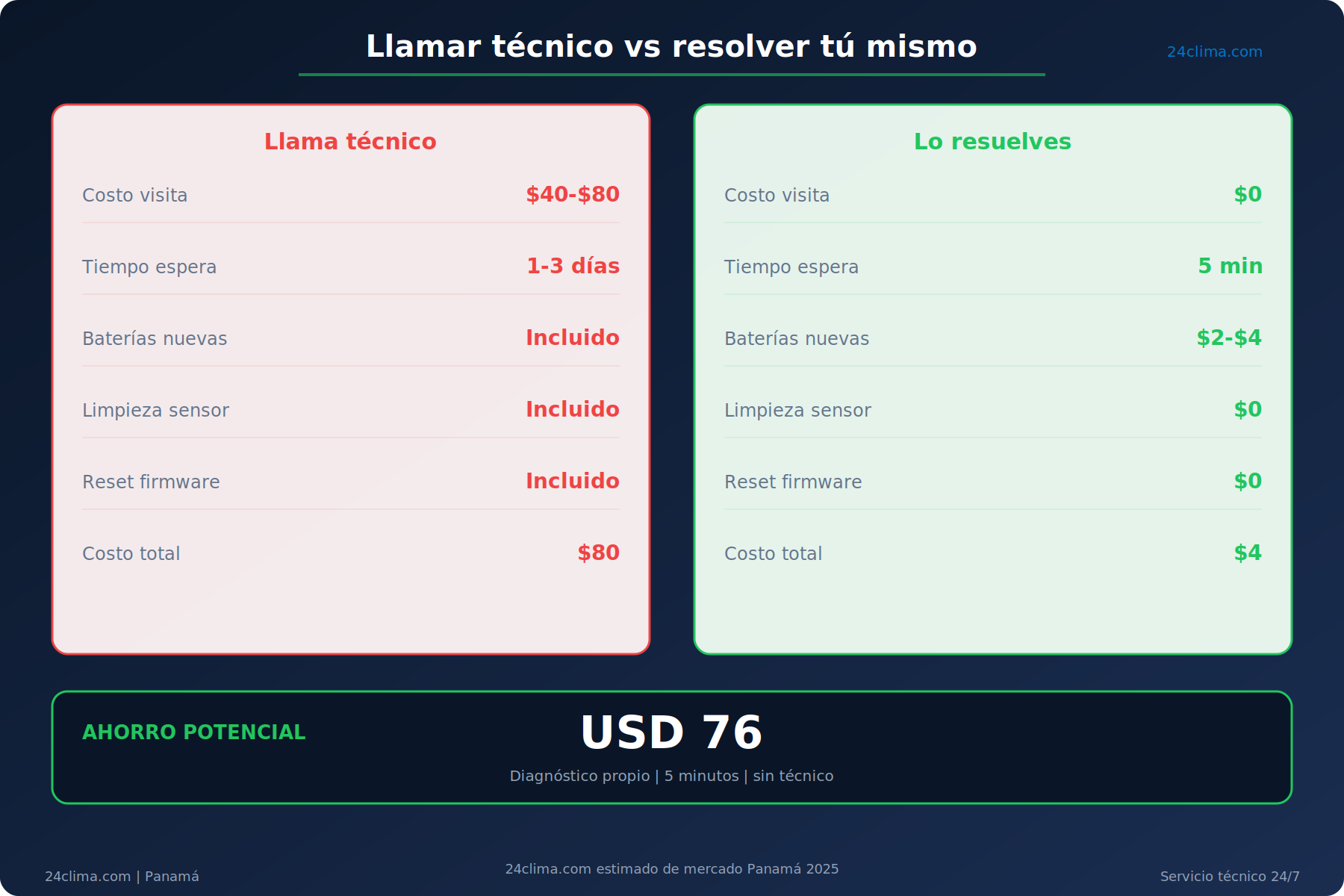
When the remote stops working, about 80% of people assume there's an internal electrical fault with the AC unit. They call a technician, pay between $40 and $80 for the visit, and find out the problem was a dirty sensor or dead batteries. The other group assumes the remote died and buys a replacement without checking whether the IR receiver on the indoor unit also failed — ending up with a brand-new remote that doesn't work either.
The remote control system on a split AC has three critical components: the IR transmitter inside the remote, which sends infrared light signals; the IR receiver on the indoor unit, which picks up those signals; and the main board microcontroller that interprets them. When something fails, it could be any of the three. Diagnosing correctly before spending money is the whole game.
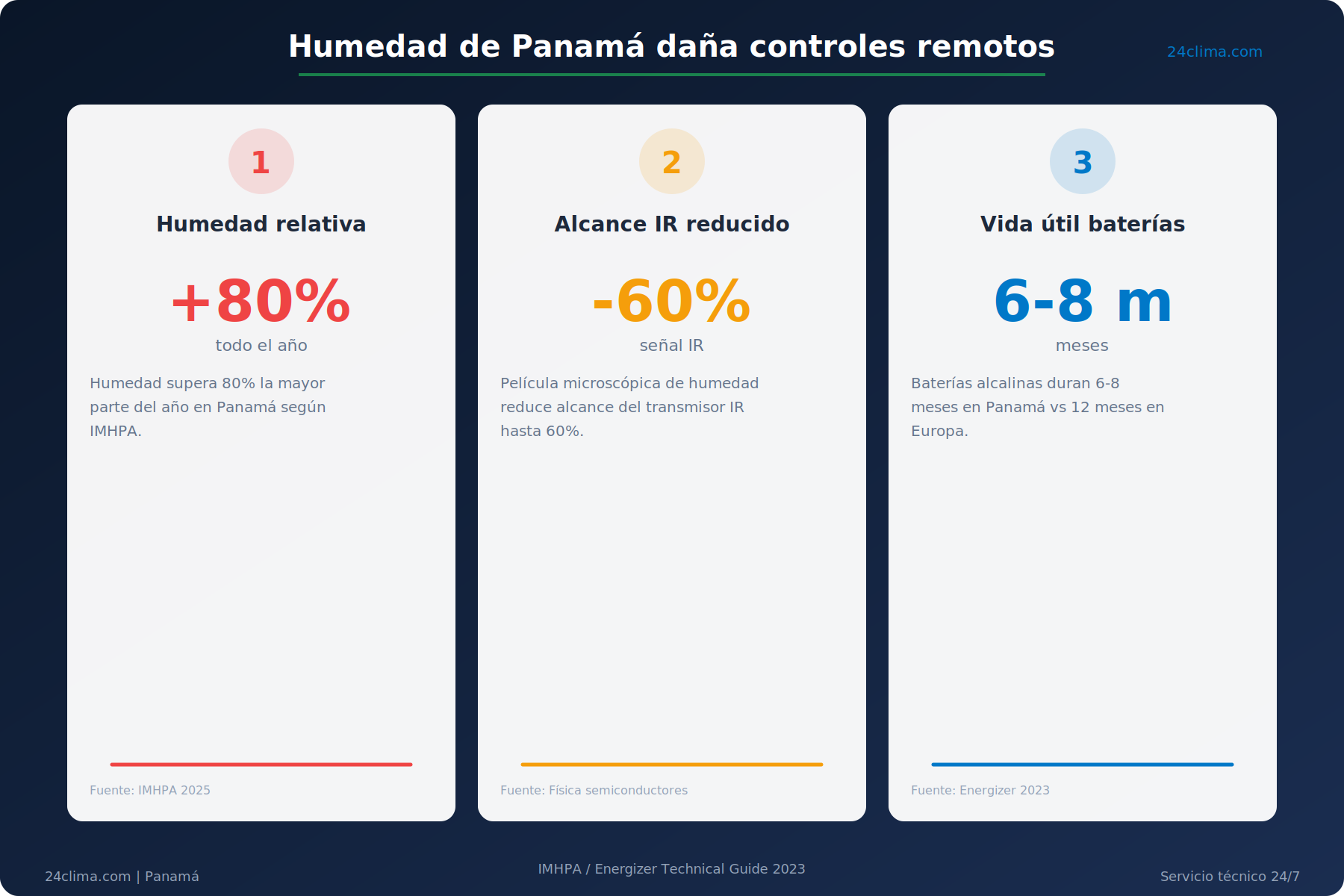
Panama's average relative humidity exceeds 80% for most of the year and climbs to 90% or higher during the rainy season, according to data from Panama's Institute of Meteorology and Hydrology (IMHPA). That humidity gets inside remote controls, corrodes battery contacts, breaks down button membranes, and deposits a microscopic film over the IR transmitter lens that can cut its effective range by up to 60%. Basic semiconductor physics in a tropical environment — not speculation.
The 7 Reasons Your AC Remote Stops Working
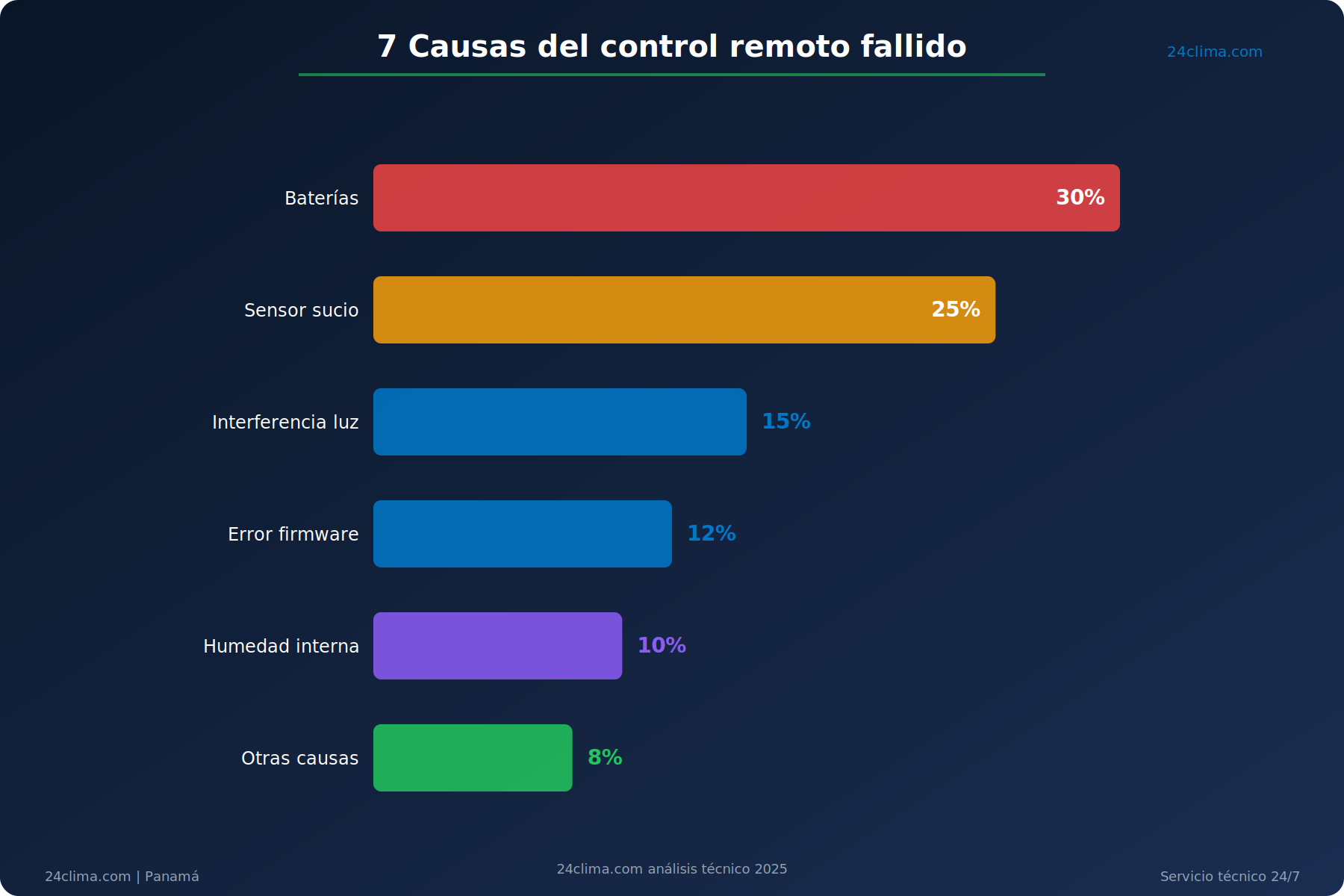
95% of non-responsive AC remote cases in tropical climates come down to one of these seven causes, listed from most to least common.
Dead Batteries or Corroded Contacts
The most common cause, and the most underestimated. AA and AAA batteries lose charge up to 30% faster in environments above 86°F (30°C), according to Energizer's published technical performance guide for tropical climates (2023). In Panama, a standard pair of alkaline batteries that would last 12 months in a cooler climate lasts six to eight months. But the bigger problem isn't the charge — it's corrosion. Humidity causes batteries to leak potassium carbonate, a white powdery residue that destroys the metal contacts inside the remote and can permanently damage the internal circuit board.
Dust and Grease on the Indoor Unit's IR Sensor
The IR receiver is a small window — usually dark translucent plastic — located at one end of the front panel. In neighborhoods like San Francisco or Marbella, where traffic and ambient pollution are constant, that sensor collects a mix of dust, airborne cooking grease, and smoke particles. That layer acts as a filter blocking the infrared signal. A grease-coated sensor can drop the communication range from 26 feet (8 meters) to under 3 feet (1 meter) — or block it entirely.
Direct Sunlight or Intense White Light Interference
Your remote's infrared signal operates at 38 kHz. High-power LED lights and direct sunlight also emit infrared radiation that can saturate the receiver, making it effectively deaf to the remote. If the indoor unit faces a window with direct sun exposure or sits under a bright LED fixture, that may be the entire problem.
Firmware Desync or Protocol Error
Some modern units — particularly LG models with ThinQ or Panasonic with Econavi — have microcontrollers that get stuck in an error state after a power outage or voltage spike. The unit powers on, the display works, but it ignores the remote. The fix is a full reset, covered in the diagnostic section below.
Moisture Damage Inside the Remote
The least visible problem and the most costly if caught late. Relative humidity above 85% — routine in Panama — works its way into remote controls through the plastic seams, especially in units more than two years old. Inside, moisture condenses on the printed circuit board, creates conductive bridges between electrical tracks, and can burn components. A humidity-damaged remote typically shows itself through some buttons working and others not, or a display showing garbled characters.
Failed IR Receiver on the Indoor Unit
If you've replaced the batteries, cleaned the sensor, eliminated interference, and the unit still won't respond, the IR receiver on the indoor unit itself may have failed. This component — technically an IR demodulator module — costs between $8 and $20 in parts, and replacing it requires opening the front panel of the indoor unit. Service data from authorized distributors in Panama shows that a failed IR receiver accounts for approximately 12% of the "remote not working" cases that come into the shop.
Irreparably Damaged Remote
A remote that's been dropped, soaked by condensation from a ceiling fan, or has five or more years of heavy use in a tropical climate may have a burned-out IR transmitter or a cracked internal board. The definitive test is in the diagnostic protocol below.
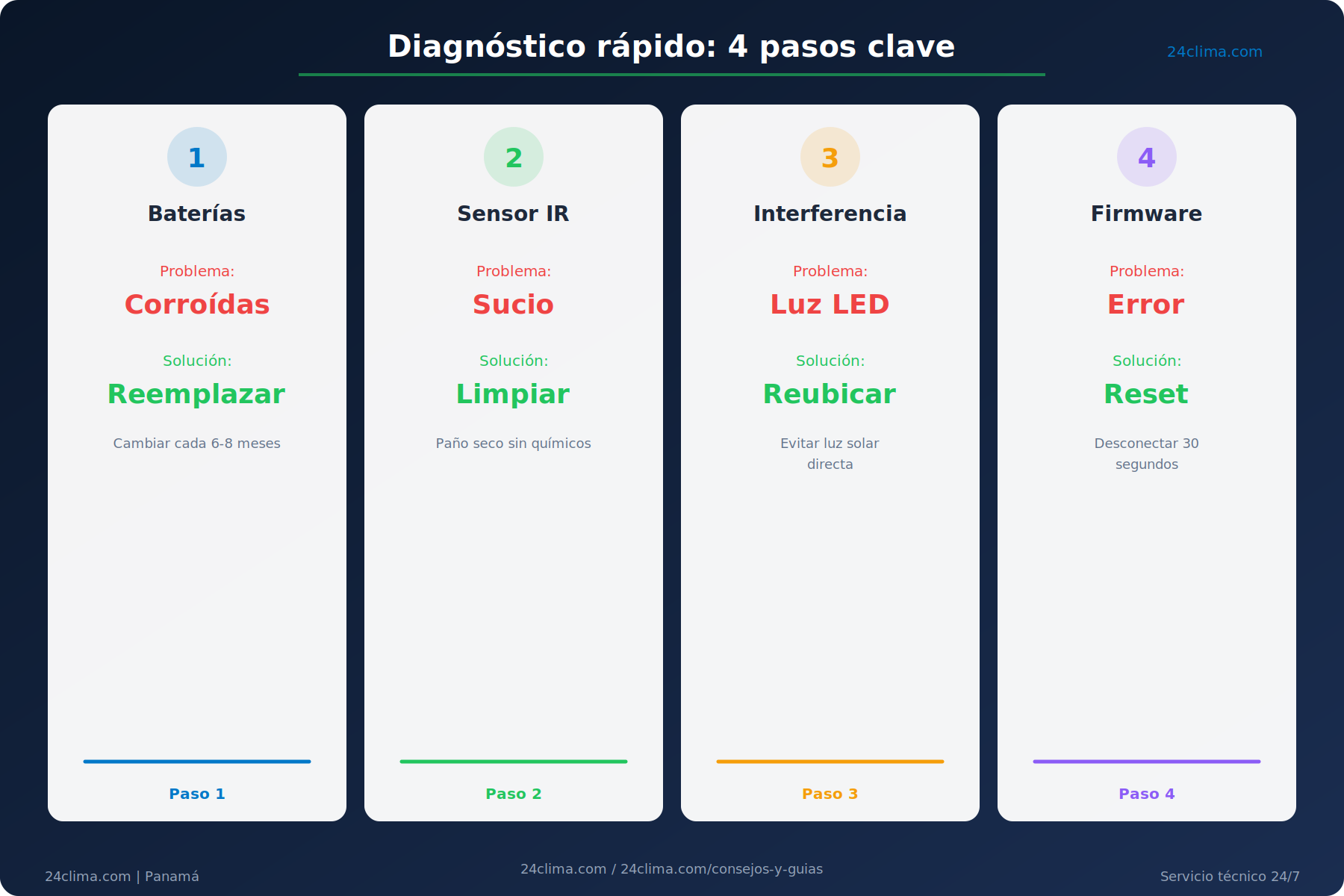
5-Minute Diagnostic Protocol: Identify the Problem Yourself
This protocol works for any split unit installed in Panama — LG, Samsung, Panasonic, Carrier, Mitsubishi. Follow the steps in order.
Test the Remote's IR Transmitter With Your Phone Camera
Open your phone's camera app — front or rear camera, no filters. Point the end of the remote directly at the lens and press any button. If the transmitter is working, you'll see a purple or white flash on screen. Your camera picks up infrared light the human eye can't see. No flash at all means the transmitter is dead or the batteries are completely drained.
Replace the Batteries With Fresh Ones Before Anything Else
Use brand-name alkaline batteries — Duracell or Energizer. Generic batteries sold at kiosks around Panama City carry 40% to 60% less actual capacity than name brands, according to comparative testing by Consumer Reports (2024). Repeat the camera test. A flash now means the batteries were your problem.
Clean the IR Sensor on the Indoor Unit
Turn the unit off at the breaker. Take a microfiber cloth slightly dampened with water — no cleaning products. Find the dark translucent panel at one end of the indoor unit's display and clean it with light circular pressure. Restore power and test. This step alone resolves approximately 25% of cases based on our service experience in Panama.
Eliminate Light Interference
Close any blinds or curtains sending direct light toward the indoor unit. Temporarily switch off the nearest LED lights. Test the remote from different angles and distances, starting at about 3 feet (1 meter).
Do a Full Reset of the Unit
If none of the previous steps resolved it, switch off the breaker for your AC unit and wait a full 3 minutes — not 30 seconds. Three minutes is the time the capacitors on the main board need to fully discharge. Restore power and test. This clears firmware errors in LG, Carrier, and Samsung units in more than 70% of cases, according to service data from authorized distributors in Panama City.
Choosing a Universal Remote in Panama
If the diagnostic confirms the remote is beyond saving, the most affordable path is a compatible universal remote. In Panama, you'll find them at Panafoto, Rodelag, DoIt Center, and electronics stores in the El Dorado area and Bazar Francés.
Current prices as of May 2025 range from $8 to $35 depending on model and compatibility.
Basic remotes covering 1,000 codes (Chinese generic brands) run $8 to $12. They work with LG, Samsung, and Carrier on most models made before 2020 but won't support special functions like Panasonic's Econavi mode or LG's Dual Inverter features.
Mid-range remotes like Chunghop or Qunda run $15 to $22, cover over 3,000 codes, and handle Mitsubishi, Daikin, and modern inverter models. Available at Rodelag.
Smart remotes with built-in WiFi running on the SmartLife/Tuya platform cost $25 to $35. You program them through a smartphone app and control the unit from anywhere with an internet connection. They require 2.4 GHz WiFi and are compatible with virtually all standard split models.
To program a universal remote, you need the specific code for your brand. LG typically uses 0004 or 0076. Carrier responds to 0178 or 0224. Samsung to 0096 or 0217. Panasonic to 0001 or 0015. Mitsubishi to 0146 or 0284. If the first code doesn't work, try the second. The whole process takes under ten minutes.
One thing to know before buying: if your unit is more than seven years old and the IR receiver on the indoor unit has also failed, a universal remote won't solve the problem. You need the receiver module replaced — that's part of a professional AC maintenance service.
Frequently Asked Questions About AC Remotes in Panama
Why won't my air conditioner respond to the remote in Panama?
The most common causes in Panama's climate are batteries drained faster than expected by the constant heat, an IR sensor on the indoor unit coated in dust or cooking grease, or humidity that has worked its way into the remote and damaged the internal circuit board. Run the five-step diagnostic protocol above to identify the specific cause before calling a technician.
How do I reset a split AC when the remote isn't working?
Switch off the breaker for your AC unit, wait a full 3 minutes to let the main board capacitors discharge completely, then restore power. This restarts the unit's microcontroller and clears firmware errors on most LG, Carrier, Samsung, and Panasonic models sold in Panama.
Can I use a universal remote for any AC brand in Panama?
A universal remote covers most basic functions — on/off, temperature, mode, fan speed — for virtually every brand. Special features like Panasonic's Econavi mode, LG's Dual Inverter, or SmartThinQ connectivity require the original remote. Universal remotes at Rodelag and Panafoto cost between $15 and $35 and handle everyday use without issues.
Can Panama's humidity actually damage my AC remote?
Yes. The 85–90% relative humidity recorded during the rainy season gets inside remote controls through the plastic seams. Once inside, it condenses on the circuit board and creates short circuits or corrodes components. To extend your remote's life, keep it in a drawer when not in use and replace the batteries every six months even if they still seem to have charge.
How much does it cost to replace an AC remote in Panama?
A brand-name original remote — LG, Samsung, Carrier — costs between $25 and $65 at authorized distributors. A compatible universal remote runs $8 to $35. If the problem is a failed IR receiver on the indoor unit rather than the remote itself, replacing the module costs between $20 and $45 including labor, depending on the technician and the brand.
Those 91°F (33°C) afternoons in Costa del Este aren't going anywhere. But now you know exactly what to check when the remote fails, in what order, and what each symptom points to. Most of the time it gets resolved in ten minutes with fresh batteries and a microfiber cloth. When there's actual damage, you know what it costs and what your options are.
At 24Clima, we diagnose the communication problem between your remote and your indoor unit before recommending any replacement or repair. If the unit still isn't responding after you've run through the protocol, reach out on WhatsApp at https://24clima.com/contacto/ and describe the exact symptom — that lets us arrive with the right component already in hand, no unnecessary visits, and no separate diagnostic charge.