How to Clean Your Air Conditioner Filter — A Step-by-Step Guide for Panama
Last updated: May 2025
It's 2 in the afternoon in Costa del Este. The sun is hammering the pavement outside at 91°F (33°C), and inside, your LG split has been running for three hours straight. The room still isn't cool. The air coming out smells stale — musty, like a closet that's been shut for weeks. You walk over to the unit and check it. It's running. The fan is spinning. The display reads 64°F (18°C). But the relief never comes.
You lift the front panel and there it is: a thick gray mat of compacted dust, clothing fibers, organic debris, and what looks like the early stages of mold, pressed into the filter like felt. You've never touched it. And the technician who installed the unit two years ago never mentioned you were supposed to.
That's more common than you'd think. Most people living in Panama — locals and expats alike — assume the air conditioner takes care of itself. Nobody really explains otherwise. This guide shows you exactly how to clean a split AC unit from the inside, without disassembling anything, in under 40 minutes, using tools you already have at home.
For more practical guides on keeping your equipment running in a tropical climate, check out our tips and guides at https://24clima.com/consejos-y-guias/
What Most People Get Wrong
The most common belief goes something like this: if the AC turns on and cools the room somewhat, it's fine. Cleaning the filter is optional — something you do when the unit stops working or when the technician shows up once a year.
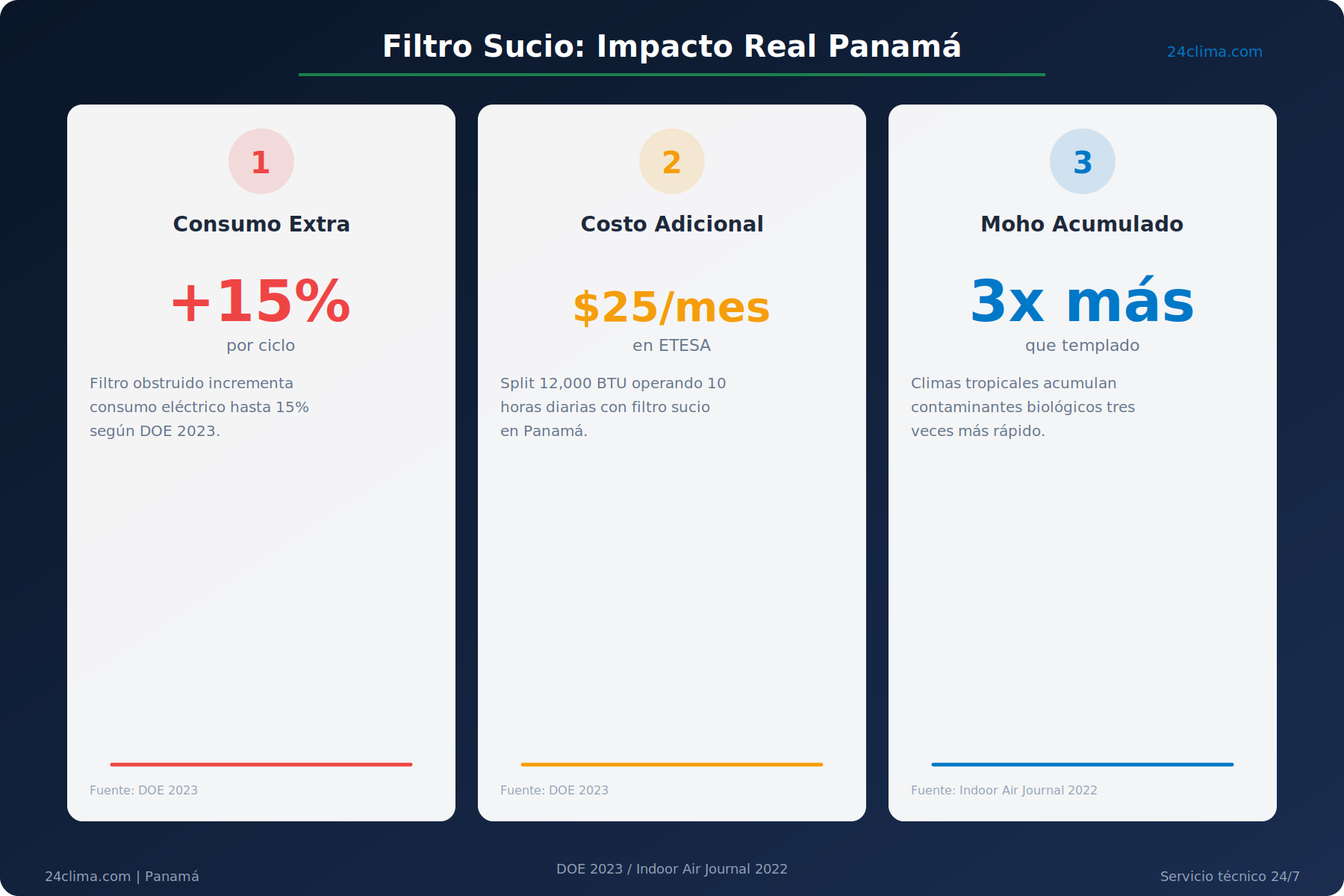
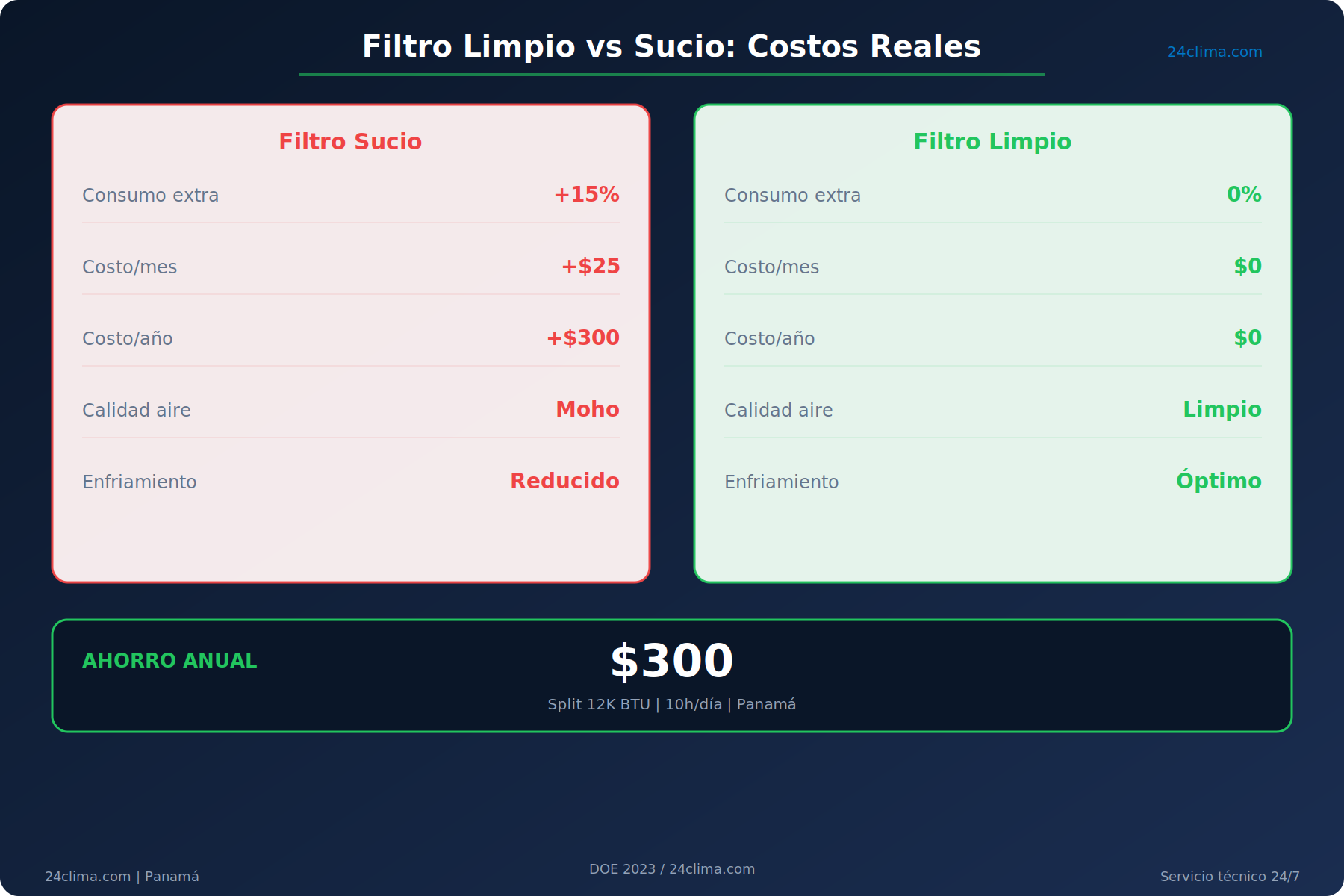
That's not how it works. A dirty filter isn't just reducing your comfort — it's costing you money every single day you leave it alone. According to the U.S. Department of Energy (DOE, 2023), a clogged filter can increase a unit's electricity consumption by 5% to 15% per cycle. In Panama, where a 12,000 BTU split runs an average of 10 hours a day during the dry season, that translates to between $8 and $25 extra per month on your ETESA bill — with zero added cooling to show for it.
Panama makes the problem worse. With relative humidity hovering between 75% and 90% according to IDEAM data, dust doesn't accumulate in your filter alone — it arrives loaded with mold spores. At 88°F (31°C) and high humidity, the evaporator filter becomes an ideal breeding environment. A study published in Indoor Air Journal (2022) found that in tropical climates, split AC filters accumulate biological contaminants up to 3 times faster than in temperate climates. That smell when you first turn on your AC in Panama? That's not just dust. That's active mold being recirculated through your bedroom.
Why Panama's Climate Demands a Different Maintenance Schedule
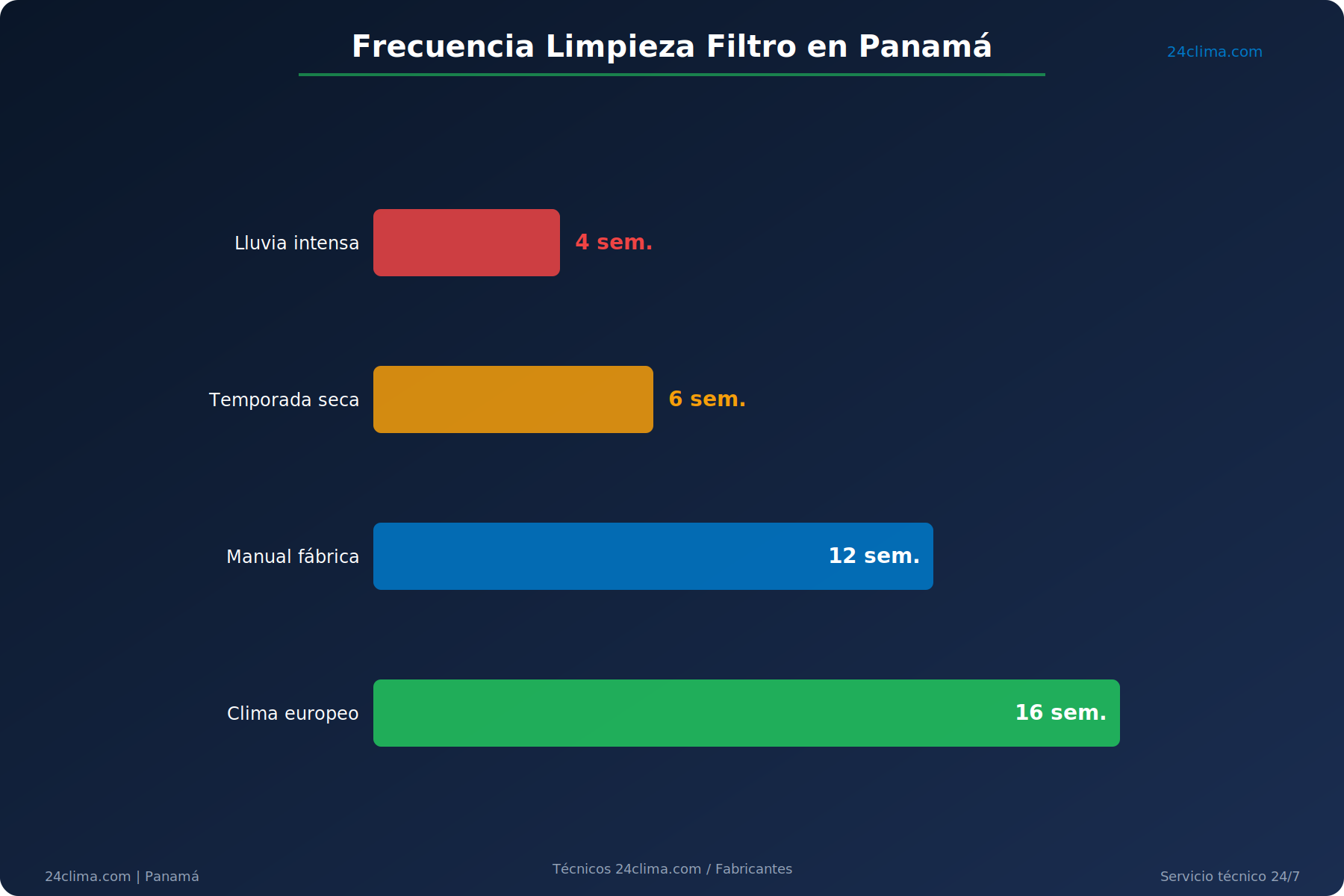
Panama's rainy season runs from May through November. During those months, ambient humidity consistently exceeds 85%. Every cubic foot of air pulled into your evaporator arrives saturated with water vapor, organic particles, and spores. The filter is the first line of defense — and if you're not cleaning it monthly during rainy season, it loses efficiency in weeks, not months.
During dry season (December through April), the problem shifts rather than disappears. Pacific winds carry fine sand particles that get in through windows and doors, and the filter saturates faster than it appears to. In both scenarios, the right cleaning frequency for Panama is significantly higher than what the manufacturer's manual says — because those manuals are written for European or North American climates where humidity sits at 40% to 50%.
A technician with over 10 years of installation experience in San Francisco and Marbella put it plainly: "In Panama, you clean the filter every 4 weeks during rainy season and every 6 weeks in dry season. If someone tells you every 3 months, that advice wasn't written for here."
What You Need Before You Start
Cleaning a split AC from the inside without disassembling it requires basic household tools. You don't need to be a technician. You do need to be methodical.
What you'll need:
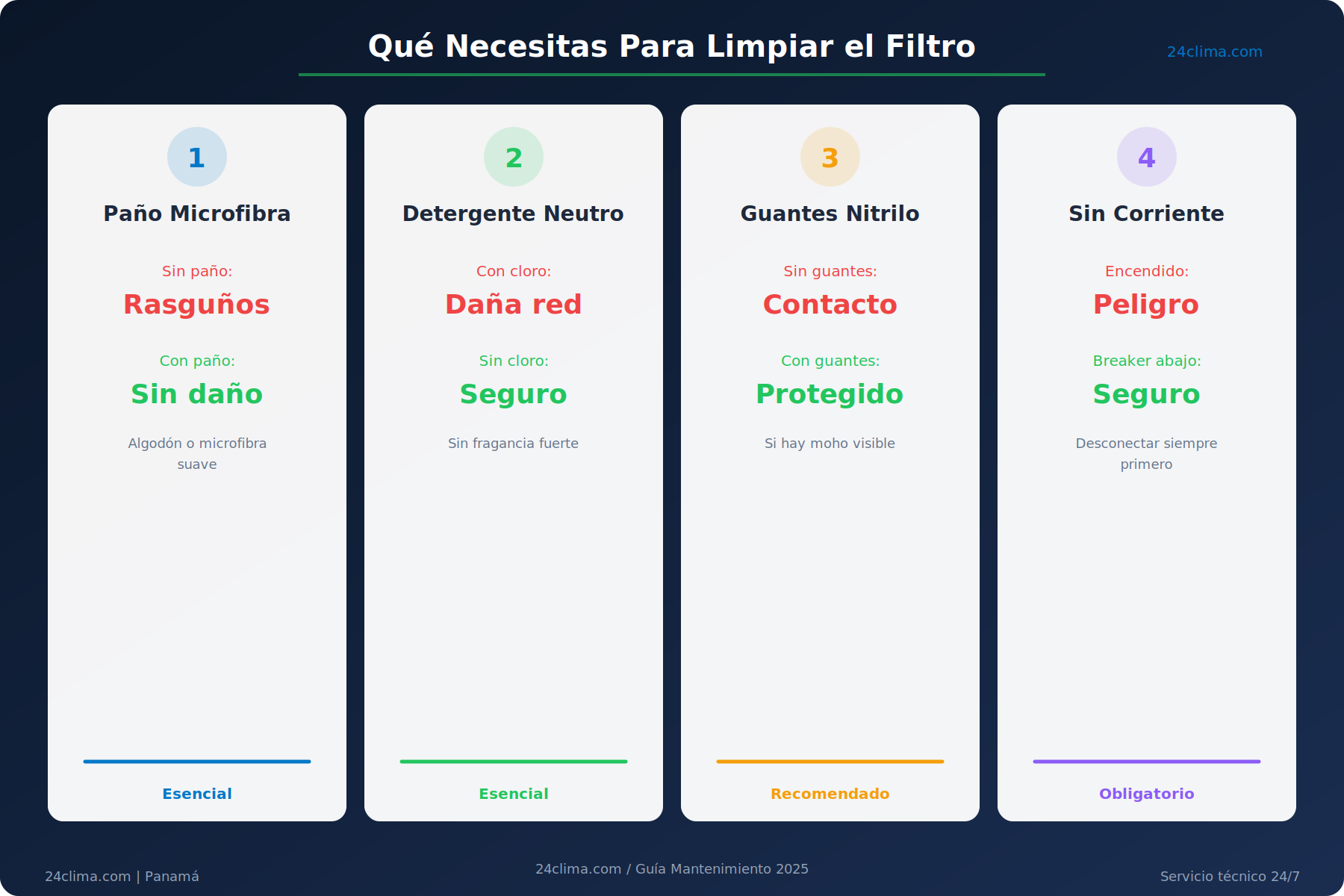
— A soft microfiber cloth (or clean cotton fabric) — A soft-bristle brush (a wide paintbrush or clean kitchen brush works fine) — Warm water — Mild neutral dish soap (fragrance-free, no bleach) — A fin comb if you have one — not required but useful — A small bucket or shallow container — A dry towel to protect the floor and furniture beneath the unit — Nitrile gloves if the filter shows visible mold growth
Before you touch anything, turn the unit off at the remote, then unplug it from the wall or switch off the dedicated circuit breaker. This is not optional. The evaporator contains electrical components and a fan that can activate unexpectedly. Always work with the unit completely de-energized.
Step-by-Step: How to Clean a Split AC Without Disassembling It
This guide applies directly to the most common split models sold in Panama: LG Dual Inverter, Samsung WindFree, Panasonic Nanoe-X, and similar units with a standard hinged front panel. On all of these, you can access the filter and evaporator without any special tools.
Open the front panel
Most splits in Panama have a cover that swings upward when you press gently on both sides. LG and Samsung models have two release tabs on the sides. Lift the panel until it locks into its open position. Behind it, you'll see the mesh filters — typically two rectangular panels, gray or white.
Remove the filters carefully
Slide each filter out along its track. They're lightweight and flexible. If they're heavily soiled, dust will fall when you pull them out — that's what the towel on the floor is for. Take the filters to a sink or utility area. Don't shake them inside the room. You'll send mold particles and dust straight into the air you breathe.
Rinse the filters under running water
Hold each filter under warm running water. Use the soft brush to work out the compacted dust, always moving in the direction of the mesh — never against it, or you'll distort the weave. If you see dark buildup or black spots (mold), mix a small amount of neutral soap into warm water and apply it gently with the brush. Rinse thoroughly until the water runs completely clear.
Let the filters dry completely before reinstalling
This is the step most people skip — and the one that causes the most damage. Reinstalling a damp filter puts moisture directly against the evaporator coil, which accelerates mold growth faster than a dirty filter would have. Let the filters air-dry in a well-ventilated spot away from direct sun, which can warp the mesh. In Panama at 88°F (31°C) with a breeze, they'll be dry in 20 to 30 minutes. If you need them sooner, press gently with a dry cloth — never rub.
Clean the evaporator fins while the filters are out
With the filters removed, you have a clear view of the evaporator — the thin metal fins sitting just behind where the filters were. Using the dry brush, pass gently between the fins from top to bottom to dislodge accumulated dust. If you have a fin comb, use it to straighten any bent fins — damaged fins restrict airflow and cut cooling performance noticeably.
Do not pour water directly onto the evaporator if you don't have technical experience. Water can reach the electrical components inside. A full coil cleaning is a job for a professional AC cleaning service.
Check the condensate drain pan
Beneath the evaporator sits a shallow tray that collects condensation. In Panama's climate, this tray builds up slime, mold, and sediment that cause odors and can block the drain line. Use your damp cloth and brush to clean the edges of the pan as far as you can reach. If you notice standing water that isn't draining, the drain line is likely clogged — a technician will need to diagnose and clear it.
Reinstall the filters and test the unit
Once the filters are completely dry, slide them back into their tracks and close the front panel. Plug the unit back in or flip the breaker on. Turn it on in cooling mode at a normal setting — 75°F to 79°F (24°C to 26°C) — and wait 10 minutes. Clean, neutral air means the process worked. If you still smell humidity or anything burning, shut it down and call a technician.
What Happens If You Skip This — The Real Numbers
A filter left uncleaned for 60 days in Panama's climate can reduce evaporator airflow by up to 40%, according to LG HVAC technical data (Technical Bulletin, 2022). Your unit ends up working twice as hard to deliver half the output. The compressor runs more cycles, runs hotter, and wears out faster.
A quality split installed correctly in Panama should last 12 to 15 years. One with poor maintenance — dirty filters, mold-covered coils, blocked drain pan — can start failing between 5 and 7 years. The cost difference is stark: replacing a 12,000 BTU unit in Panama runs between $450 and $800. Keeping it clean costs you time and a few drops of dish soap.
Common Questions About AC Filter Cleaning in Panama
How often should I clean my AC filter in Panama?
Every 3 to 4 weeks during rainy season (May through November), and every 5 to 6 weeks in dry season (December through April). That's more frequent than manufacturer instructions, because those guidelines are written for climates with 40% to 50% humidity — not the 75% to 90% that's normal in Panama City. If your unit runs more than 8 hours a day, or if you have pets in the home, clean every 3 weeks without exception.
Can I clean the inside of a split AC without taking it apart?
Yes. Everything described in this guide requires no disassembly and no special tools. Opening the front panel gives you access to the filter, the visible evaporator fins, and the drain pan. What you cannot reach without disassembly is the full evaporator coil, the internal blower wheel, and the refrigerant lines — those components need professional service at least once a year.
What actually happens if I skip filter cleaning?
The consequences build gradually. Within the first few weeks, cooling performance drops and your electricity bill rises by 5% to 15%. Within 2 to 3 months without cleaning in Panama's climate, mold colonizes the evaporator coil and begins circulating through your living space. Over time, the compressor runs under constant strain, which can cause permanent damage. The World Health Organization classifies indoor mold as a genuine health risk, linked to respiratory symptoms and allergies — particularly in children and adults with sensitivities.
When to Call a Professional
Back in Costa del Este at 2 in the afternoon, your cleaned split is now blowing actual cold air. Not that lukewarm, stale-smelling drift from before. The room hits 75°F (24°C) in 12 minutes. Your next electricity bill will show the difference.
Cleaning the filter yourself handles your monthly maintenance. But there's a level of cleaning that a brush and some soap can't reach: the blower wheel, the deep coil, the refrigerant charge, the electrical connections. That's a full professional service — and in Panama, qualified technicians recommend it every 6 months for units in heavy use.
At 24Clima, we provide complete AC cleaning and maintenance across Panama City's main neighborhoods, with certified technicians and equipment built for tropical climate conditions. If your unit hasn't been professionally serviced in more than 6 months — or if the smell persists or performance doesn't improve after you clean the filter — contact us on WhatsApp at https://24clima.com/contacto/ We'll point you in the right direction at no cost and schedule a visit whenever works for you.