2 PM in Costa del Este. The sun is hammering the pavement. Thermometer says 33°C (91°F). You walk in sweaty, arms full of groceries, and hit the AC without thinking.
That familiar click. The system starts.
But something's off.
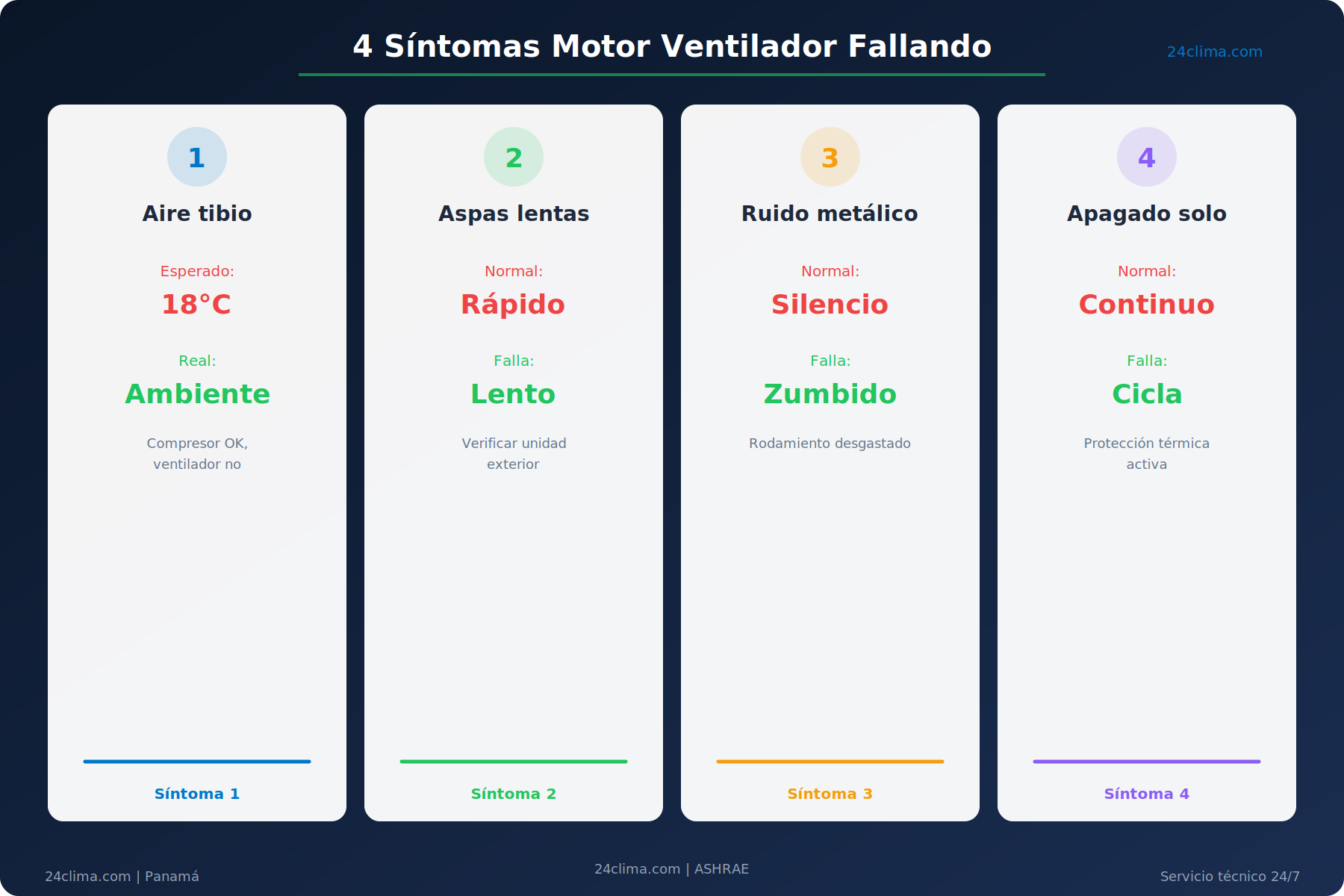
A deep hum, almost metallic. Air coming out, but warm. You hold your hand in front of the split and confirm what you already suspected — it's not cooling like it used to. You drop it to 18°C (64°F) on the remote. Same result. Room-temperature air.
Your first instinct: the refrigerant is gone. That's what almost everyone assumes. But after years of service calls across Panama, where humidity stays above 85% for most of the year, I can tell you the most common reason an AC loses cooling capacity isn't the refrigerant. It's the fan motor.
What Most People Believe (And Why They're Wrong)
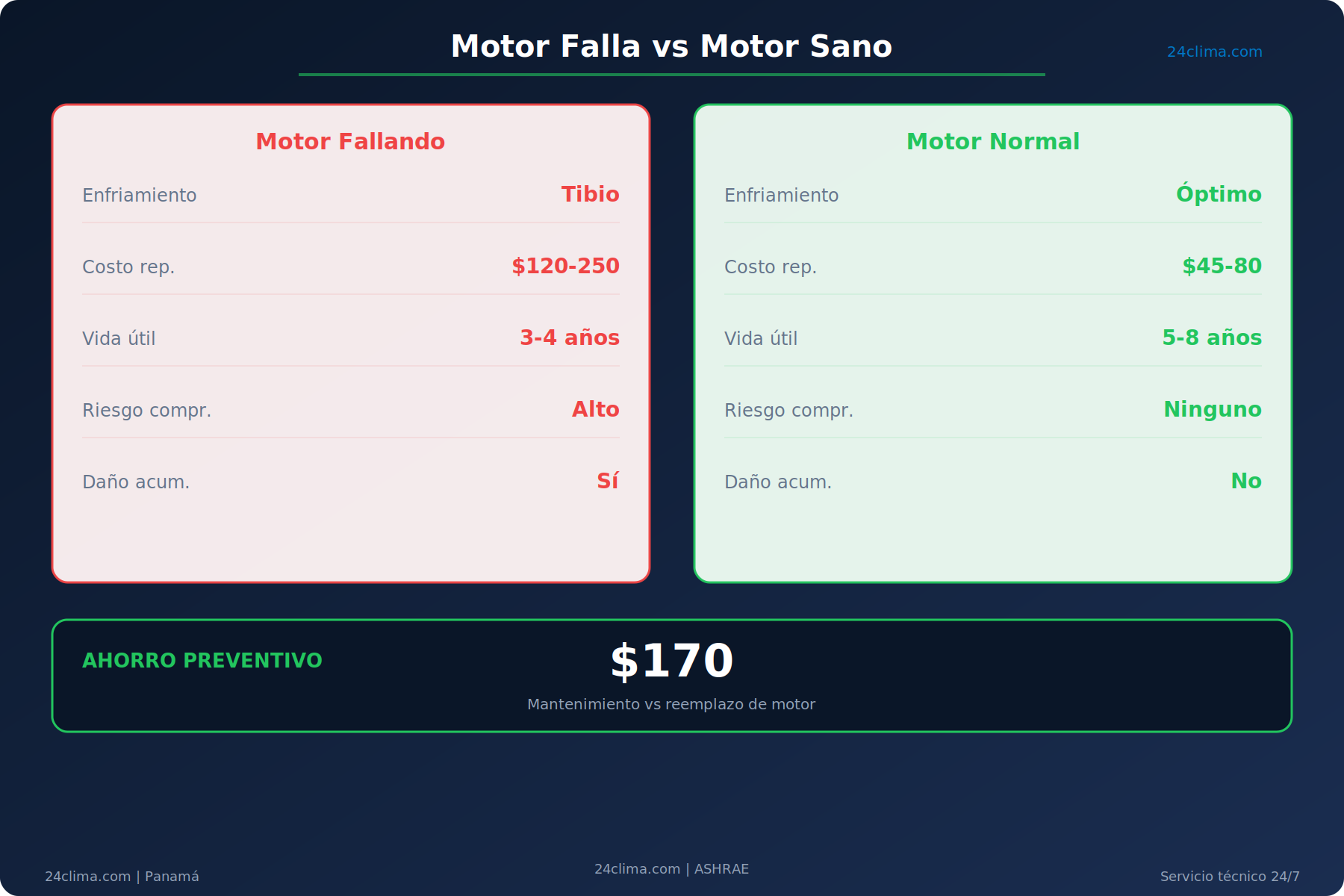
When an air conditioner stops cooling properly, 90% of homeowners point to the same suspect: the gas. "It ran out of freon" is the standard assumption here — as if refrigerant gets consumed like propane in a grill. That assumption leads hundreds of owners every year to pay for refrigerant recharges that fix nothing, because the system already has plenty of gas. What's actually failing is the component that moves air across the coils where heat exchange happens.
The fan motor forces air circulation over the evaporator (indoor unit) and the condenser (outdoor unit). Without that airflow, the refrigeration cycle breaks down even if the compressor is running perfectly and the refrigerant level is correct. The unit runs, draws electricity, doesn't cool. And the longer it operates that way, the more damage it does to the compressor — the most expensive component in the system.
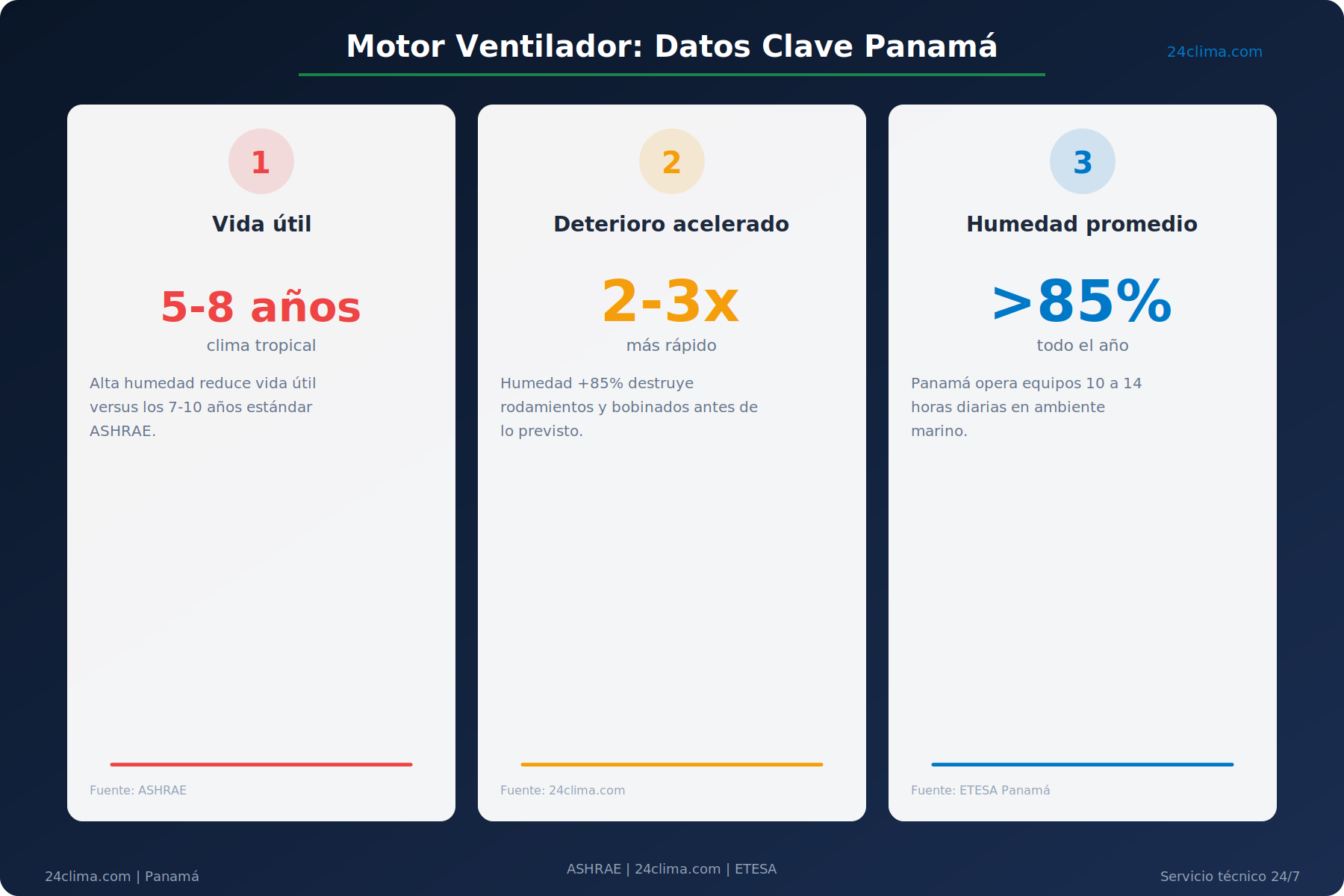
Panama's tropical climate chews through fan motors two to three times faster than dry climates do. Constant humidity, fine salt-laden dust in coastal areas like Punta Pacífica and San Francisco, and 10 to 14 hours of daily operation create ideal conditions for accelerated wear on bearings, windings, and the motor shaft.
You can find more on this type of failure and others in our guides and maintenance tips at 24clima.com.
How Your AC Fan Motor Actually Works — No Technical Runaround
The fan motor in a residential split system performs two distinct jobs in two separate locations. In the indoor unit, it spins a turbine-style blower — also called a squirrel cage fan — that pulls warm room air across the evaporator coil, where refrigerant absorbs the heat. In the outdoor unit, it spins a propeller blade that pushes the absorbed heat out into the surrounding air.
If either motor starts failing partially, performance drops. If one fails completely, the compressor faces a thermal emergency and can burn out within minutes.
According to the American Society of Heating, Refrigerating and Air-Conditioning Engineers (ASHRAE), fan motors in residential units in tropical climates average 7 to 10 years under normal operation. In high-humidity, heavy-use conditions like those in Panama, that range drops to 5 to 8 years. A motor running dirty, with worn bearings or unstable voltage, can fail in as little as 3 to 4 years.
The Clearest Signs Your Fan Motor Is Failing
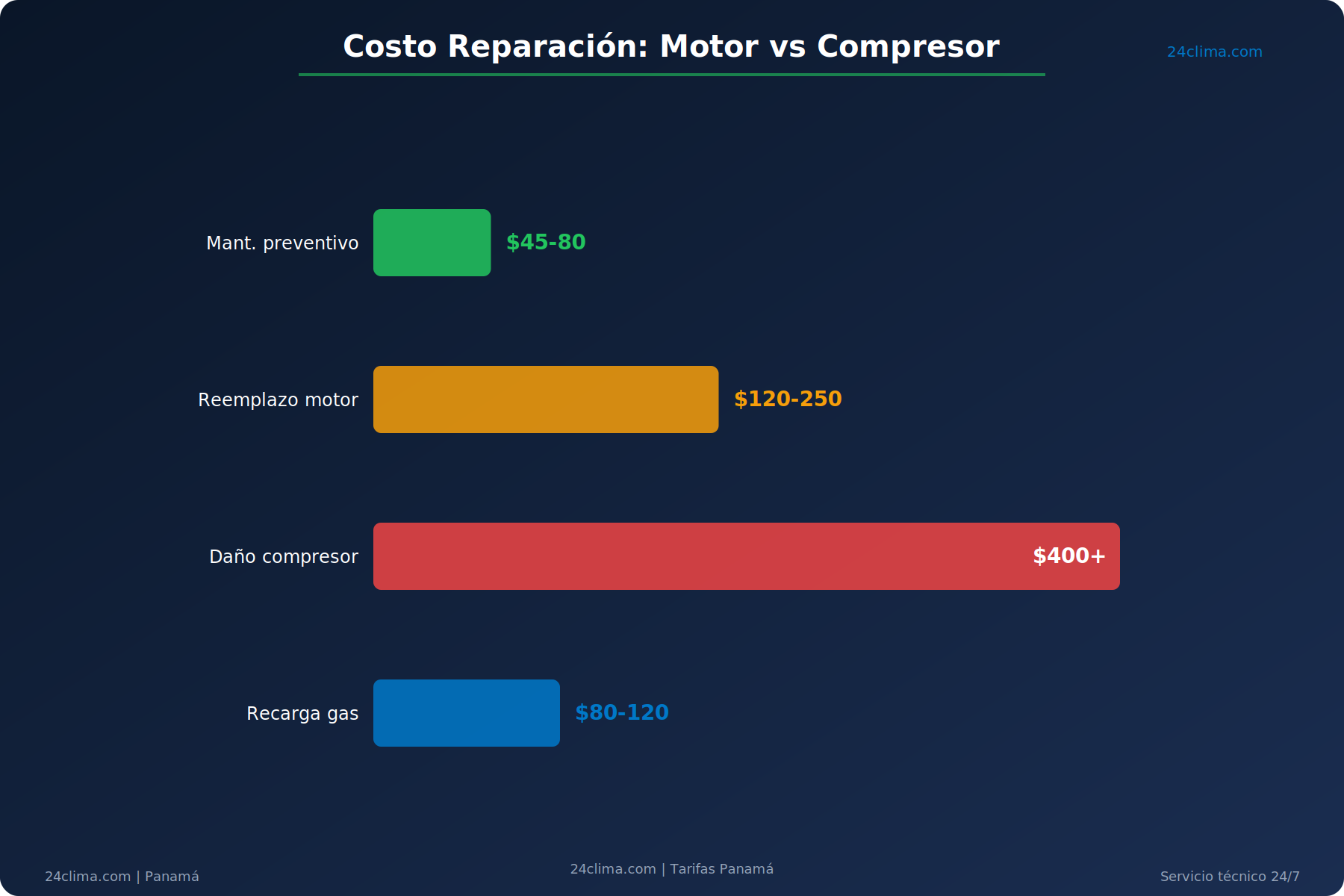
A fan motor rarely dies all at once. It almost always gives warning signs for days or weeks before complete failure. Catching those signs early can be the difference between a preventive maintenance visit at $45 to $80 and a full motor replacement ranging from $120 to $250.
These are the symptoms I see most often, ranked by frequency:
The AC turns on but doesn't cool, even though the compressor starts. If you can hear the compressor running — that deep hum from the outdoor unit — but warm air is coming out of the split, the evaporator fan may not be spinning at the right speed, or not spinning at all.
The outdoor unit fan isn't spinning, or is spinning very slowly. Check this visually from a safe distance. With the unit running in cooling mode, the condenser blades should be spinning fast and steadily. Sluggish, stopping and starting, or completely still means the motor is failing.
Unusual noises — repetitive clicking, metallic humming, heavy vibration. A worn bearing produces a metallic scraping sound. A bent shaft causes uneven vibration. A defective winding generates an electrical buzz distinctly different from the unit's normal operating sound.
The unit shuts itself off after a few minutes. Most modern systems have thermal protection built into the compressor. If the condenser fan isn't working, the compressor overheats and the system shuts down for safety. Then it starts again, runs a few minutes, shuts off again. That cycle repeating is a red flag.
The indoor unit is pushing less airflow than normal. If the indoor fan loses speed, the airflow feels weak even with the temperature set low. Hold your hand in front of the vents — if the stream feels reduced, the evaporator motor is losing power.
Safe DIY Diagnostics: What You Can Check Without Risk
You don't need electrical training to do visual and behavioral checks. These steps are safe and require no special tools.
Watch the outdoor unit with the system running in cooling mode. Stand about three feet away. The blades should spin continuously and evenly. If they don't spin, or move irregularly, note when it happens and how often.
Check the air temperature coming out of the outdoor unit. Hold your hand about eight inches above the top vent — you should feel hot air pushing out with force. If it feels barely above ambient, the condenser isn't releasing heat properly, which points to fan failure.
Listen during startup. In the first 10 seconds after turning the unit on, pay attention. A healthy motor starts without hesitation. A motor with a damaged bearing may take a moment to reach speed, or produce a repetitive click while trying to start.
Look for visible dust buildup on the indoor unit's fan blades. When the indoor blower is coated in damp dust, the imbalance causes vibration that accelerates motor wear. Open the front panel of the split and take a look.
Track how often the unit shuts off automatically. Cycling off more than twice an hour on a typical hot day is active thermal protection working overtime — not a coincidence.
One important boundary: don't try to manually spin the blades with the unit powered on, don't open the outdoor unit's electrical box, and don't disconnect capacitors without technical knowledge. Start-up capacitors store electrical charge that can deliver a serious shock even after the unit is turned off.
Repair vs. Replace: The Real Numbers in Panama
The decision between repairing the existing motor or replacing the unit comes down to three factors: the age of the unit, the cost of the part, and whether the compressor has already sustained secondary damage from running with a failing fan.
In the Panama market as of 2025, here's what fan motor work actually costs:
— Preventive maintenance with fan cleaning and motor inspection: $45 to $80 — Start capacitor replacement (a frequent cause of fan failure): $35 to $65 including labor — Evaporator fan motor replacement (indoor unit): $90 to $160 depending on brand and model — Condenser fan motor replacement (outdoor unit): $120 to $250 including blades and labor — Full unit replacement if the compressor has sustained damage: $600 to $1,800 depending on BTU capacity
The number that should make every owner take action early: according to the Electric Power Research Institute (EPRI), a compressor running without the condenser fan can sustain irreversible damage in just 15 to 30 minutes of continuous operation. Ignoring the symptom can cost ten times what fixing it early would have.
If your unit is more than 10 years old and the condenser motor fails, a straight conversation has to include comparing total replacement cost against the remaining value of the equipment. Any technician who skips that conversation isn't working in your interest.
Our AC maintenance service includes fan motor inspection, blade cleaning, and capacitor verification as part of the standard protocol.
How Preventive Maintenance Prevents This Failure
Fan motors in Panama fail ahead of schedule for the same reason, almost every time: the fan has been spinning for months with a layer of damp dust stuck to the blades. At 85% humidity, that dust becomes paste. It unbalances the blades, increases vibration, raises the motor's operating temperature, and destroys the bearings prematurely.
A study published in the International Journal of Refrigeration (2021) found that evaporator fans that don't receive cleaning every 6 months in tropical climates accumulate a biofilm and dust layer that reduces airflow by up to 35%, forcing the motor to draw higher amperage to compensate. That added effort raises the motor's internal temperature 8°C to 12°C (14°F to 22°F) above its design range — exponentially shortening the winding's lifespan.
Cleaning the indoor blower is the most effective and affordable thing you can do to extend motor life. Every 6 months for standard residential use. Every 3 to 4 months if your unit is in a coastal area like Balboa or Casco Antiguo, or in a high-traffic space with significant dust exposure.
Frequently Asked Questions About Your AC Fan Motor
How do I know if my AC fan motor is damaged?
The most direct sign is a unit that powers on — compressor running — but delivers warm air or weak airflow. If the outdoor unit isn't pushing hot air out forcefully, or the outdoor fan blades aren't spinning while the system is in cooling mode, the condenser motor is failing. Metallic sounds, excessive vibration, and frequent automatic shutoffs confirm it.
How much does it cost to replace an AC fan motor in Panama?
It depends on which motor needs replacing. The evaporator motor (indoor unit) runs $90 to $160. The condenser motor (outdoor unit) typically runs $120 to $250, including labor. Before any motor replacement, a technician should check the start capacitor first — that's often the actual cause and costs only $35 to $65 to fix. Always ask for a written diagnosis before approving any work.
Can I clean my AC fan myself without taking anything apart?
Yes, within limits. You can clean the visible indoor blower blades by opening the front panel of the split and using a soft brush and damp cloth on the accessible surfaces. A no-rinse AC foam cleaner also works well for surface cleaning. A thorough cleaning of the squirrel cage blower requires disassembly, though — and that job should be done by an experienced technician to avoid damaging the bearings or drain assembly. Professional indoor unit cleaning in Panama runs $45 to $80 and covers the parts you simply can't reach from the outside.
Back to that sweltering afternoon in Costa del Este. This time, before you call a technician to "add more gas," you know exactly what to ask: Did you check the fan motor? The start capacitor? The airflow at the outdoor unit? Those three questions change the entire conversation — and protect your wallet.
The fan motor isn't the most expensive part in your AC. It's the one that causes the most failures due to neglected maintenance in Panama's climate. Catching it early, before it takes out the compressor, is the difference between an $80 service call and a $1,500 repair. At 24Clima, we inspect the fan motor as part of every visit, at no additional charge for the inspection. If you've noticed any of the symptoms described here, contact us on WhatsApp and we'll schedule a technical visit in your area.