AC Maintenance in Panama — How Often Do You Really Need It?
It's 2 in the afternoon in El Cangrejo. The asphalt is throwing heat like a mirror. You walk into your apartment, hit the remote for the living room split, and wait for that wall of cold air that saves you every single day. But today the air comes out warm. Humid. With a smell that wasn't there last week.
You check the remote. Set to 64°F (18°C). Everything looks fine. Twenty minutes later the room is still at 81°F (27°C). Your AC is running — it's just not cooling. And the worst part? This didn't happen suddenly. It crept up over months, while you waited for something to actually break before calling a technician.
That's exactly the mistake that costs Panama homeowners the most money.
What Most People Believe — And Why They're Wrong
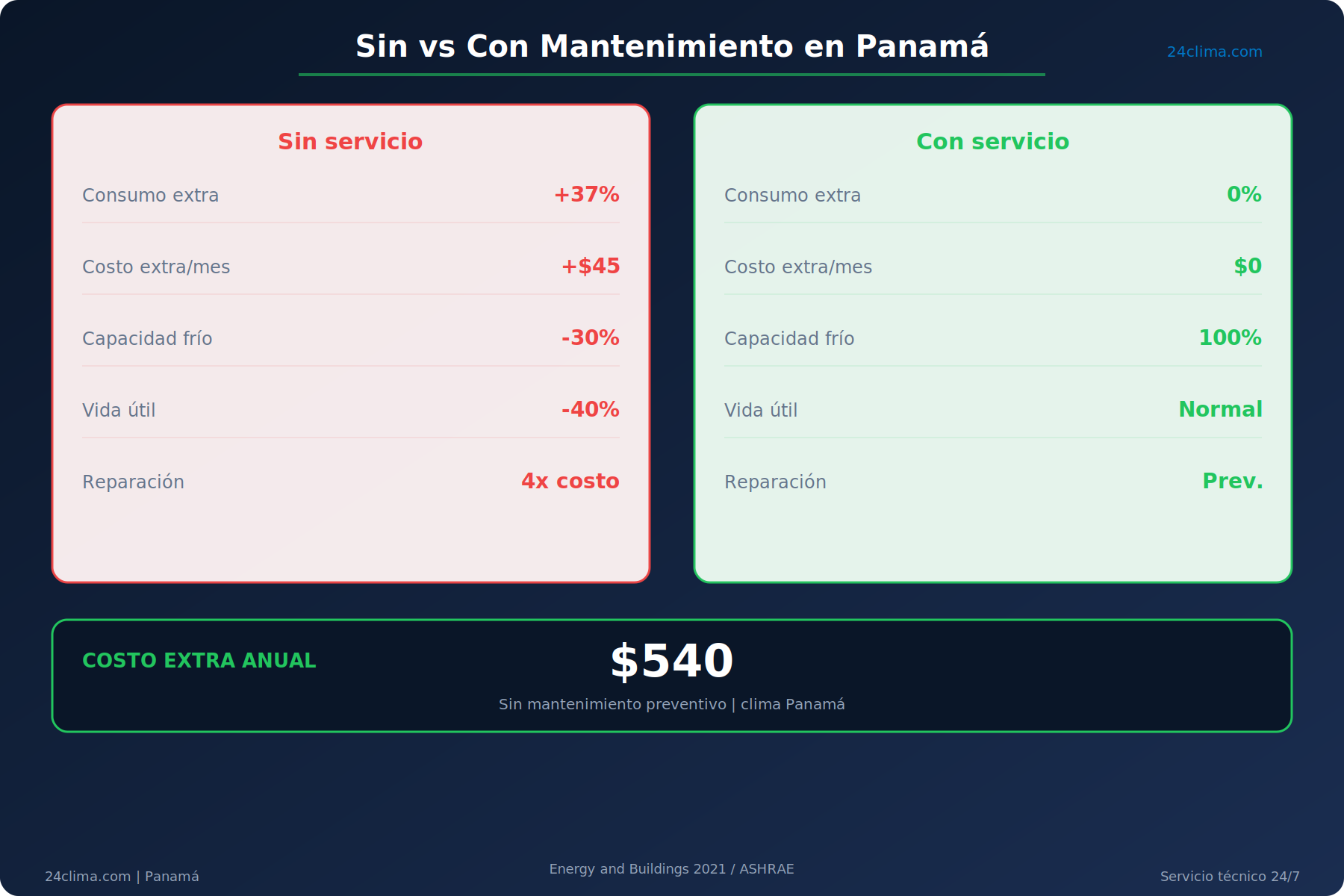
The most common assumption goes like this: "If the AC is blowing cold, it's fine." Whether you're in a Punta Pacífica high-rise or a house in Clayton or Miraflores, most people only call a technician when the unit stops working completely. By that point, there's already damage. The repair bill runs three or four times what routine maintenance would have cost.
The technical reality is different. An air conditioner can lose between 20% and 30% of its cooling efficiency without showing any obvious signs of failure. A study published in Energy and Buildings (2021) found that AC systems with dirty evaporator coils consume between 15% and 37% more electricity than clean systems — same level of cooling comfort, but at a much higher energy cost. In Panama, where electricity bills already hurt, that difference can mean $25 to $45 extra per month that nobody notices until the ENSA bill arrives.
And in Panama's climate, that deterioration happens two to three times faster than in temperate climates. There is no off-season here. Air conditioners in Panama run between 10 and 18 hours a day, year-round, with outdoor temperatures sitting between 86°F and 91°F (30°C–33°C) and relative humidity ranging from 80% to 90%. Those conditions aren't neutral for a refrigeration system. They're brutal. For more technical guides on AC operation and upkeep, check out our consejos y guías at 24clima.com.
Why Panama's Climate Demands More Frequent Service — Not Less
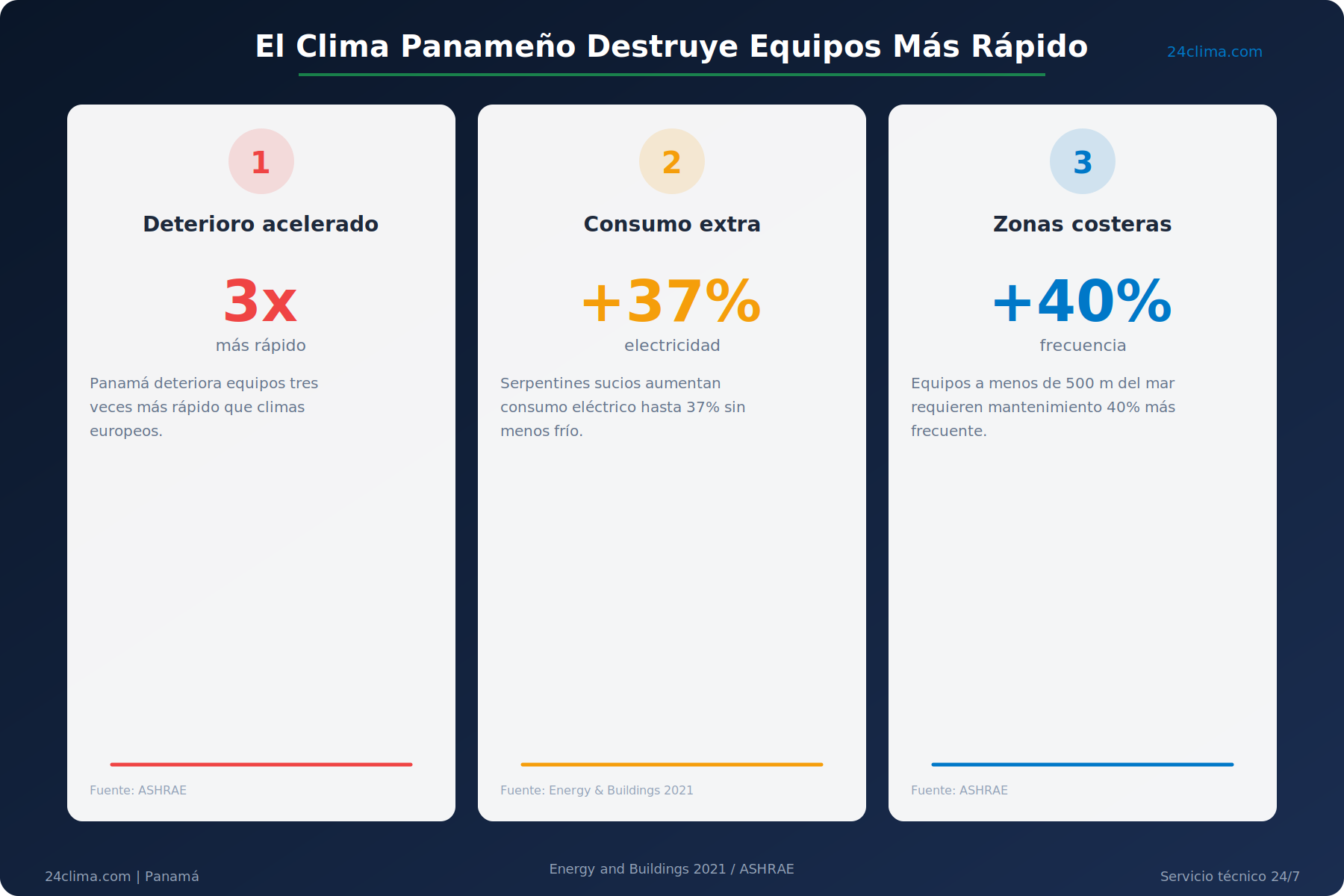
In Panama, the combination of constant humidity, urban dust, and relentless heat causes AC components to accumulate contaminants three times faster than in European or northern climates. A unit that goes 12 months without service in Panama City has effectively gone 36 months without service by New York standards.
The filters on a standard residential split, left uncleaned, build up a layer of dust, mold, and organic particles that acts as insulation over the evaporator coil. This blocks heat exchange. The compressor works harder. The refrigerant never reaches the right pressure. The unit burns more electricity to produce less cooling. After 18 to 24 months without service, it starts losing refrigerant through accelerated wear at the fittings — because the compressor has been chronically overloaded.
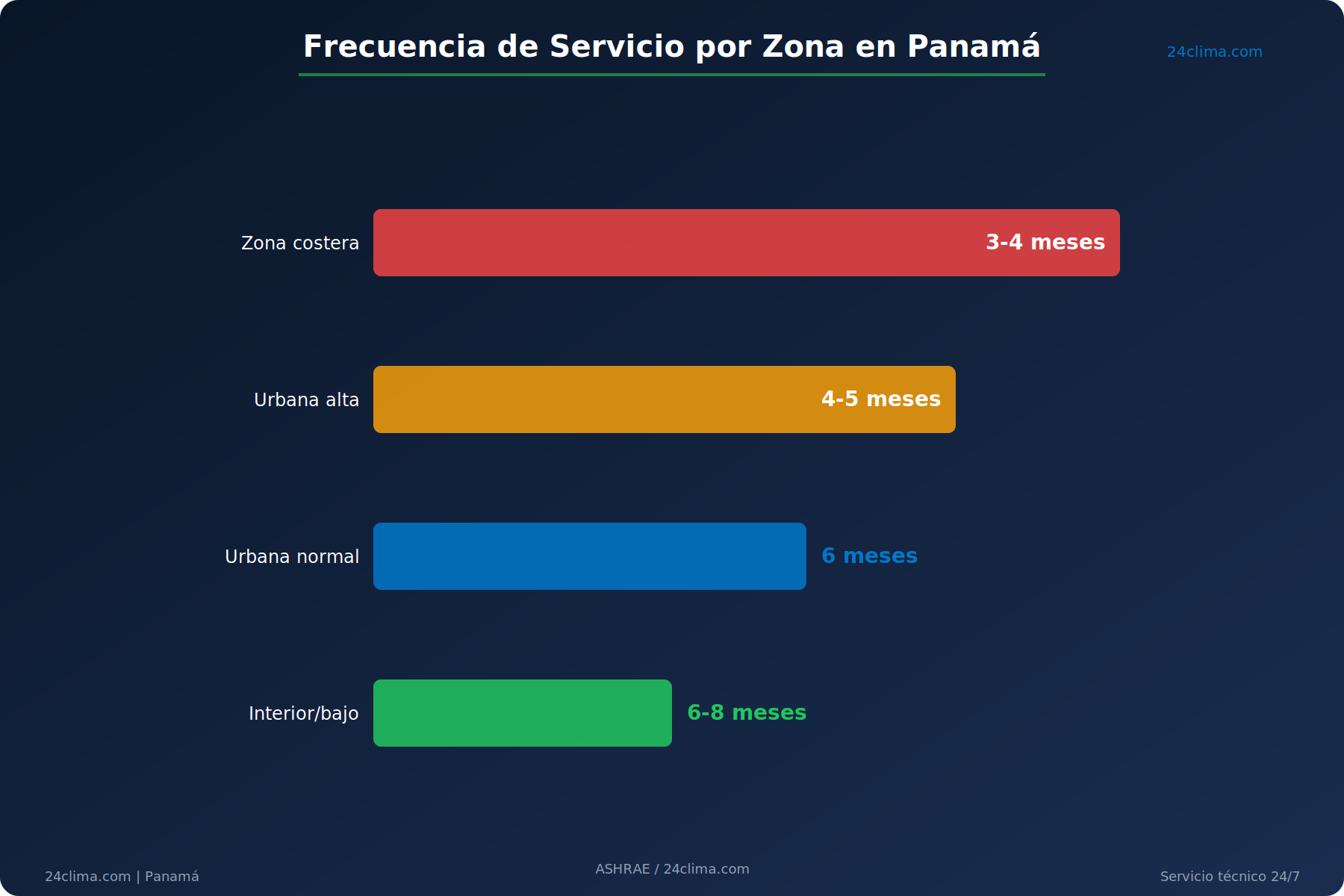
In coastal neighborhoods like Punta Pacífica, Amador, or Casco Viejo, there's an additional factor: salt air. Sodium chloride particles carried by the Pacific Ocean breeze settle on the outdoor condenser fins and accelerate the oxidation of copper and aluminum. According to ASHRAE data, units installed within 500 meters of the coast require condenser maintenance up to 40% more frequently than units in inland areas. If you live oceanfront in Punta Pacífica, your unit cannot wait a year between services. Every four to six months is the real interval.
The Right Frequency — A Real Maintenance Calendar for Panama
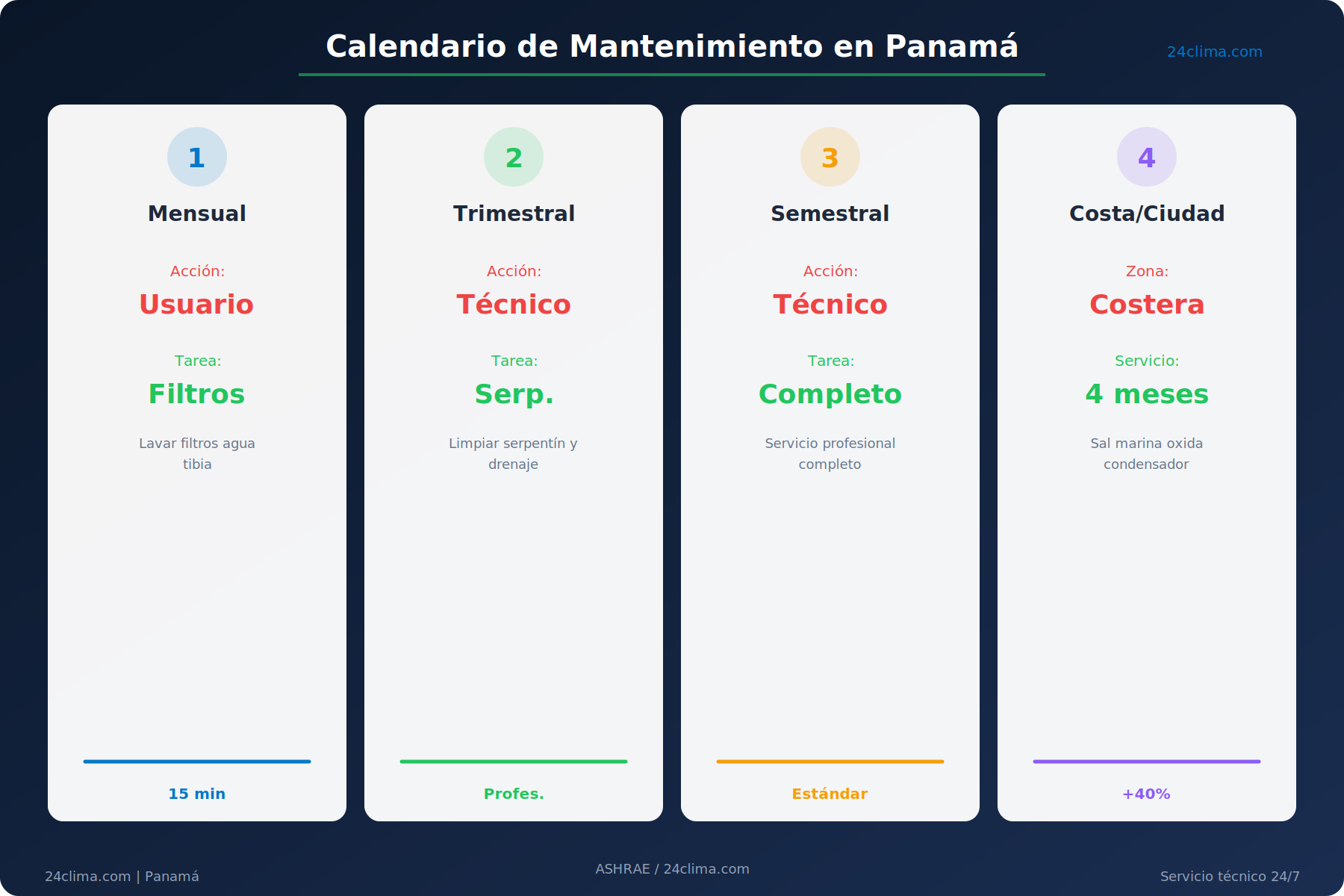
The correct standard for Panama is monthly filter cleaning by the user, coil inspection every three months, and full professional service every six months. In coastal areas or high urban pollution zones, professional service should be quarterly.
Here's what that looks like in practice:
Monthly — Filter cleaning (you do this yourself)
Pull out the evaporator filters, wash them with warm water and mild dish soap, let them dry completely before reinserting. Fifteen minutes, no tools. If the filters are heavily clogged after just one month, that's a signal your unit is working in a high-dust environment and may need more frequent professional service.
Every three months — Coil and drain inspection
The evaporator coil — the aluminum-finned copper tubing inside the indoor unit — accumulates mold and biofilm fast in Panama's humidity. Cleaning it means opening the front panel, applying coil-specific foam, and clearing the drainage system to prevent water overflow. If you're not comfortable doing this yourself, it belongs to a technician. Our servicio de limpieza profesional covers exactly this procedure.
Every six months — Full professional service
This includes deep cleaning of both evaporator and condenser, refrigerant pressure check, electrical inspection of capacitors and contactors, fan lubrication, condensate tray cleaning, and a full-load functional test. In coastal areas like Amador or Casco Antiguo, that interval drops to every four months because of salt corrosion.
In high-traffic neighborhoods like El Cangrejo, Miraflores, or along Avenida Balboa, fine carbon particles from vehicle exhaust deposit rapidly on coils. Our technicians have pulled units apart after just eight months of service and found dirt layers up to 3mm thick on the coils — in units the owners considered "fine."
What's Happening Inside — Clean Coil vs. Dirty Coil
A clean evaporator has bright aluminum fins, properly separated, with free airflow between them. A dirty evaporator has those same fins covered in a gray-green layer of compacted dust and biological biofilm that acts as a thermal barrier — reducing heat transfer by up to 35%.
When a technician opens your split after a year without service in Panama City, here's what they typically find:
— Aluminum fins partially crushed under the pressure of accumulated buildup — Black or green mold on the coil surface (Aspergillus and Cladosporium are the most common species in humid tropical environments) — A condensate tray full of black slime and stagnant water — the direct source of that smell coming through your vents — Partially blocked drainage causing water to drip inside your wall or ceiling
A unit serviced every six months tells a different story: clean fins, unrestricted airflow, and a discharge temperature between 55°F and 61°F (13°C–16°C) under normal operating conditions. That temperature difference isn't cosmetic. It's the difference between a unit that cools properly and one burning 30% more electricity without ever reaching your target temperature.
The Cost of Maintenance vs. the Cost of Neglect — Real Numbers
A professional maintenance visit in Panama costs between $60 and $120 per unit. Skip that service for two years and you're looking at repair costs of $200 to $800, refrigerant recharge fees of $80 to $150 per fill, and cumulative extra electricity charges the whole time the unit was running dirty.
Here's the real comparison:
Proper maintenance over 12 months: — 2 full professional services: $120 to $240 — Electricity savings vs. a dirty unit: $25 to $45/month x 12 = $300 to $540 per year — Expected equipment lifespan: 12 to 15 years
No maintenance over 12 to 24 months: — Cumulative extra electricity cost: $300 to $540 in year one alone — Risk of refrigerant loss from overloaded compressor: $80 to $150 — Risk of capacitor or compressor failure: $150 to $600 — Reduced equipment lifespan: 6 to 8 years
According to data from the Air Conditioning Contractors of America (ACCA, 2022), units on regular preventive maintenance schedules experience premature failure at a rate 73% lower than units without scheduled service. In Panama, where units run almost continuously, that number is likely conservative.
Preventive maintenance isn't an expense. It's the cost of not paying far more later.
Can I Clean My AC Myself?
Yes — the monthly filter cleaning is something any homeowner can do without tools or technical knowledge. Pull the filters, wash with soap and water, dry them fully, put them back. That step alone makes a real difference.
Cleaning the evaporator coil, the outdoor condenser, and the drainage system is a different matter. Those require specific tools and technical knowledge. Refrigerant handling is legally restricted to certified technicians in Panama. Attempting to clean the evaporator coil without experience can bend the aluminum fins or push water into electrical components — turning a $90 service call into a $400 repair.
Frequently Asked Questions
How often should you service an AC unit in Panama?
Professional service every six months for most homes, and every three to four months if the unit is in a coastal location — Punta Pacífica, Amador, Veracruz — or a high-pollution urban area like El Cangrejo, Miraflores, or Avenida Balboa. Users should also clean filters manually every month. This is more frequent than recommendations for temperate climates because Panama's permanent heat and humidity accelerate both dirt accumulation and component wear at a rate that simply doesn't apply elsewhere.
What happens if you skip AC maintenance in Panama?
The unit loses efficiency progressively — consuming between 15% and 37% more electricity while producing less cooling. The compressor runs under chronic overload, accelerating internal wear. Within 18 to 24 months, refrigerant loss, capacitor failure, or full compressor failure become likely outcomes, with compressor replacement alone running $300 to $600. On top of that, mold buildup on the evaporator turns the unit into an active source of indoor air contamination.
Can I clean my own AC or do I need a technician?
Monthly filter cleaning is something any user can handle without tools or training. Everything beyond the filter — the evaporator coil, outdoor condenser, and drainage system — requires a technician. Attempting to clean the coil without experience risks physically damaging the fins or introducing water into electrical components. Refrigerant handling is legally restricted to certified technicians in Panama.
A Unit That Works Well Is One That Can Breathe
Go back to that El Cangrejo apartment at the start of this article. The difference between that warm, stale air and the clean cold you're waiting for has nothing to do with the brand on the remote or the model number on the unit. It's about what's inside that coil — and whether anyone opened that front panel in the last six months, or whether it's been sitting untouched for two years.
At 24Clima, we carry out full preventive maintenance visits covering evaporator and condenser cleaning, drain clearing, refrigerant pressure checks, and electrical system inspection — calibrated for the specific conditions of each zone in Panama. If you can't remember when your unit was last serviced, it's probably time. Contáctanos por WhatsApp at 24clima.com/contacto/ and we'll tell you exactly what your unit needs before your ENSA bill tells you first.
Last updated: May 2025