AC Modes — Which One to Use in Panama and When (and Why Almost Everyone Gets It Wrong)
Last updated: June 2025
It's 2 PM in Costa del Este. The sun is coming straight down on the asphalt, the thermometer reads 33°C (91°F), and humidity is at 88%. You walk into your apartment, grab the remote, and hit the first button you find: Cool mode. The unit kicks on, the room drops to 22°C (72°F) in twenty minutes — and you still feel sticky. Your clothes won't dry. The air feels heavy. Then the electricity bill arrives and you start wondering if your AC is broken.
It's not broken. You picked the wrong mode for the conditions outside.
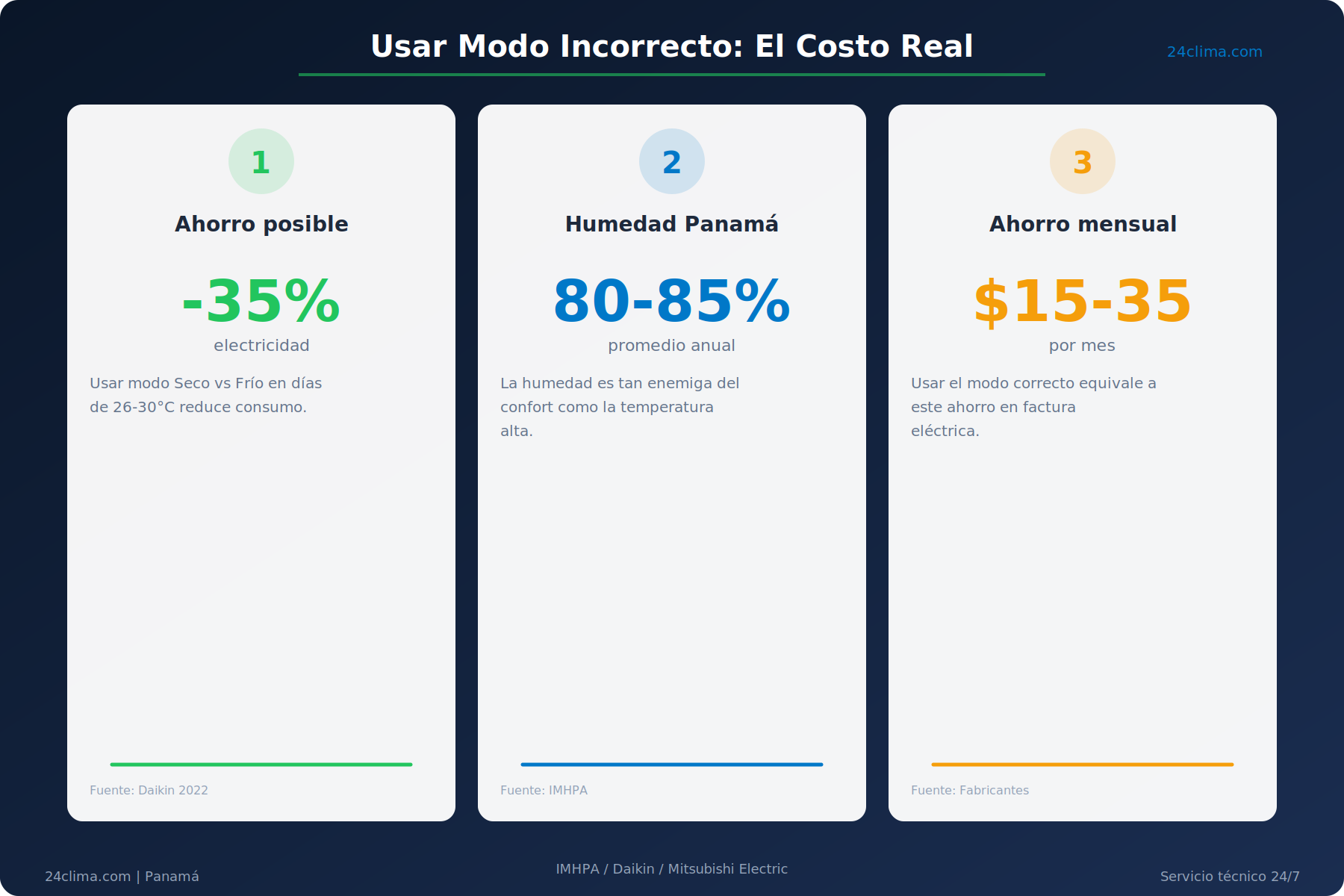
In Panama, where annual average relative humidity sits between 80–85% according to the Institute of Meteorology and Hydrology (IMHPA), temperature is not your only enemy. Humidity is just as bad — sometimes worse. The modes on your AC remote are not interchangeable: each one attacks a different problem. Using them without any strategy is like taking the wrong medication for the right illness. For more on how tropical climate affects your equipment, check out the guides and tips section at 24clima.com.
What Almost Everyone Does Wrong With the Remote
Most people in Panama operate their AC in exactly one mode: Cool, all the time, at the lowest temperature possible. The logic seems solid — "it's hot, so I cool it down." But comfort doesn't depend on temperature alone. It depends on the combination of temperature and humidity. At 75°F (24°C) with 90% humidity you feel worse than at 81°F (27°C) with 55%.
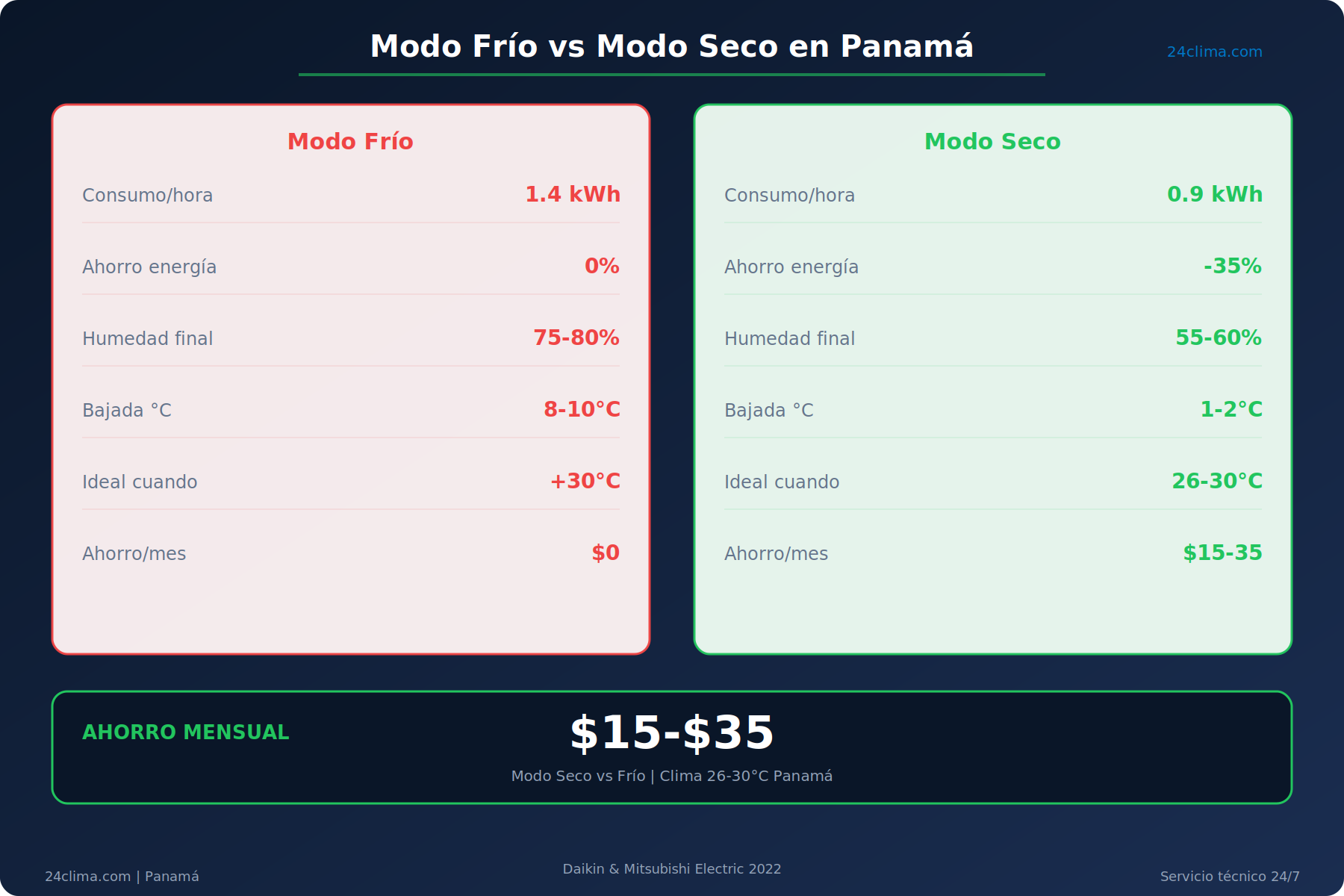
Running Cool mode all day creates three problems at once: your electricity bill climbs higher than it needs to, the room can still feel humid anyway, and the unit runs long cycles that wear down the compressor faster. Comparative data from Daikin and Mitsubishi Electric for tropical climates shows that matching the mode to actual conditions cuts electricity consumption by 20% to 35% — with no sacrifice in comfort.
Your remote has between four and six modes. Each one exists for a specific technical reason. Here's what each one actually does, when to use it given Panama's real climate, and what that means for your bill and your body.
The Five Modes on Your AC Unit — and What Each One Actually Does
Cool Mode — the workhorse, but not for every situation
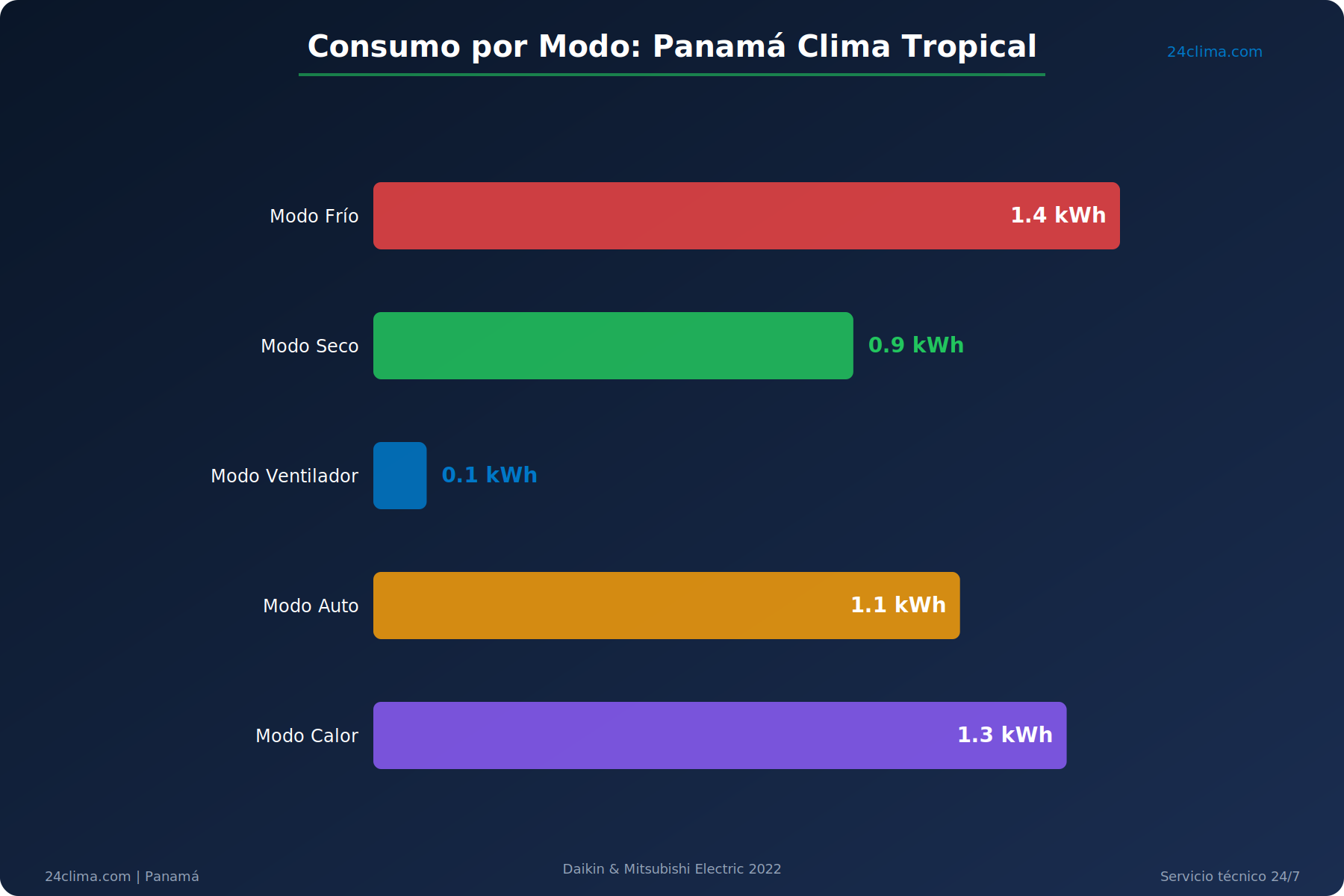
Cool mode activates the full refrigeration cycle: the compressor runs continuously, refrigerant circulates between the evaporator and condenser, and the unit extracts heat from the room until it hits the programmed temperature. This is the highest power-consumption mode. A 12,000 BTU unit in Cool mode draws between 1.0 and 1.4 kWh per hour depending on its SEER rating.
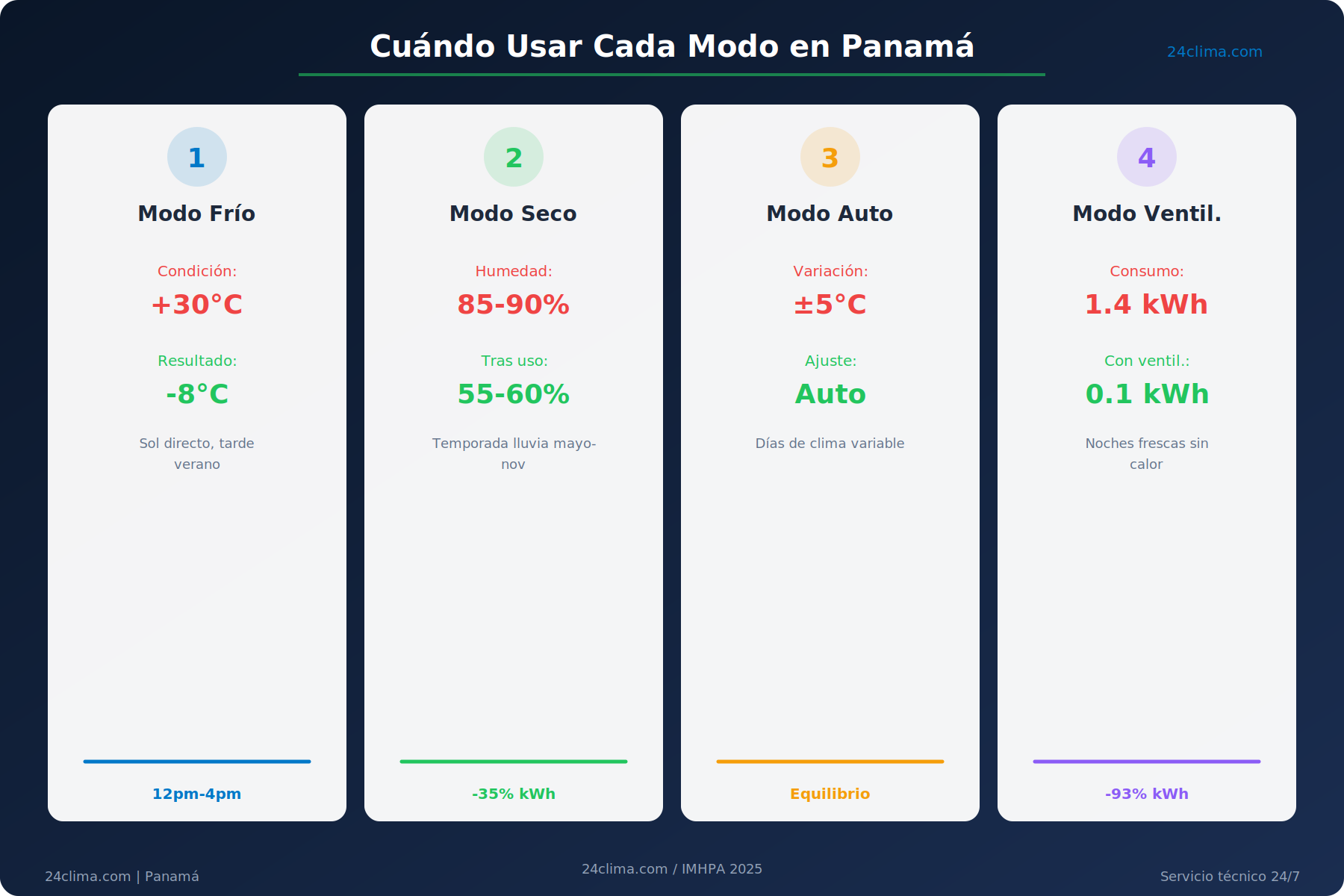
This is the right call when outdoor temperatures exceed 30°C (86°F) and the heat load inside is high — direct sun on the windows, multiple people in the space, electronics running. In Costa del Este or Punta Pacífica between noon and 4 PM during the dry season, Cool mode is the correct answer.
What most people miss: Cool mode does dehumidify as a side effect. When the evaporator cools air below the dew point, water vapor condenses and drains away. But on days when the outdoor temperature is manageable — 80–84°F (27–29°C) — and humidity is sitting at 90%, Cool mode will over-cool the room and burn unnecessary energy just to dehumidify it. That's where the next mode comes in.
Dry Mode — the mode Panama needs more than it uses
Dry mode, the water droplet icon on your remote, is probably the most underused mode in Panama and the most valuable one during rainy season (May through November). Its job is not to cool — it's to dehumidify.
Here's what happens technically: the compressor runs in short, intermittent cycles. The indoor fan drops to low speed, so air passes slowly over the cold coil. That slow contact pulls more moisture per cubic meter of air than Cool mode does, where air moves fast. Room temperature drops only about 2–4°F (1–2°C) below outdoor levels, but relative indoor humidity can fall from 85% down to 55–60% in 30 to 45 minutes.
What that feels like: at 82°F (28°C) and 55% humidity, your body experiences the thermal equivalent of roughly 75°F (24°C) at 80% humidity. Same comfort — or better — with significantly less electricity.
Daikin's energy efficiency studies for tropical markets in Asia and Latin America (2022) found that Dry mode consumes 25% to 40% less energy than Cool mode to achieve equivalent comfort when outdoor temperatures are between 79–86°F (26–30°C). In Panama, those conditions cover approximately 60% of rainy season days.
When Dry mode makes sense in Panama: — Overcast rainy season days where temperature is 80–84°F (27–29°C) but humidity is above 80% — Evenings in coastal neighborhoods like Punta Pacífica or San Francisco, where sea breezes bring moisture but temperatures have already dropped — Rooms that feel sticky even though the thermometer isn't showing extreme heat — Spaces where clothes take forever to dry or condensation forms on the windows
Fan Only Mode — for when you need neither cooling nor dehumidification
Fan Only mode shuts the compressor off completely. Only the indoor fan runs, circulating room air without changing its temperature or humidity. Power draw is minimal: 0.05 to 0.15 kWh per hour — ten to fifteen times less than Cool mode.
In Panama, this mode has specific and limited uses. It works on the relatively few nights of the year — December through February, especially in inland or elevated zones like Clayton — when temperatures fall to around 72–75°F (22–24°C) and humidity is at a tolerable level. Moving the air is enough to feel comfortable without paying for refrigeration.
It also works for ventilating a room after cleaning with chemicals, or keeping air moving when the weather is pleasant but the space feels stuffy.
What you should not do: run Fan Only mode when it's hot and humid. All it does is move hot, humid air around without solving either problem.
Auto Mode — the smart choice for people who don't want to manage the remote
Auto mode lets the unit decide between Cool, Dry, and Fan based on what the internal sensors read for temperature and humidity. You set a target — say, 75°F (24°C) — and the unit selects the mode and compressor speed to reach and hold it with the least energy.
On mid-to-high-end inverter units from Mitsubishi Electric, Daikin, and LG, Auto mode is calibrated for tropical climates and can optimize the cycle better than most users can manually. Mitsubishi Electric lab testing (2023) under simulated tropical conditions found that Auto mode cut total monthly consumption by 18% compared to users running fixed Cool mode at a constant temperature.
For residents in Panama City who don't want to think about the remote every time the weather shifts, Auto mode on an inverter unit is the most efficient default.
Heat Mode — rarely useful in Panama, but it exists for a reason
For most residents in Panama City and coastal areas, Heat mode is almost irrelevant. In highland areas like Boquete, Cerro Azul, or El Valle — where nights can drop to 59–64°F (15–18°C) during the dry season — a unit with heat pump functionality earns its place. Heat mode reverses the refrigeration cycle: the unit pulls heat from the outdoor air and moves it inside.
Mode Comparison — Which to Use Based on the Day's Conditions in Panama
Sunny dry season day, 90–93°F (32–34°C) / 75–80% RH / Use Cool mode / 1.0–1.4 kWh/h
Overcast rainy season day, 80–84°F (27–29°C) / 85–92% RH / Use Dry mode / 0.6–0.9 kWh/h
Cool coastal evening, 75–79°F (24–26°C) / 80–85% RH / Use Dry or Auto mode / 0.5–0.8 kWh/h
Inland night, 68–73°F (20–23°C) / 60–70% RH / Use Fan Only mode / 0.05–0.15 kWh/h
Variable weather, no time to manage settings / any temperature / Use Auto mode (inverter) / variable, optimized
Night in highland area (Boquete, Cerro Azul), 57–64°F (14–18°C) / 65–75% RH / Use Heat mode / 0.8–1.1 kWh/h
The Refrigeration Cycle vs. the Dehumidification Cycle — the technical difference that explains everything
To understand why Dry mode uses less power, you need to see what actually changes in the physical operation of the unit.
In Cool mode, the goal is to transfer as much heat as possible to the outside in the shortest time. The compressor runs continuously, the indoor fan spins at high speed, and refrigerant circulates at high pressure. The evaporator coil gets down to about 43–46°F (6–8°C). Air moves through fast, gets cooled, comes out cold.
In Dry mode, the goal shifts: remove moisture, not heat. The indoor fan drops to minimum speed — on many units, about a third of maximum. Air moves slowly over the coil. That extended contact with the cold surface causes more water vapor to condense and drain away through the condensate system. The compressor cycles in short bursts — on for 5–8 minutes, off for 3–5 minutes — rather than running straight through. Lower consumption, more dehumidification per unit of energy.
The dew point in Panama during rainy season typically runs 75–79°F (24–26°C), meaning the air is already near saturation at ambient temperature. The coil in Dry mode operates just below that threshold, maximizing condensation without aggressive cooling.
Frequently Asked Questions About AC Modes in Panama
What is the difference between Cool mode and Dry mode on an air conditioner?
Cool mode runs the compressor continuously to lower room temperature through the full refrigeration cycle. Dry mode runs the compressor in short cycles with the fan at low speed, targeting humidity reduction rather than temperature drop. On days with tolerable temperatures but heavy humidity — which describes much of Panama's rainy season — Dry mode delivers greater comfort with less energy.
Does Dry mode use less electricity than Cool mode in Panama?
Yes. Under typical rainy season conditions, Dry mode consumes 25% to 40% less electricity than Cool mode to reach an equivalent comfort level. A 12,000 BTU unit in Cool mode might draw 1.2 kWh/h; the same unit in Dry mode under the same outdoor conditions typically draws 0.7–0.8 kWh/h. Over a month, that gap adds up.
When should I use Fan Only mode instead of Cool mode?
Fan Only makes sense when outdoor temperatures are already comfortable — below about 75°F (24°C) — and humidity is at a tolerable level, so that moving air is enough without any refrigeration. In Panama this happens mainly on December-through-February nights in inland or elevated areas, and in rooms that are already cool and just need airflow. If it's hot or humid outside, Fan Only won't help.
Practical Recommendations by Zone in Panama City
Residents of Costa del Este, San Francisco, and Punta Pacífica face the toughest combination: constant marine humidity, temperatures that rarely drop below 79°F (26°C), and nights where the salt air arrives already saturated. The approach that maximizes comfort and keeps the bill in check: Cool mode between noon and 5 PM on sunny days, Dry mode from 6 PM through the night. If you have an inverter unit with a well-calibrated Auto mode, use it after dark.
In Clayton, Albrook, and zones with more vegetation and moderate elevation, afternoons still call for Cool mode during the dry season. Rainy season nights in these areas can touch 73–75°F (23–24°C) with manageable humidity, where Fan Only or Dry mode at minimum speed is often enough from around 9 PM onward.
For units without Auto or Dry mode — window units or budget brands missing these functions — the most practical fix is a timer: run Cool mode for two hours before bed, then let it shut off. The room will already be cold and dehumidified. That's more efficient than running it all night.
One thing that gets overlooked: maintenance. A dirty filter in Dry mode can cut dehumidification capacity by up to 40% because it restricts the slow airflow over the evaporator. If your unit in Dry mode stopped pulling moisture the way it used to, check the filter first. If that doesn't fix it, schedule a professional cleaning of the evaporator coil and condensate drain.
Back to that apartment in Costa del Este at 2 PM. The heat is real. The humidity is real. But now you know the remote has more options than the big Cool button — and using them correctly can mean $15 to $35 a month in electricity savings without giving up a single hour of comfort.
At 24Clima we've spent more than five years working with residential and commercial systems in the most humid zones of Panama. If you have questions about which mode works best with your specific unit, feel like your system isn't dehumidifying the way it should, or want us to evaluate your setup, reach out on WhatsApp at https://24clima.com/contacto/ — no commitment, just straight technical guidance.