Multi-Split Systems in Panama — One Outdoor Unit, Real Cooling for Every Room
Last updated: May 2025
It's 2 PM in Costa del Este. The sun is hammering directly through the floor-to-ceiling glass on the 14th floor, and the thermometer on the balcony reads 91°F (33°C). Inside, you've got the living room, the master bedroom, and the kids' room — all needing cooling at the same time. You step out to the utility area and immediately see the problem: there's only space for one outdoor unit. One available exterior wall, one technical area assigned by the building, and three rooms waiting for cold air.
Most people in that situation buy three separate mini-splits, fight with the condo association to install three condensers in the utility area, and end up paying more on installation, more on electricity, and juggling three separate maintenance bills. There's an alternative that HVAC technicians know well but that few apartment owners in Panama actually consider: the multi-split inverter system.
If you're trying to figure out how to cool multiple rooms in an apartment or house where outdoor space is limited — this is what you need to read before making any decision. You'll find more resources for every stage of that decision in our guides and tips at 24clima.com.
What You Probably Think About Multi-Split Systems (And Why That's Only Half the Story)
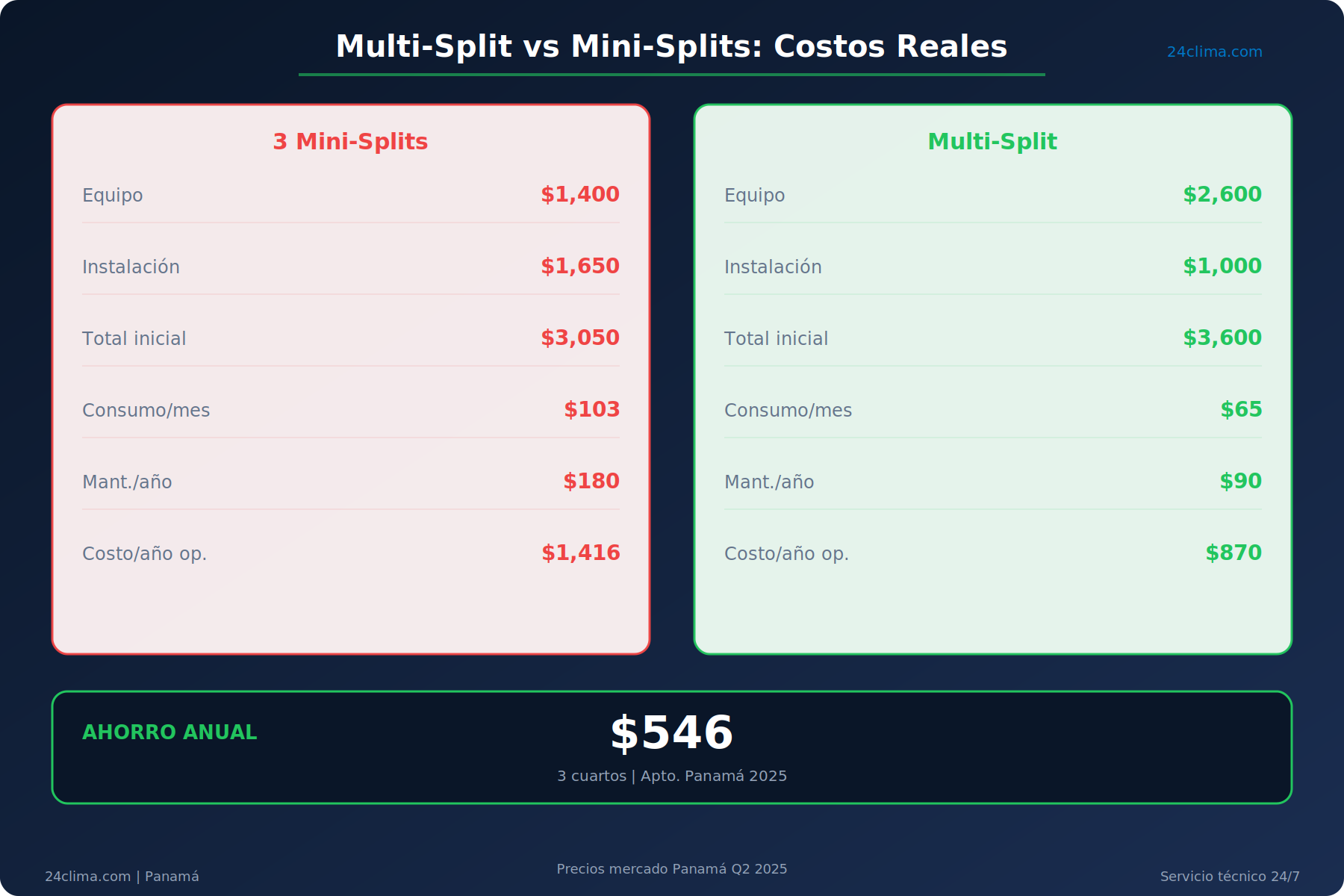
The most common assumption goes something like this: "a multi-split is just more expensive and more complicated — I'll buy two or three individual mini-splits and be done with it." That's a logical conclusion if you're only looking at the equipment price tag in a store. But that comparison ignores four costs that most salespeople never bring up: the installation of each additional outdoor unit, the combined electricity consumption running without intelligent coordination, the physical footprint each condenser takes up, and the annual maintenance bill multiplied by the number of units.
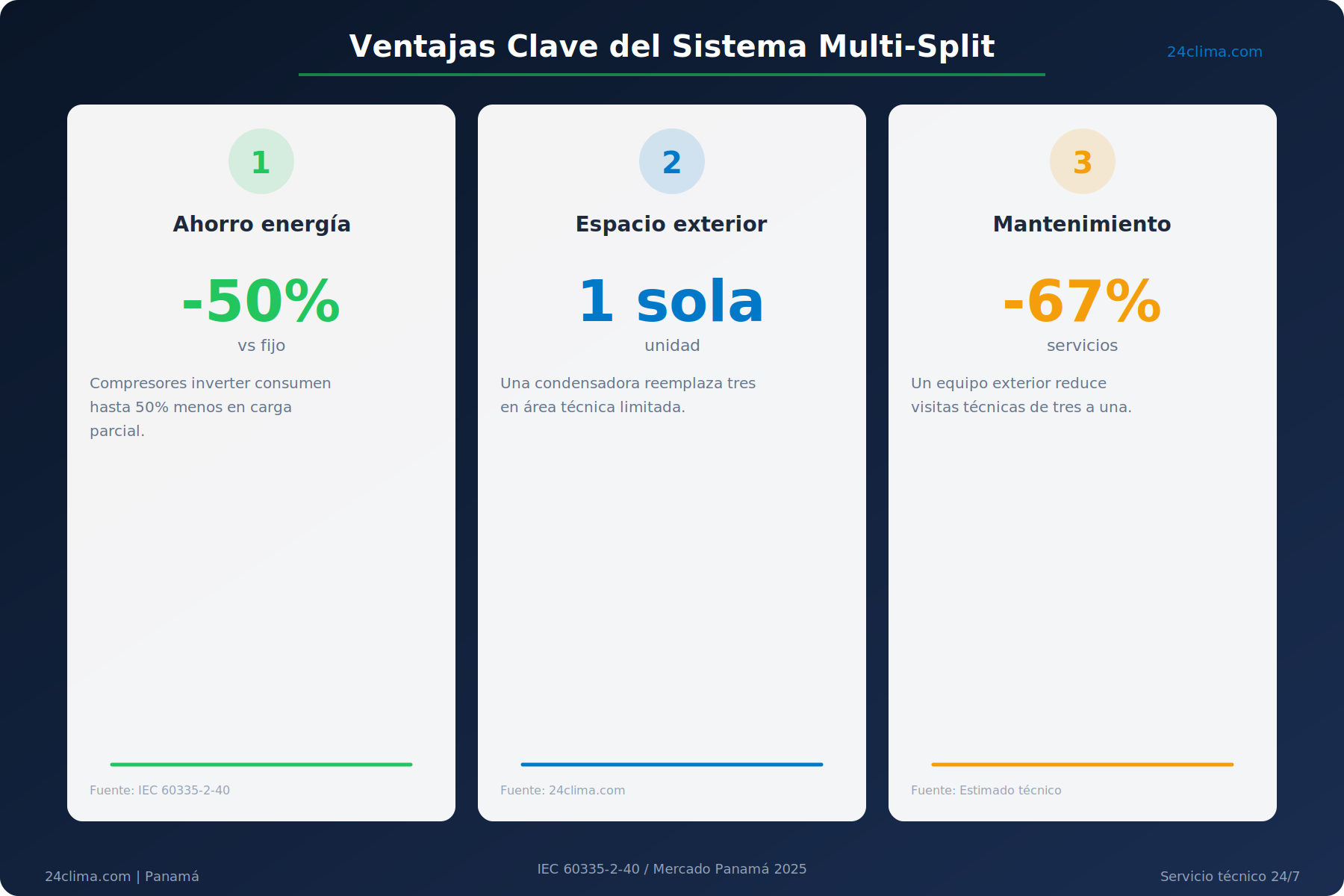
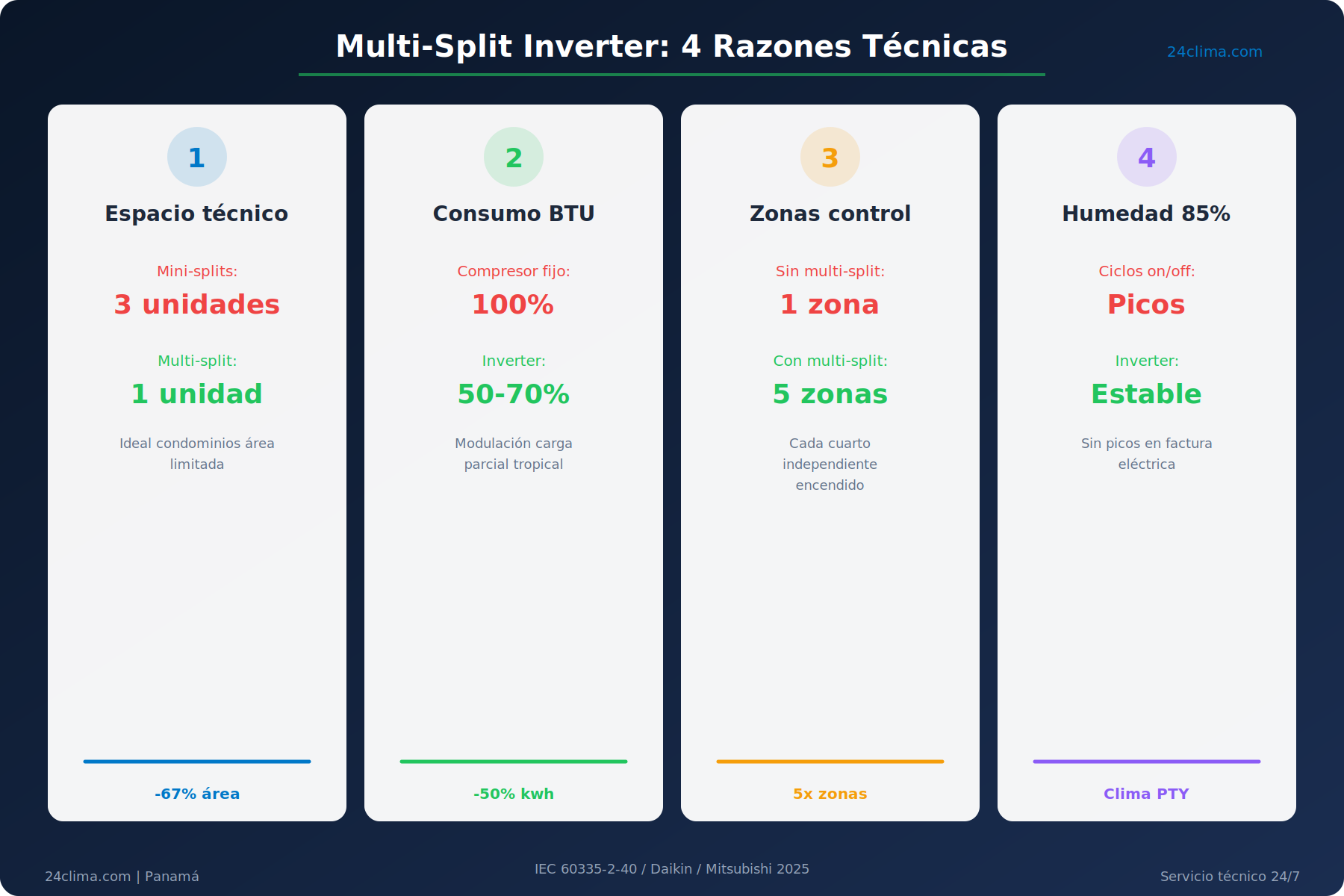
In apartments in San Francisco, Punta Pacífica, or Bella Vista, the technical area assigned by the building is often just 0.6 to 1 square meter per unit. A standard 12,000 BTU condenser occupies between 0.3 and 0.4 square meters of wall or floor space. Installing two or three condensers in that area is either physically impossible or violates the building's co-ownership regulations. The multi-split eliminates that problem entirely: one outdoor unit handles everything.
What a Multi-Split System Actually Is and How It Works in Panama's Climate
A multi-split inverter system is a cooling setup where one outdoor condenser connects to two, three, four, or up to five independent indoor units. Each indoor unit operates on its own — you can run only the master bedroom unit at 10 PM and leave the others off, without touching the performance of the rest of the system.
The technical principle is the same as any standard split-type air conditioner: refrigerant circulates between the outdoor unit, where the compressor and condenser release heat, and the indoor units, where the evaporator absorbs heat from the room. The difference is that the refrigerant circuit branches through a distributor toward each indoor evaporator, with independent electronic expansion valves regulating flow to each zone.
In Panama — where average annual outdoor temperatures sit around 88°F (31°C) and relative humidity in coastal areas like Punta Pacífica routinely exceeds 85% — the inverter compressor has a critical advantage: it modulates its speed based on the actual demand from each zone. When only two out of three rooms are active and an afternoon rainstorm drops the temperature to 81°F (27°C), the compressor slows down rather than cycling on and off. That constant stop-start cycling is the primary driver of those electricity bill spikes that catch so many apartment owners off guard.
According to the International Electrotechnical Commission (IEC), standard 60335-2-40, inverter compressors consume between 30% and 50% less energy than fixed-speed compressors under partial load conditions — which is exactly how a residential system in Panama runs most of the time, since not every room is occupied simultaneously.
Multi-Split vs. Individual Mini-Splits — The Real Comparison in Panama 2025
This is the question that matters most when you're making a decision, and the answer depends on three things: number of rooms, available outdoor space, and how far out you're looking at the costs.
Direct comparison for a 3-bedroom apartment in Panama (market prices 2025):
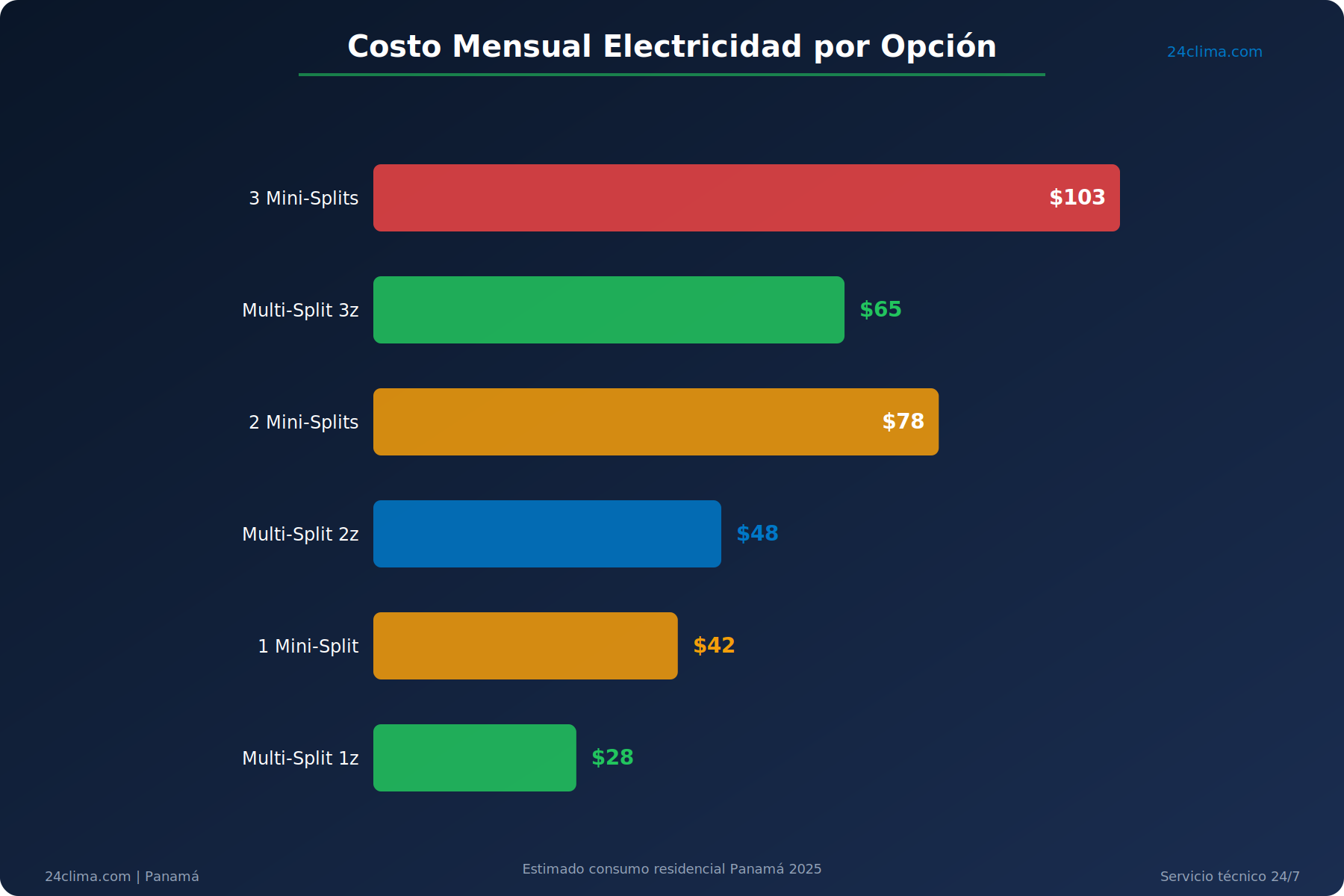
Option A — Three independent inverter mini-splits (3 x 12,000 BTU): — Equipment: $1,200 to $1,600 (three mid-range units such as Midea, Innovair, or Carrier Performance) — Installation: $450 to $650 per unit, total $1,350 to $1,950 (three separate installations, three condensers, three sets of refrigerant lines) — Total installed cost: $2,550 to $3,550 — Estimated monthly electricity cost: $85 to $120 (three compressors running without coordination) — Annual maintenance: $150 to $210 (three separate cleanings)
Option B — Multi-split inverter system, 1 outdoor + 3 indoor units (36,000 BTU total): — Equipment: $2,200 to $3,000 (mid-to-upper tier brands: Daikin, Mitsubishi, LG Multi F) — Installation: $800 to $1,200 (one outdoor unit, three refrigerant line runs from the distributor) — Total installed cost: $3,000 to $4,200 — Estimated monthly electricity cost: $55 to $80 (one inverter compressor with intelligent load modulation) — Annual maintenance: $120 to $160 (one condenser, three indoor units)
The upfront cost difference is real: the multi-split runs $450 to $650 more at the starting line. But electricity savings of $30 to $40 per month close that gap within 24 months. From month 25 onward, the multi-split costs less in total cumulative terms — every month.
There's also a factor the numbers don't fully capture: in many buildings along Costa del Este, El Cangrejo, or Avenida Balboa, installing three separate condensers simply isn't permitted under the building's horizontal property regulations. In that scenario, the multi-split isn't just the more efficient option — it's the only viable one.
A 2023 study by Lawrence Berkeley National Laboratory (LBNL) on cooling systems in humid tropical climates confirmed that multi-split systems operating at partial load (60-80% capacity) show a coefficient of performance (COP) between 15% and 22% higher than equivalent individual units running independently.
How Many Rooms Can a Multi-Split Handle, and What Capacity Do You Need in Panama
A standard residential multi-split connects between 2 and 5 indoor units to a single outdoor condenser. Total system capacity ranges from 18,000 BTU for a 2-zone setup up to 60,000 BTU for 5-zone commercial-residential models.
Sizing the system correctly for Panama's conditions starts with calculating the heat load of each space. Given the combination of outdoor temperature, direct solar radiation, and humidity, the industry standard here applies approximately 600 to 700 BTU per square meter for spaces with windows facing west or south, and 450 to 550 BTU per square meter for spaces with less solar exposure.
A typical configuration for a 3-bedroom apartment in Panama City:
Master bedroom (150 sq ft / 14 m²) — 9,000 BTU Secondary bedroom (108 sq ft / 10 m²) — 7,000 BTU Living-dining room (237 sq ft / 22 m²) — 12,000 BTU Outdoor condenser — 24,000 to 28,000 BTU (with diversity factor applied)
That diversity factor is where most people get surprised. In practice, not every room runs at 100% demand at the same time. Manufacturers like Daikin and Mitsubishi allow up to 130% of indoor capacity relative to outdoor capacity to be installed, precisely because the system distributes load intelligently across zones. That's what keeps the outdoor unit smaller — and cheaper — without sacrificing performance.
Dehumidification deserves a separate mention here. In Panama, relative humidity can exceed 90% in August and September. Inverter multi-split systems include an independent dehumidification mode that runs the evaporator at low temperature without necessarily dropping the room temperature further. That solves the problem you've probably noticed with oversized or poorly configured units: rooms that feel cold but still damp.
Installing a Multi-Split in Panama — What You Need to Know Before Hiring Anyone
Multi-split installation is technically more demanding than a standard mini-split job. Three factors determine whether the system performs reliably for years or starts giving you headaches within 18 months.
Refrigerant line routing. In a multi-split, the refrigerant lines branch out from the outdoor condenser to each indoor unit. Maximum total line length and the difference in length between branches have specific limits set by the manufacturer. In Daikin systems, for example, the maximum equivalent length per branch is generally 20 meters, and the difference between the longest and shortest branch cannot exceed 10 meters. An installer who ignores those limits will leave you with pressure imbalances that quietly reduce efficiency and shorten compressor life.
Refrigerant charge. Every additional meter of refrigerant line requires an additional quantity of refrigerant — typically R-32 or R-410A in modern systems. A technician without multi-split experience may charge the system with too little or too much, and both mistakes damage the compressor. The correct procedure means measuring the actual length of each branch and adjusting the charge to the manufacturer's specifications.
The electrical circuit. A 24,000 BTU outdoor condenser requires a dedicated 220V/20A circuit. Many apartments in buildings from the 1990s and 2000s in El Cangrejo or Bella Vista have electrical panels that don't have that capacity available. Before you buy anything, have a qualified technician check the panel and calculate whether a service upgrade is needed.
At 24clima, our multi-split installation service includes a prior technical evaluation of the space, refrigerant line routing design, and electrical verification. You can learn more on our installation service page.
Frequently Asked Questions About Multi-Split Systems in Panama
What is a multi-split system and how does it work in a tropical climate?
A multi-split system is an air conditioning configuration where one outdoor unit connects to multiple indoor units in separate rooms, each with independent control. In Panama's climate, the inverter compressor adjusts its speed to match the actual demand from each zone, avoiding the repeated start-up cycles that spike electricity bills. At 88°F (31°C) and 85% humidity, that continuous modulation outperforms three individual compressors running without coordination.
How much does it cost to install a multi-split system in Panama in 2025?
The total installed cost for a 3-zone configuration runs from $3,000 to $4,200 — equipment plus installation, based on market prices as of Q2 2025. A 2-zone system starts from around $2,200 installed. Those figures include equipment from brands such as Daikin, LG, or Mitsubishi, professional installation with refrigerant lines, refrigerant charge, and commissioning. The cost runs $450 to $650 higher than three individual mini-splits, but monthly electricity savings of $30 to $40 recover that difference in approximately 18 to 24 months.
Is a multi-split better than several independent mini-splits for an apartment in Panama?
It depends on two things: available outdoor space and your time horizon. If the building restricts you to a single technical area — which is the case in most residential towers in Costa del Este, San Francisco, and Punta Pacífica — the multi-split is the only technically viable option. If space isn't a constraint, the multi-split is still the stronger long-term choice: 25-35% lower electricity consumption depending on usage patterns, a smaller exterior footprint, and a single unit to maintain. Individual mini-splits make sense when you're only cooling one or two rooms. For three or more, the multi-split wins in almost every scenario.
Which areas of Panama make the most sense for a multi-split system?
High-rise residential towers in Costa del Este, Punta Pacífica, San Francisco, Avenida Balboa, El Cangrejo, and Bella Vista are the clearest cases — technical areas are small and co-ownership regulations restrict the number of condensers per apartment. Two-story houses in suburban areas like Clayton, Albrook, or Brisas del Golf also benefit, since concentrating all the noise and heat dissipation from a single outdoor point is a real operational advantage.
The Cooling You Need, Without Using the Space You Don't Have
Back to that 14th-floor apartment in Costa del Este. With a properly sized and installed multi-split system, that one-square-meter utility area is no longer a problem — it's enough. One outdoor condenser, three rooms with independent cooling, one maintenance appointment per year.
The technology is proven. Prices in Panama in 2025 make it genuinely accessible. What determines whether you get years of reliable performance or an expensive headache is correct sizing and a technical installation that respects refrigerant line limits, proper refrigerant charge, and dedicated electrical circuitry. At 24Clima, we evaluate your space, design the right system for your rooms and building conditions, and carry out the installation with a performance guarantee. Contact us on WhatsApp at https://24clima.com/contacto/ and get a no-cost technical evaluation for your apartment or house in Panama.