Commercial AC in Panama — the complete guide no technician will give you for free
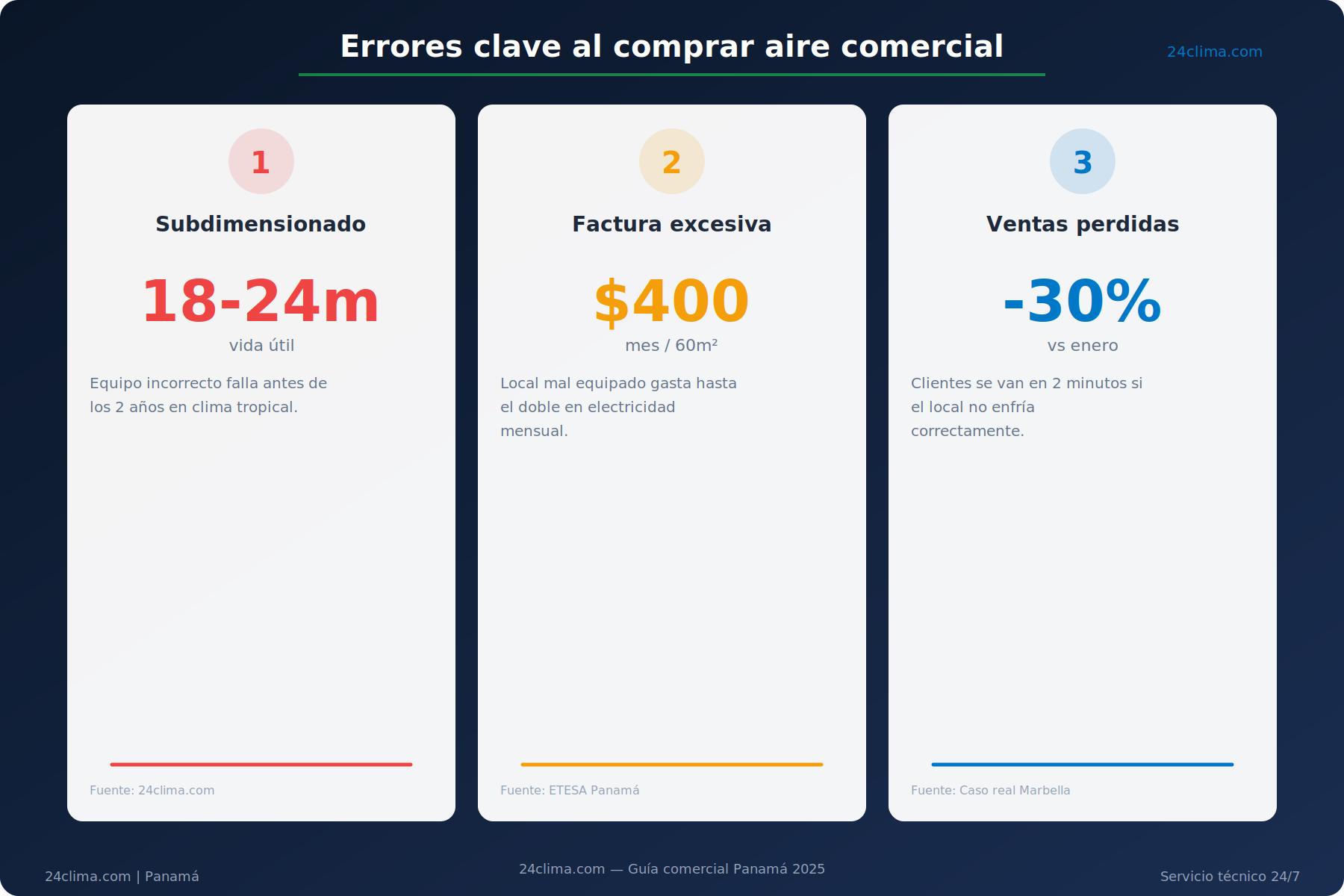
It's 2:30 in the afternoon in Marbella. The thermometer hit 91°F at noon and relative humidity is hovering around 84%. Your shop has been running the AC at full blast for three hours, and customers are still walking in drenched, glancing at the menu for two minutes, and leaving. The register doesn't lie: last Tuesday's sales were 30% worse than the same day in January.
Then the ETESA bill arrives. Four hundred dollars. For a 650-square-foot space.
Something is off. Either you have the wrong equipment, it was installed incorrectly, or nobody ever explained how to properly size a commercial AC system in Panama — which is a fundamentally different calculation than sizing one for a condo in Miami or an office in Bogotá. This guide gives you the real numbers, the correct technical criteria, and the questions you should be asking any contractor before signing anything.
More resources on equipment selection and tropical climate maintenance are at 24clima.com.
What most businesses get wrong — and why it costs them
The most common mistake isn't buying cheap equipment. It's buying the wrong equipment for the actual thermal load of the space. Most shop, restaurant, and office owners in Panama make the decision based on one of three wrong criteria: price, what the business next door installed, or the recommendation of whoever works the counter at the hardware store.
None of those criteria account for real heat load. In a commercial space in Panama, you're dealing with factors that don't exist in a residence: customers constantly coming and going — hot, humid air flooding in every time a door opens — heat-generating equipment like computers, cash registers, refrigerated display cases, and commercial kitchens, LED or fluorescent lighting running all day, and glass facades that turn into a greenhouse under the midday sun.
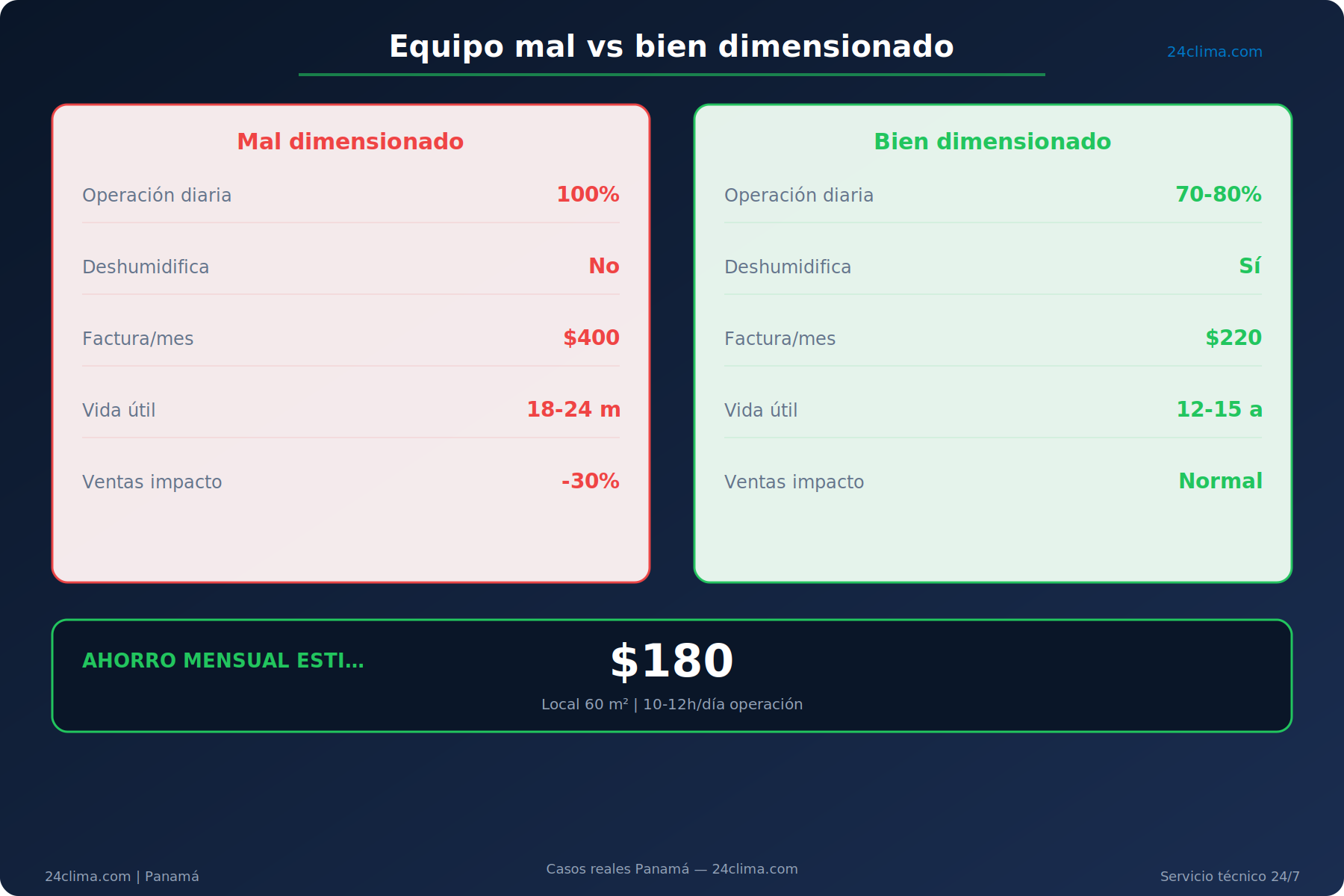
The typical result: an undersized unit running at 100% capacity for 10 to 12 hours a day, never fully dehumidifying the air, burning more electricity than a correctly sized system, and failing in 18 to 24 months instead of lasting the 12 to 15 years it should.
How to calculate the BTUs your commercial space actually needs in Panama
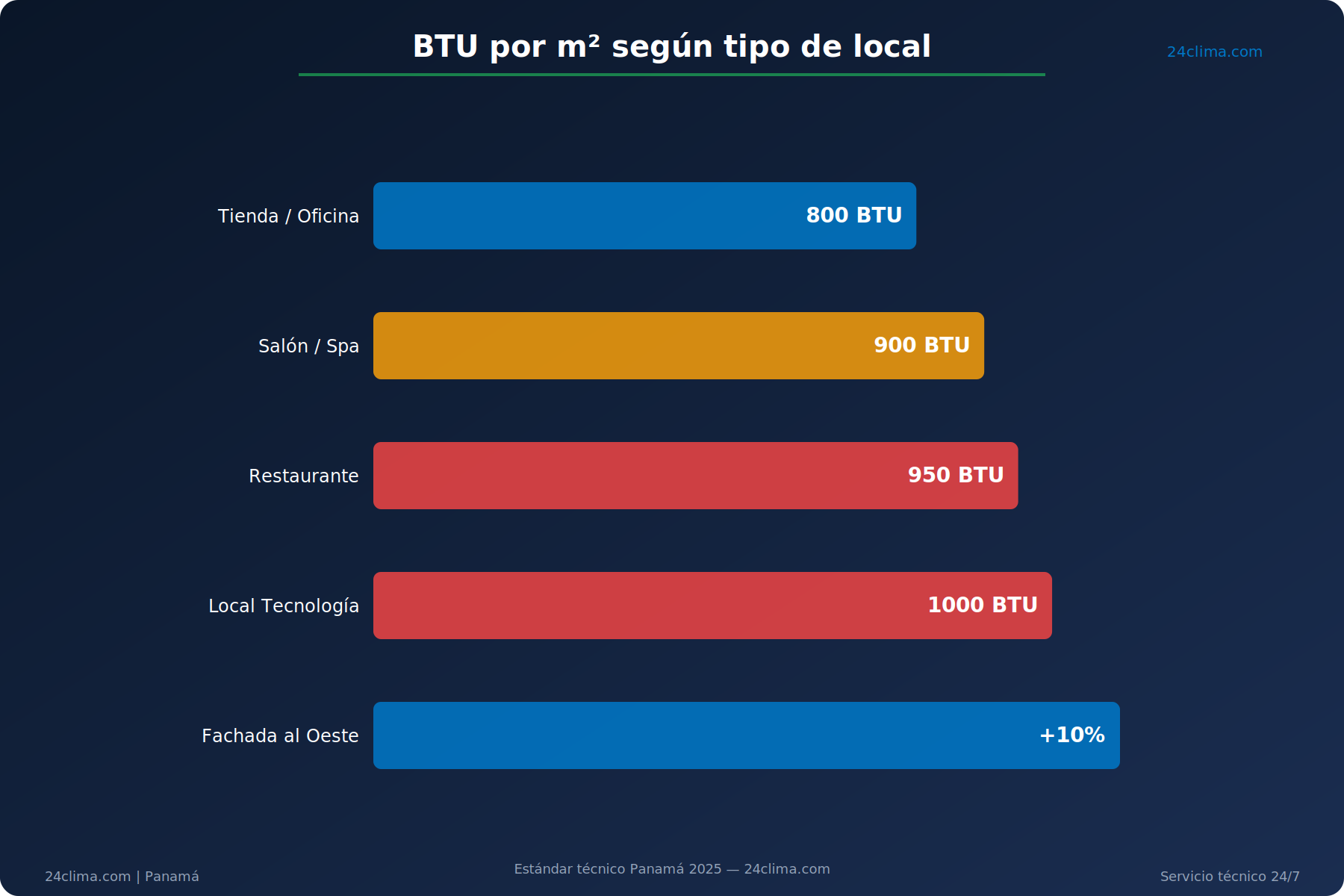
In Panama, the minimum standard for commercial spaces is 800 BTU per square meter (roughly 74 BTU per square foot). That figure already incorporates corrections for tropical humidity and typical occupancy loads. In spaces with active kitchens, high-density electronics, or west-facing facades that take the full force of the afternoon sun, the number climbs to 900 to 1,000 BTU per square meter.
BTU reference by business type and size — Panama 2025
Type of space — 30 m² (320 sq ft) — 50 m² (540 sq ft) — 80 m² (860 sq ft) — 120 m² (1,290 sq ft) — Clothing store / boutique: 24,000 BTU — 40,000 BTU — 64,000 BTU — 96,000 BTU — Standard office (low density): 24,000 BTU — 40,000 BTU — 64,000 BTU — 96,000 BTU — Restaurant / active kitchen: 30,000 BTU — 50,000 BTU — 80,000 BTU — 120,000 BTU — Salon / spa: 27,000 BTU — 45,000 BTU — 72,000 BTU — 108,000 BTU — Tech / electronics retail: 30,000 BTU — 50,000 BTU — 80,000 BTU — 120,000 BTU
These figures assume a standard ceiling height of 2.7 meters (about 9 feet). If your space has ceilings of 3.5 meters (11.5 feet) or higher — common in mall or plaza units — multiply the result by 1.15. West-facing windows without solar protection add another 10%.
The quick formula:
Measure the area in square meters (length x width). Multiply by 800 BTU for standard use, or 900 to 1,000 BTU for kitchens, high occupancy, or west-facing facades. If ceilings exceed 2.7 meters (9 feet), multiply the result by 1.15. Divide by 12,000 to convert to tons of refrigeration.
Real-world example: A 60 m² (645 sq ft) restaurant in Costa del Este, 3-meter (10-foot) ceilings, north-facing facade. 60 m² x 950 BTU = 57,000 BTU x 1.11 (ceiling correction) = 63,270 BTU, approximately 5 tons of refrigeration. Typical solution: two 2.5-ton units.
Cassette vs. wall-mount split vs. floor-ceiling — which one is right for your business
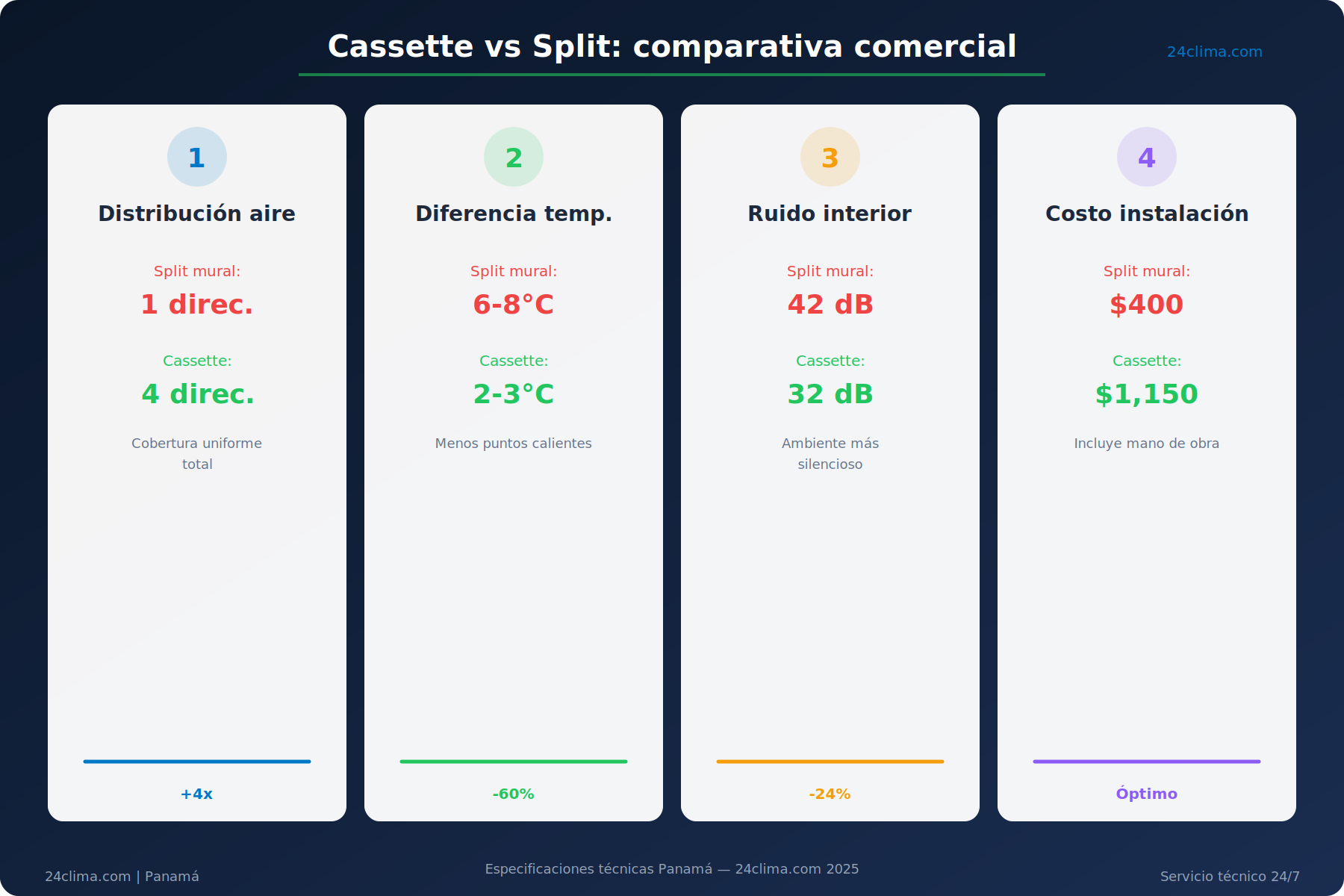
For commercial spaces larger than 270 square feet, the ceiling cassette is generally the best technical choice in Panama. A cassette unit distributes air in four directions simultaneously, eliminates hot spots, and does all of this without occupying wall space. The temperature difference between the coldest and warmest point in the room drops from the 10 to 14°F you typically see with a wall-mount split down to just 4 to 5°F with a well-installed cassette.
Technical comparison for commercial spaces in Panama:
Ceiling cassette — Air distribution: 4 directions, uniform coverage — Space required: ceiling (requires a dropped ceiling or minimum 25 cm / 10 inches of structural clearance) — Best for: shops from 300 to 1,600 sq ft, restaurants, waiting rooms — Installation cost in Panama: $800 to $1,500 per unit (labor included) — Maintenance: filters accessible from below, quarterly service recommended — Indoor noise level: 30 to 38 dB
Wall-mount inverter split — Air distribution: 1 adjustable direction, partial coverage — Space required: interior wall, minimum 15 cm (6 inches) from ceiling — Best for: spaces up to 300 sq ft, small offices, server rooms — Installation cost in Panama: $350 to $700 per unit — Maintenance: easy filter access, monthly cleaning under heavy use — Indoor noise level: 25 to 32 dB
Floor-ceiling unit — Air distribution: vertical, strong penetration in high-ceiling spaces — Space required: free wall or corner — Best for: tall spaces without a dropped ceiling, climate-controlled storage — Installation cost in Panama: $600 to $1,100 per unit — Maintenance: accessible filters, quarterly service — Indoor noise level: 35 to 42 dB
According to ASHRAE (2023), centralized distribution systems with four discharge points — like the cassette — reduce energy consumption by 12% to 18% in commercial spaces compared to multiple wall-mount splits covering the same area. On your ETESA bill, that difference works out to $40 to $80 per month in a mid-sized commercial space.
For businesses without a dropped ceiling or the budget to build one, the floor-ceiling unit is the most efficient alternative. A wall-mount split only makes sense as a primary solution in spaces up to 250 to 300 square feet.
For cassette installation, our commercial AC installation and maintenance service covers the entire process from load calculation to commissioning.
How much will your electricity bill increase — and how to calculate it before you install
A 2-ton (24,000 BTU) commercial inverter unit in Panama consumes between 1.5 and 1.8 kW per hour during continuous operation. At ETESA's current 2025 commercial rate (approximately $0.22 per kWh for average consumption), the daily operating cost of a single 2-ton unit running 10 hours is:
1.65 kW average x 10 hours x $0.22 = $3.63 per day Monthly (26 working days): $94.38 per unit
For a 645 sq ft space requiring 5 total tons (two 2.5-ton units): 2 units x $94.38 = approximately $189 per month in cooling alone
Here's what most contractors won't bring up: a correctly sized inverter unit consumes 30% to 44% less electricity than a fixed-speed unit of the same size. A study published in Energy and Buildings (2022) documented that in climates with relative humidity above 75%, inverter compressors reduce consumption by an average of 38%, because they don't have to cycle on and off — they hold the target temperature with less sustained effort.
In concrete Panama numbers: if your business is currently spending $240 per month on air conditioning with fixed-speed equipment, switching to inverter technology brings that figure down to $149 to $168 per month. The difference — between $72 and $91 every month — pays off the cost of quality equipment in 24 to 36 months.
Three factors that drive consumption beyond the equipment itself:
Dirty filters cut efficiency by up to 25% and raise your bill proportionally. Low refrigerant — even 15% below spec — pushes consumption up by 20%. An undersized compressor running at full load all day is the most expensive scenario of all: 35% to 50% more electricity consumed, and a unit that wears out years ahead of schedule.
Preventive maintenance for commercial equipment in a tropical climate — the real checklist
In Panama, a commercial unit that doesn't receive preventive maintenance loses between 20% and 30% of its efficiency within the first 12 months of operation. The combination of 84% humidity and airborne particles from urban traffic clogs filters and evaporator coils at roughly twice the rate of a dry climate.
Minimum maintenance schedule for commercial equipment in Panama:
Monthly (can be handled in-house): — Clean or replace air filters. In high-traffic or dusty spaces, this is non-negotiable. — Visual check of the condensate drain — no standing water in the drain pan. — Confirm that supply grilles are not blocked by furniture, signage, or display materials.
Quarterly (requires a certified technician): — Deep cleaning of evaporator coils with a biodegradable coil cleaner — Refrigerant pressure check (R-410A or R-32 depending on the unit) — Electrical connection inspection and actual amperage reading — Drain line cleaning via blow-out or light pressure wash — Verification of supply-to-return temperature differential (should be 18 to 22°F / 10 to 12°C)
Twice a year (recommended for restaurants and high-load environments): — Cleaning of the outdoor condenser unit (coils and fan) — Inspection of refrigerant line insulation — Vibration check on compressor and fan motor
A quarterly preventive maintenance visit for a commercial unit in Panama typically runs $80 to $150 depending on equipment size. Compare that to a compressor replacement ($600 to $1,200) or a full unit replacement ($1,800 to $4,500). The math is not complicated.
Our business maintenance service at 24clima.com includes a written technical report after every visit — with actual measured parameters, not just "everything looks fine."
Frequently asked questions
How many BTUs do I need for a 50 m² (540 sq ft) commercial space in Panama?
For a standard 50 m² commercial space — a retail shop, office, or service business — you need between 40,000 and 45,000 BTU of total capacity. An active kitchen, high-density electronics, or a west-facing facade pushes that to 48,000 to 50,000 BTU. That translates to two 24,000-BTU units (2 tons each), or a single 48,000-BTU unit if the layout allows.
Is a cassette or wall-mount split better for a business in Panama?
For spaces larger than 300 square feet, the cassette wins on every technical measure: uniform airflow in four directions, a temperature difference between zones of just 4 to 5°F (2 to 3°C), and quieter operation than a wall-mount split. A wall-mount split is the right call only when the space is under 250 to 300 sq ft, or when there is no dropped ceiling to house a cassette. The monthly electricity difference can reach $40 to $80 in favor of the cassette in mid-sized commercial spaces.
How much will a commercial AC system add to my electricity bill in Panama?
A 2-ton inverter unit running 10 hours a day in Panama costs approximately $85 to $100 per month at 2025 ETESA commercial rates (roughly $0.22/kWh). For a space requiring 4 to 5 total tons, expect cooling costs of $170 to $220 per month. A fixed-speed unit without inverter technology can cost 30% to 44% more for the same result, according to ASHRAE data and field studies conducted in humid tropical climates.
The heat in Marbella is not going anywhere
That customer who walked in at 2:30 in the afternoon made a decision in the first 20 seconds: if the space was cool and comfortable, they stayed. If it wasn't, they found the exit. In Panama, climate is not just a comfort variable — it directly affects sales, employee retention, merchandise preservation, and the lifespan of your electronics.
The difference between a correctly sized system and a guessed one is $70 to $100 per month in electricity, 8 to 10 additional years of equipment life, and customers who come back because they remember your place felt good to be in.
At 24Clima we assess the real thermal load of your business, tell you exactly what you need with actual numbers — not guesswork — and install it to the technical standard that Panama's climate demands. If you have a commercial space in Panama City and want to know precisely what you need, contact us via WhatsApp at 24clima.com/contacto/ and you'll have a technical proposal with full load calculation included within 24 hours. No commitment required — just the numbers.
Last updated: May 2025. Information based on current ETESA rates, ASHRAE 2023 standards, and field experience from commercial installations across Panama City.