Air Conditioning for Your Living Room in Panama — The Guide Nobody Gave You Before You Bought
It's 3 in the afternoon in Costa del Este. The sun is hammering straight through the floor-to-ceiling window. The TV is on, two people are spread out on the couch, and the smell of lunch is still drifting in from the open kitchen. You switch on the AC you bought two years ago — the one the salesperson swore was "more than enough" — and you wait. And wait. The room cools down a little, but never quite gets there. Never really comfortable.
Your ENSA bill hit B/. 180 last month. And you're still sweating.
That's the mistake most homeowners and renters in Panama make: they buy the wrong AC for their living room, or they install it in the wrong spot, then pay double on electricity while getting half the comfort. This guide exists so that doesn't keep happening to you.
What They Told You at the Store — And Why It Was Incomplete
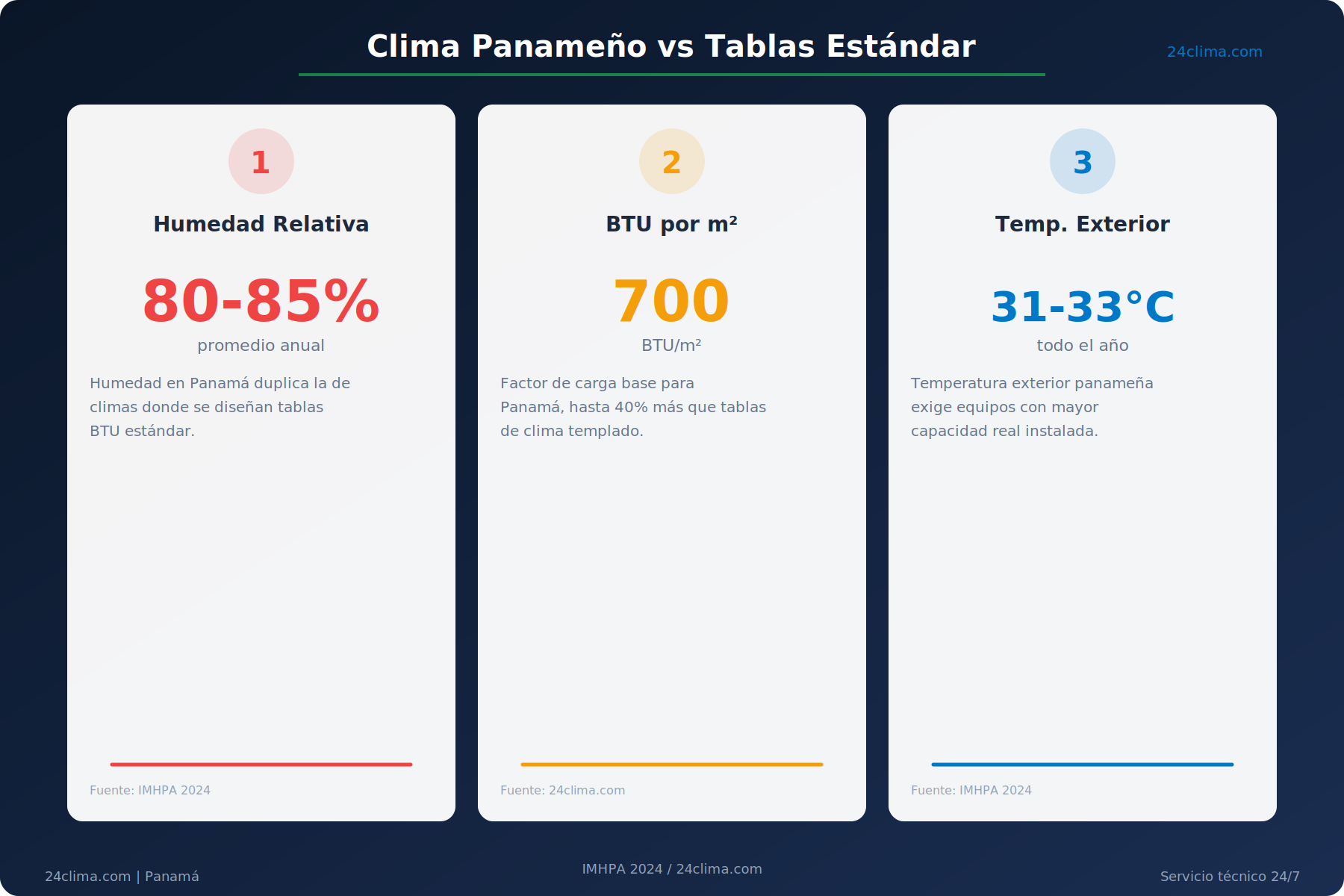
The most common advice you'll hear at Novey, Do it Center, or Machetazo goes something like this: "For a 20-square-meter living room, a 12,000 BTU unit is enough." On paper, that sounds reasonable. The problem is that figure comes from tables built for temperate climates in the United States or Europe, where outdoor temperatures hover around 72–75°F and humidity rarely tops 50%.
In Panama, you're dealing with completely different conditions: outdoor temperatures of 88–91°F (31–33°C) with relative humidity reaching 80–85% for most of the year, according to data from Panama's Institute of Meteorology and Hydrology (IMHPA, 2024). That's not a minor detail. That's the difference between a unit that actually cools and one that just pushes warm air around.
Your living room makes things harder still. It's the most thermally complex space in the entire home — large west-facing windows, an open kitchen constantly adding heat, more people gathered together, electronics running. Each of those factors adds BTU load that standard store tables never account for. For more technical guidance on choosing and running AC equipment in the tropics, check out our guides and tips at 24clima.com.
How to Calculate the Right BTUs for Your Living Room in Panama
The direct answer: start by multiplying the floor area by 700 BTU per square meter, then add 15% to 40% on top depending on your specific heat load factors. A 25 m² living room in Panama typically needs between 18,000 and 24,000 BTU — not 12,000.
Here's how the calculation works:
Measure your living room in square meters (length × width). Most apartments in Panama have living rooms ranging from 20 to 35 m².
Multiply by 700 BTU/m² to get your base load. A 25 m² room gives you 17,500 BTU as a starting point.
Then apply correction factors based on your actual situation:
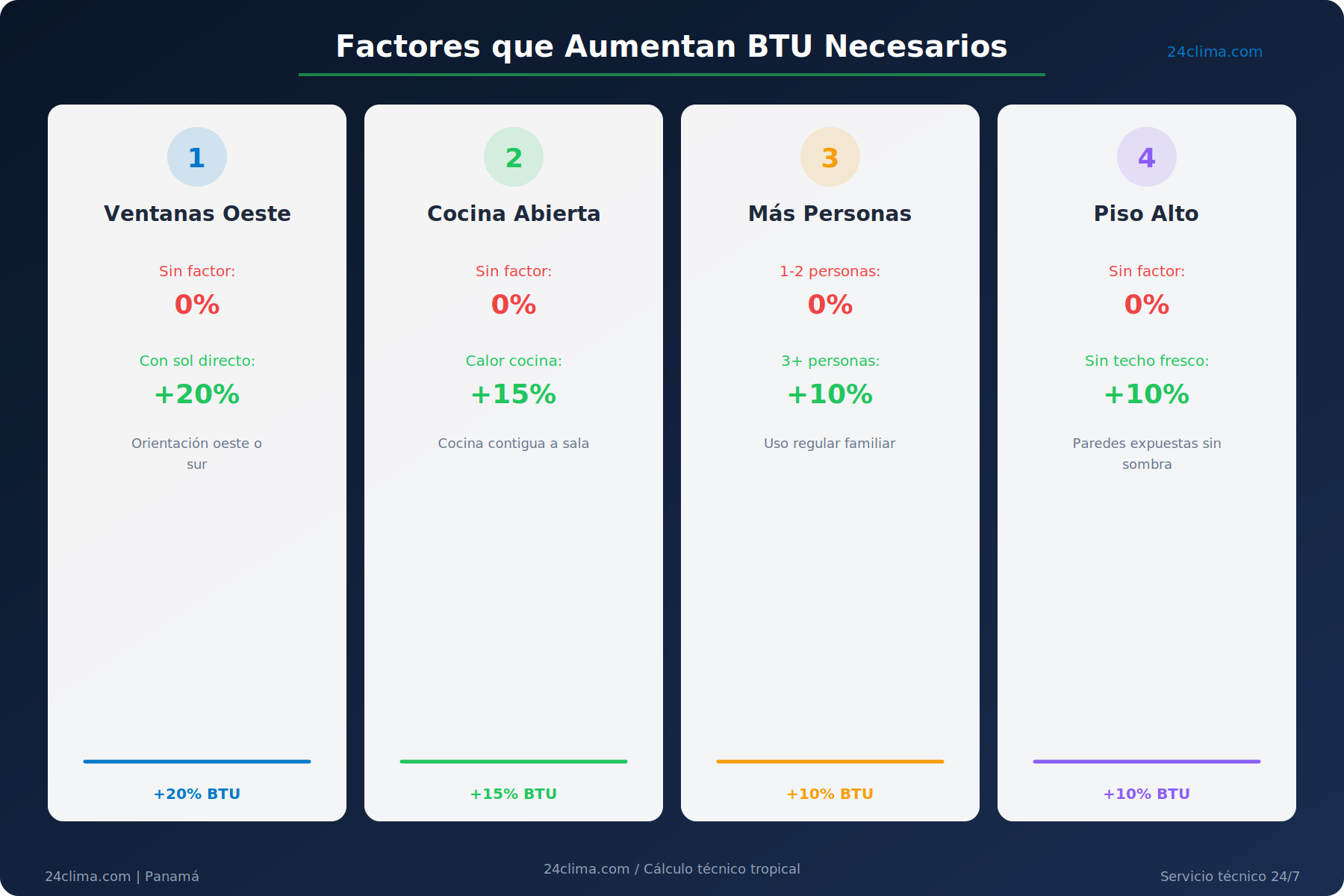
— Large windows receiving direct sun (west or south-facing): +20% — Open kitchen adjacent to the living room: +15% — More than 3 people using the space regularly: +10% — Upper floor with no insulated ceiling above: +10% — Exterior walls fully exposed with no balcony or shade cover: +10%
A 25 m² room with west-facing windows and an open kitchen can easily require 24,000 BTU. A 12,000 BTU unit in that scenario isn't "economical" — it's a machine running at 100% capacity all day and never reaching the temperature you set. Your wallet and your comfort both lose.
Inverter vs. Conventional for the Living Room — Which One Actually Makes Sense
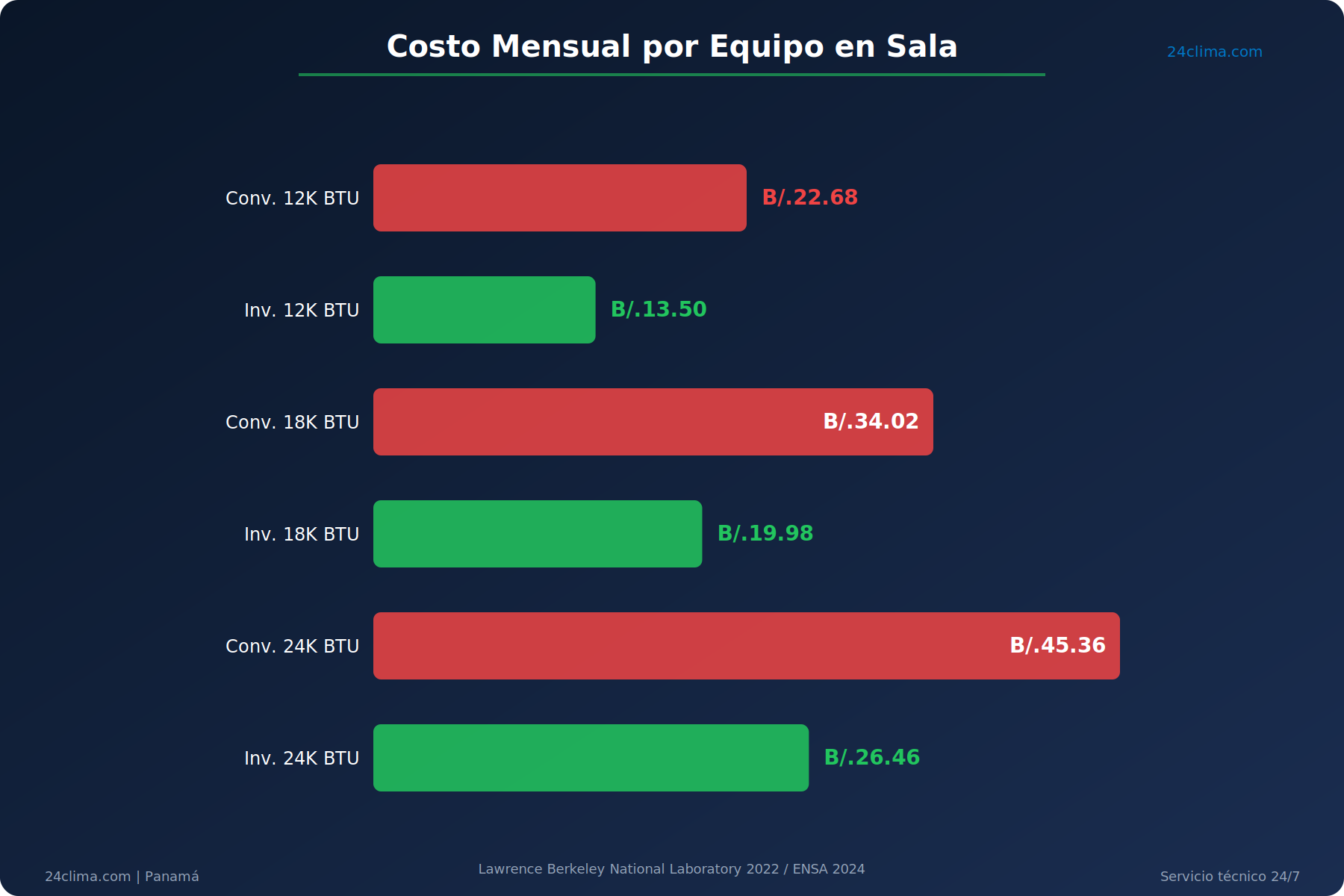
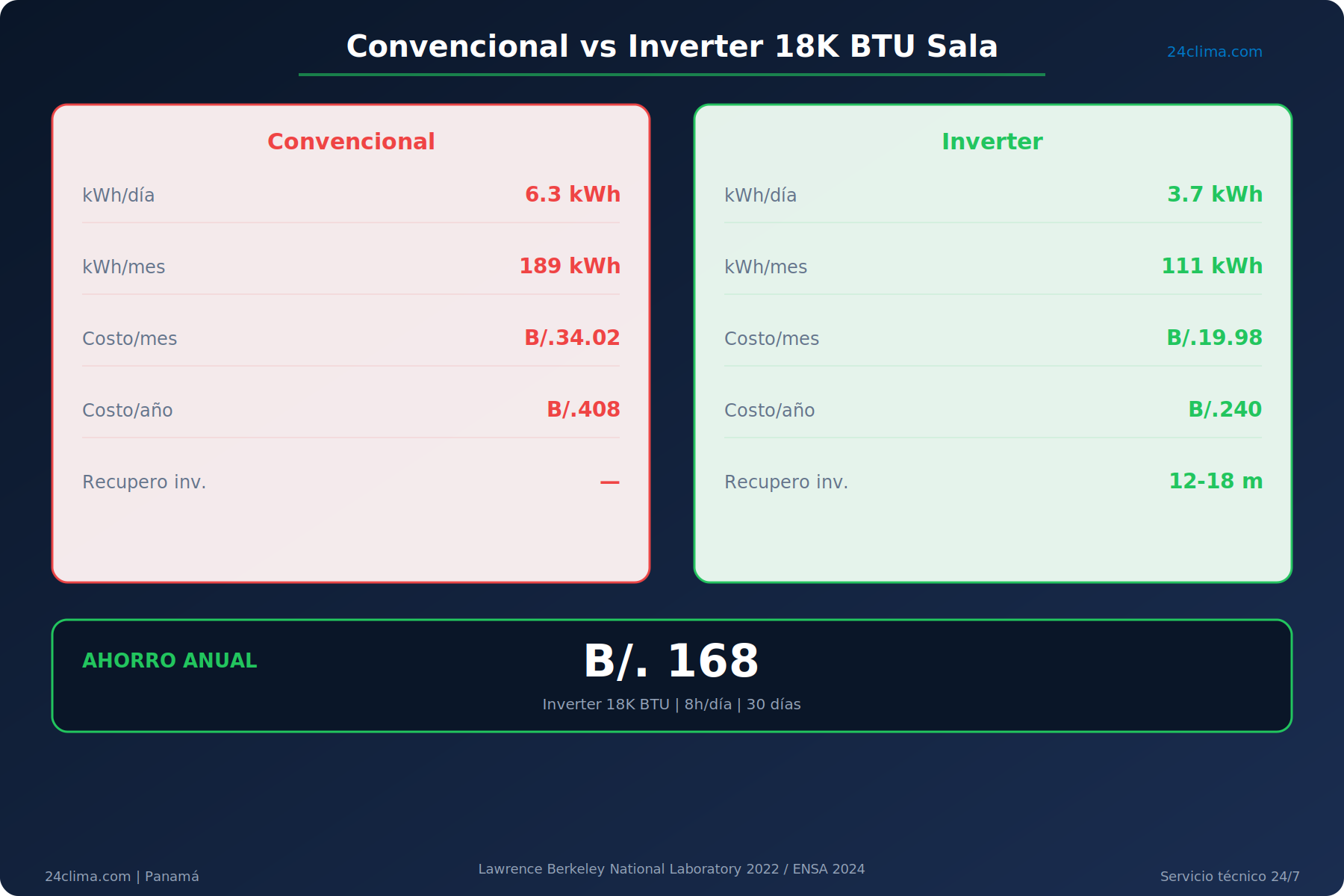
For a living room in Panama where the AC runs 6 to 10 hours a day, inverter is the right call. An 18,000 BTU inverter unit consumes 35% to 50% less electricity than a conventional unit of the same size under extended daily use, according to data published by the Lawrence Berkeley National Laboratory (2022). At B/. 0.18 per kWh (average ENSA residential rate, 2024), that gap adds up to real money fast.
Here's a concrete comparison for 8 hours of daily use in Panama:
Estimated monthly electricity consumption (30 days, 8 hours/day):
— Conventional 12,000 BTU: ~4.2 kWh/day = 126 kWh/month = B/. 22.68/month — Inverter 12,000 BTU: ~2.5 kWh/day = 75 kWh/month = B/. 13.50/month — Conventional 18,000 BTU: ~6.3 kWh/day = 189 kWh/month = B/. 34.02/month — Inverter 18,000 BTU: ~3.7 kWh/day = 111 kWh/month = B/. 19.98/month — Conventional 24,000 BTU: ~8.4 kWh/day = 252 kWh/month = B/. 45.36/month — Inverter 24,000 BTU: ~4.9 kWh/day = 147 kWh/month = B/. 26.46/month
The gap between a conventional and inverter 18,000 BTU unit is B/. 14 per month. Over 12 months, that's B/. 168. Over five years, you're paying B/. 840 extra in electricity alone. The higher upfront cost of an inverter — typically B/. 100 to B/. 200 more — pays itself back in 12 to 18 months of normal use in Panama.
A conventional unit only makes sense if you're running the AC less than 4 hours a day or it's for a secondary space you rarely use. For your main living room, where the unit runs from 5 p.m. until midnight or later, inverter isn't a luxury. It's basic math.
Models Available in Panama — Concrete Options for 2025
For living rooms of 20–25 m² with moderate heat load (no open kitchen, partial window exposure):
— LG Dual Inverter 18,000 BTU (available at Novey): reference price B/. 750–850. SEER 21. App control. Dual compressor with lower vibration. — Midea Inverter 18,000 BTU (available at Machetazo and Do it Center): reference price B/. 620–700. The better choice when the budget is tight and efficiency still matters.
For living rooms of 25–35 m² or high heat load situations (open kitchen, west-facing windows, upper floors):
— LG Dual Inverter 24,000 BTU (Novey): reference price B/. 950–1,100. The most capable option in its category. — Samsung WindFree 24,000 BTU (Do it Center): reference price B/. 1,050–1,200. Uses micro-hole diffusion instead of a direct cold airstream — worth considering if anyone in your household is sensitive to direct AC airflow. — Gree Inverter 24,000 BTU (Machetazo): reference price B/. 700–800. Strong presence across Central America and solid parts availability throughout Panama.
For living rooms of 35–45 m² or open-plan living and dining combined:
— Carrier 36,000 BTU inverter (specialized distributors): for open-plan spaces that require higher capacity. Requires professional installation with hydraulic system calculations.
One thing to check before you buy: prices at Panamanian stores vary by season and stock availability. Always confirm whether installation is included — in many cases it's an additional B/. 150–300 depending on the complexity of the job.
Where to Mount the Indoor Unit in Your Living Room for Maximum Efficiency
Mount the indoor unit on the interior wall opposite the main heat source — windows or kitchen — at a height of 2.0 to 2.4 meters (roughly 6.5 to 8 feet) above the floor, with at least 15 cm of clear space on each side. Not directly above the sofa, and not pointed straight at the TV area.
The positioning factors that most affect efficiency in typical Panama living rooms:
Which wall you use: choose an interior wall, not an exterior one. Less radiant heat transfer means better compressor performance.
Direction of airflow: cold air should sweep the room diagonally. If the unit is on the north wall, the airflow should reach the southeast corner of the room.
Distance to the outdoor unit: every additional meter of refrigerant tubing increases pressure losses. Keep the total pipe run under 5 meters equivalent length whenever the layout allows.
Outdoor unit orientation: in Panama, avoid mounting the outdoor unit on west or south-facing walls where it receives direct sun between 11 a.m. and 4 p.m. According to ASHRAE Standard 90.1, an outdoor unit exposed to direct sun can consume up to 12% more energy than one sitting in shade.
Obstructions near the indoor unit: curtains, tall artwork, or shelving in front of the unit reduce effective airflow by up to 30%. Keep at least 50 cm of clear space directly in front of the unit.
A poorly positioned installation can turn a quality inverter into a unit with energy consumption closer to a conventional model. Installation is not an afterthought — it's part of how the equipment performs. Our professional installation service at 24clima includes position calculation, pipe length assessment, and a load test before we hand over the job.
Factors That Drive Up Heat Load in Panama Living Rooms
The following conditions significantly increase the BTUs your living room actually needs. If you recognize several of these in your home, go one capacity level higher when choosing your unit:
— Floor-to-ceiling windows facing west or southwest — Open kitchen without a strong overhead exhaust fan or island barrier — Living room on the 4th floor or higher with no insulated slab above — Four or more people regularly using the space at the same time — TV larger than 55 inches or high-output audio equipment — Exterior walls with no vegetation, awning, or shade cover — Double-height ceilings (above 2.8 meters / 9 feet) — Gas stove in or adjacent to the kitchen (generates significantly more heat than induction or electric)
If your living room checks three or more of these boxes, don't cut corners on capacity. A unit sized 10–15% above minimum only consumes marginally more under normal operation. An undersized unit runs at 100% capacity continuously, wears out faster, and never delivers the comfort you're paying for.
Frequently Asked Questions About Living Room AC in Panama
How many BTUs do I need for a 25 m² living room in Panama?
For a 25 m² living room in Panama, you need between 18,000 and 24,000 BTU depending on heat load. The starting point is 17,500 BTU (700 BTU/m²), but Panama's tropical climate — temperatures above 88°F (31°C) and humidity at 80–85% — requires an additional margin of 15–35% over standard calculations. If you have west-facing windows or an open kitchen, go straight to 24,000 BTU.
Is an inverter or conventional unit better for a living room?
For a living room where average daily use exceeds 6 hours, inverter wins clearly. The consumption difference between an inverter and conventional unit of the same size amounts to B/. 14–19 per month, and the higher upfront cost pays itself back in under 18 months of normal use. A conventional unit only justifies if the initial purchase budget is the absolute limiting factor.
Where should the AC be installed in the living room for best efficiency?
Mount the indoor unit on the interior wall opposite the main heat source — windows or kitchen — at 2.0 to 2.4 meters (6.5–8 feet) in height, with airflow directed diagonally toward the far end of the room. Avoid installing it directly above the sofa or aimed at the TV area. The outdoor unit should never be placed where it receives direct sun during peak solar hours.
A Properly Cooled Living Room Isn't a Luxury in Panama — It's Quality of Life
Back to that afternoon in Costa del Este. Same living room, same 3 p.m. sun. Now you have a 24,000 BTU inverter correctly mounted on the interior north wall, the outdoor unit sitting in shade, and thermal-insulating curtains cutting solar gain by 20%. The unit started up quietly 15 minutes ago. The room is already at 72°F (22°C). Your bill dropped B/. 35 compared to last month.
That's what happens when equipment selection and installation are done with real technical judgment — not the quick advice from a store counter.
At 24Clima, we assess the heat load of your living room, recommend the exact capacity for your specific home, and carry out the installation with the correct positioning and pipe specifications. If you have questions about which unit to choose or want us to evaluate your situation, contact us on WhatsApp at https://24clima.com/contacto/ — no commitment, no sales pressure.
Last updated: June 2025