Air Conditioning and Your Electric Bill in Panama — What That Monthly Number Isn't Telling You
It's 2 p.m. in Costa del Este. The sun is hammering the asphalt, the thermometer reads 91°F (33°C), and the humidity hits you like a wet towel the moment you step outside. You get home, flip on the 12,000 BTU split unit you bought three years ago, and within minutes the bedroom drops to a comfortable 72°F (22°C). Instant relief. The problem shows up twenty days later, when you open your Naturgy bill and the number stops you cold.
You figured it was normal. Everyone in Panama runs air conditioning. Everyone pays high bills. That's just how it is here, right? Not quite. There's a real difference between paying what your usage actually costs and paying more than you should — for reasons that have straightforward fixes. That difference can be $40, $60, or even $90 a month, depending on your equipment, its condition, and how you use it.
This guide answers with real numbers the question we get most often at 24Clima: exactly how much is my air conditioner adding to my electric bill? We use current 2025 Naturgy/ENSA and Union Fenosa rates, actual consumption figures measured in tropical conditions, and an honest comparison between conventional and inverter units. For other technical topics, check out our guides and tips at https://24clima.com/consejos-y-guias/.
What Most People Assume — and Why It Costs Them
The most common belief goes something like this: "my AC uses what it uses, and there's not much I can do about it." A close second: "inverter units are a luxury for people with money to burn." And the most expensive assumption of all: "if it's cooling, it's working fine."
All three are wrong.
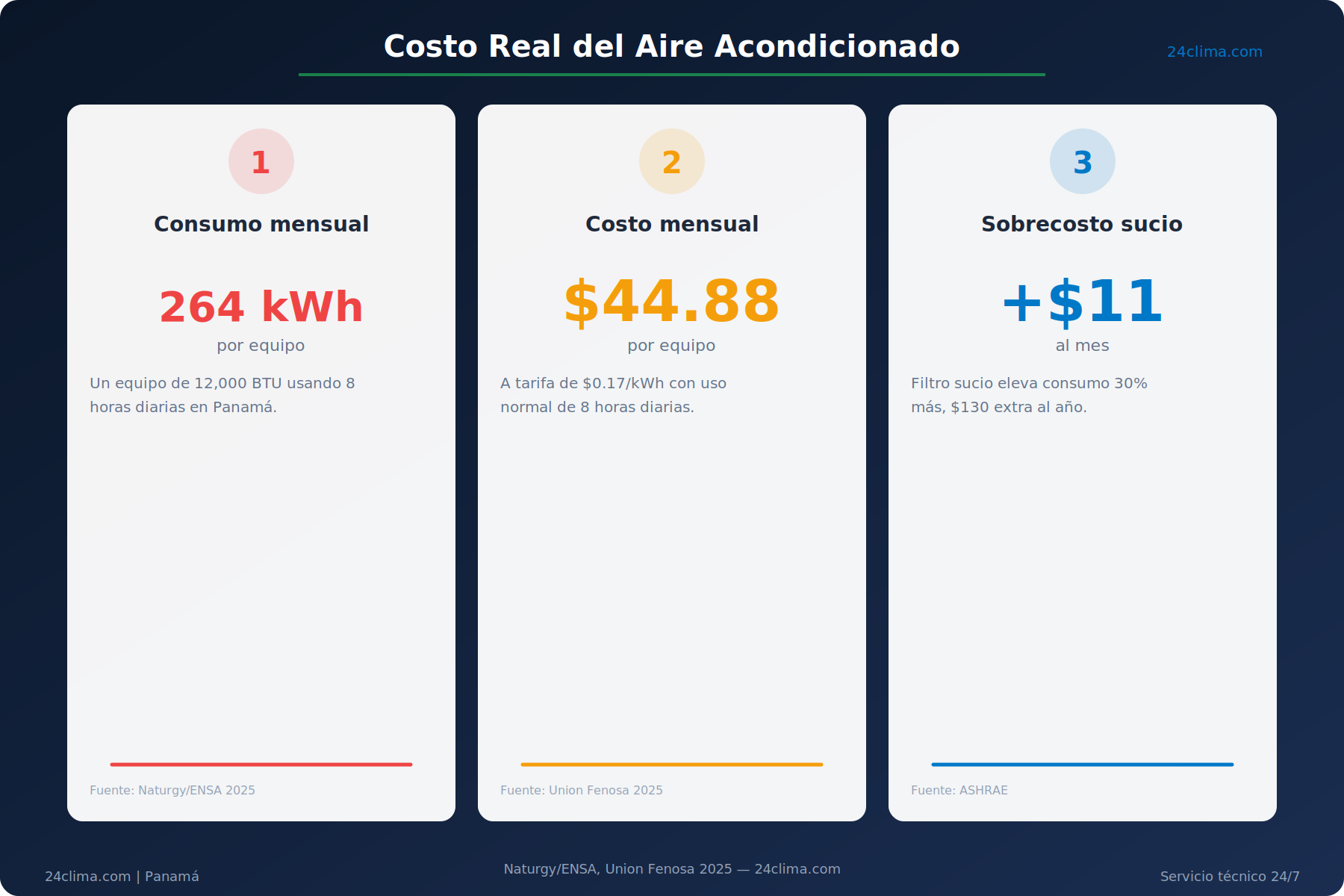
A conventional 12,000 BTU air conditioner that hasn't been serviced in 12 months can consume up to 30% more electricity than a clean unit of the same model, according to data from the American Society of Heating, Refrigerating and Air-Conditioning Engineers (ASHRAE). A dirty filter forces the compressor to run longer to move the same volume of air. That extra runtime shows up directly on your bill, because every extra compressor cycle means more kilowatt-hours — and kilowatt-hours in Panama cost real money.
As for inverter technology — it's not a luxury purchase. For most households in Panama running AC more than 6 hours a day, it's a financial decision that pays for itself in under 18 months. The numbers below prove it.
What an Air Conditioner Actually Costs to Run in Panama
A 12,000 BTU unit (1 ton) consumes between 900 and 1,400 watts per hour during continuous operation, depending on the model and its maintenance history. At Panama's current 2025 residential rate — between $0.16 and $0.18 per kWh according to Naturgy/ENSA and Union Fenosa — the hourly operating cost falls between $0.14 and $0.25.
That sounds manageable. The problem is the accumulation.
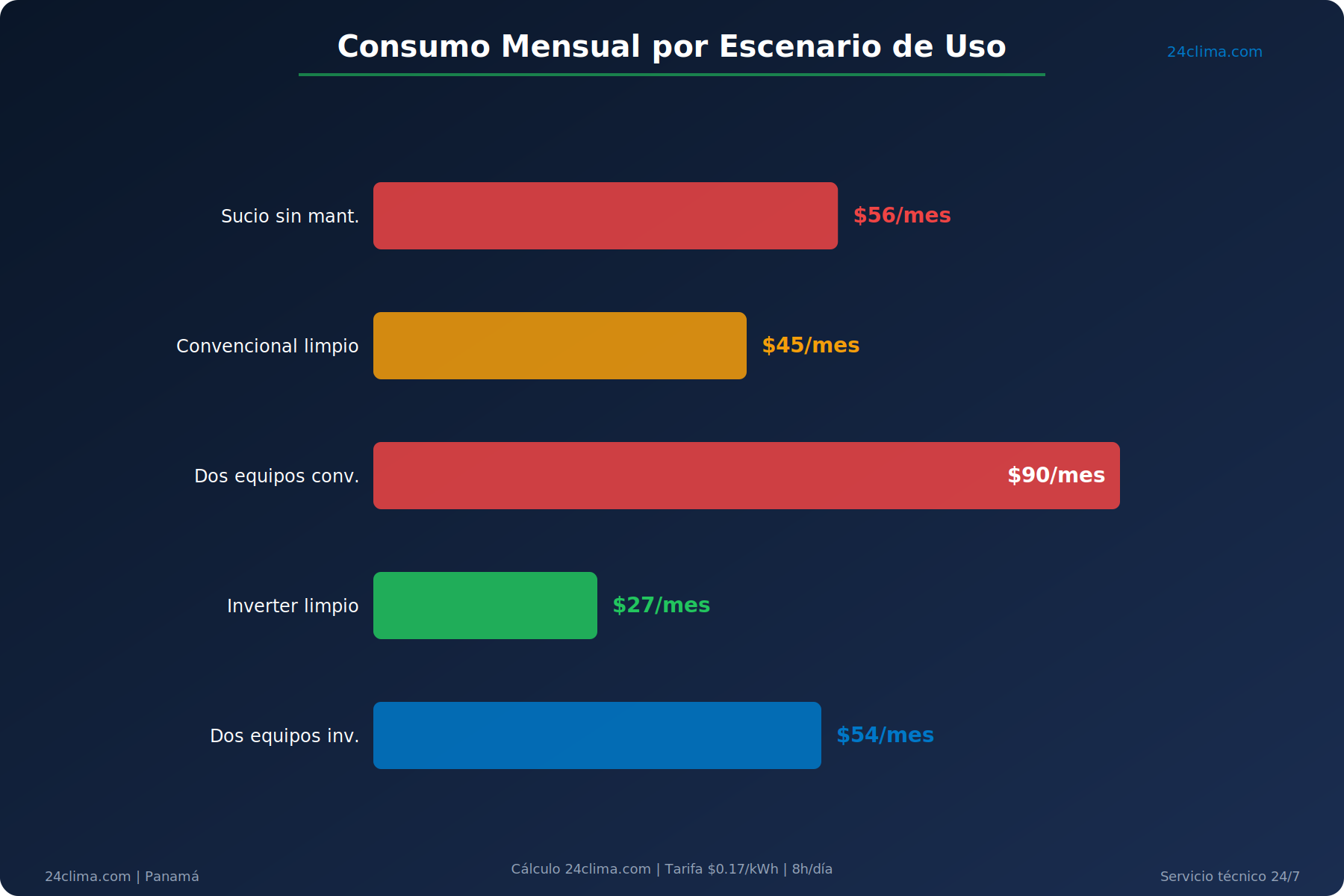
At 8 hours of daily use — a full night of sleep plus some afternoon cooling — a conventional 12,000 BTU unit generates between $33 and $54 in monthly consumption for that single piece of equipment. Two units running in your home means $66 to $108 in additional monthly charges before counting your refrigerator, washer, televisions, and lights.
Here's the exact formula to calculate your own monthly cost:
Find the wattage on your unit — it's on the label or in the manual. A 12,000 BTU unit typically draws between 900 and 1,200 W.
Multiply that wattage by your daily hours of use. Example: 1,100 W × 8 hours = 8,800 Wh = 8.8 kWh per day.
Multiply by 30 days: 8.8 × 30 = 264 kWh per month.
Multiply by the rate: 264 × $0.17 = $44.88 per month for that one unit.
If your unit is dirty or running low on refrigerant, that same calculation can climb to 330 kWh or more, because the compressor runs longer cycles to reach the target temperature. That's $56 a month instead of $44 — an annual difference of more than $130 that you can avoid entirely with a professional cleaning service at https://24clima.com/servicios/limpieza/.
Conventional vs. Inverter — The Comparison Nobody Shows You
A conventional 12,000 BTU unit operates on simple on/off logic: the compressor kicks on at full power, cools the room to the target temperature, shuts off, then restarts when the temperature climbs again. Every startup draws a spike of current. In Panama's tropical climate, where outdoor temperatures rarely drop below 82°F (28°C) even at night, that start-stop cycle happens every 8 to 12 minutes during the hottest parts of the day.
An inverter unit modulates compressor speed instead of shutting down completely. Rather than cycling off, it drops to 20–30% capacity to maintain the target temperature. A study published in Energy and Buildings (2022) measured inverter units consuming between 30% and 45% less electricity than equivalent conventional models in climates with average outdoor temperatures above 82°F (28°C) — exactly the conditions in Panama City.
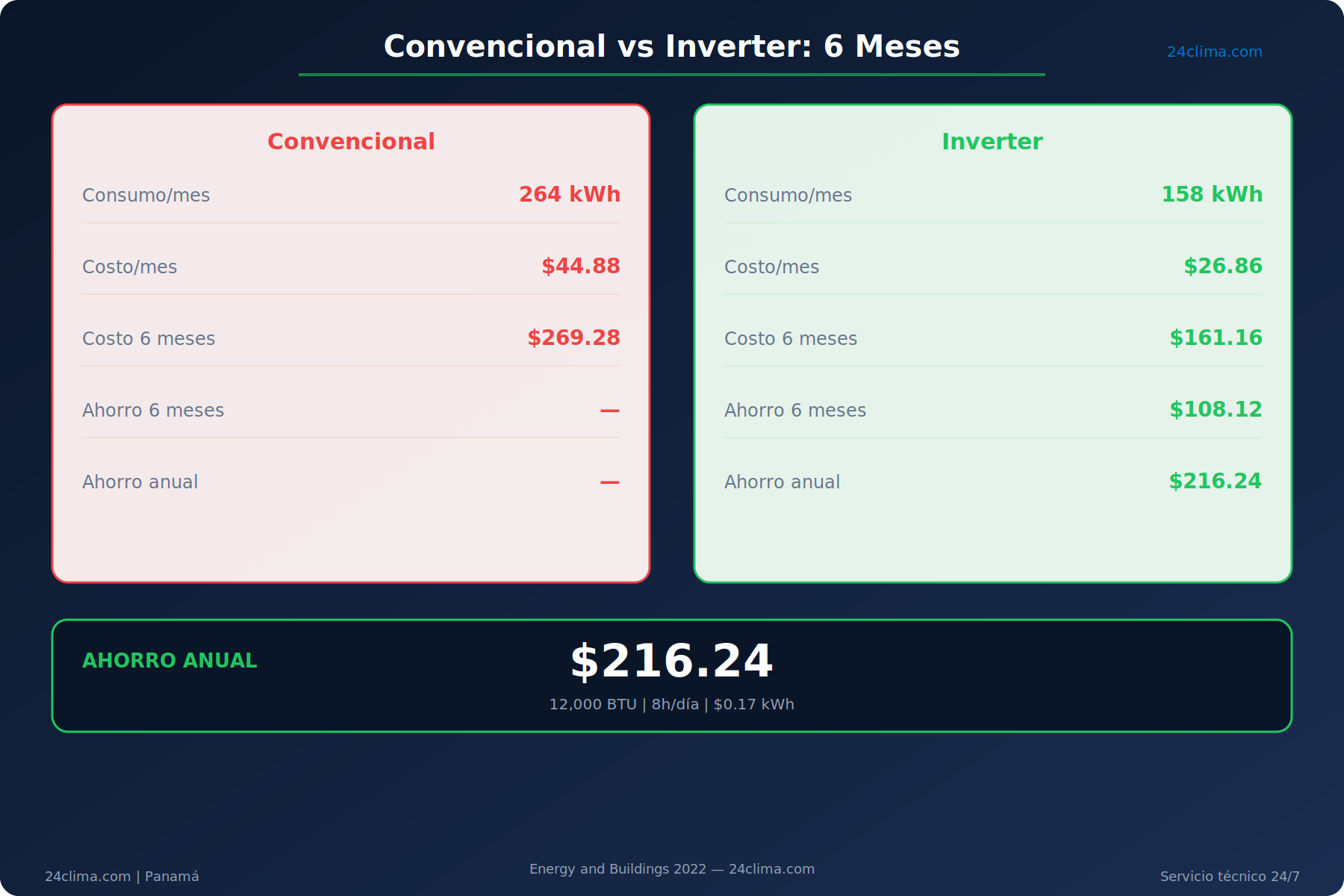
Here's the six-month comparison, based on 8 hours of daily use at $0.17/kWh:
Conventional 12,000 BTU unit: 264 kWh per month, $44.88 per month, $269.28 over six months.
Inverter 12,000 BTU unit (EER 15+ efficiency): 158 kWh per month, $26.86 per month, $161.16 over six months.
Six-month difference: $108.12 in favor of the inverter.
The price gap between a conventional and an inverter unit of the same capacity in Panama typically runs between $150 and $300, depending on brand and distributor. With savings of $108 every six months, the break-even point arrives somewhere between month 8 and month 17, depending on that initial price difference. After that, every month puts $18 to $20 back in your pocket.
These figures assume new equipment. If your current conventional unit is more than 5 years old and hasn't been serviced, the real gap is likely larger — older, degraded units consistently consume more than newer models in the same category.
The Four Things Inflating Your Bill Without You Noticing
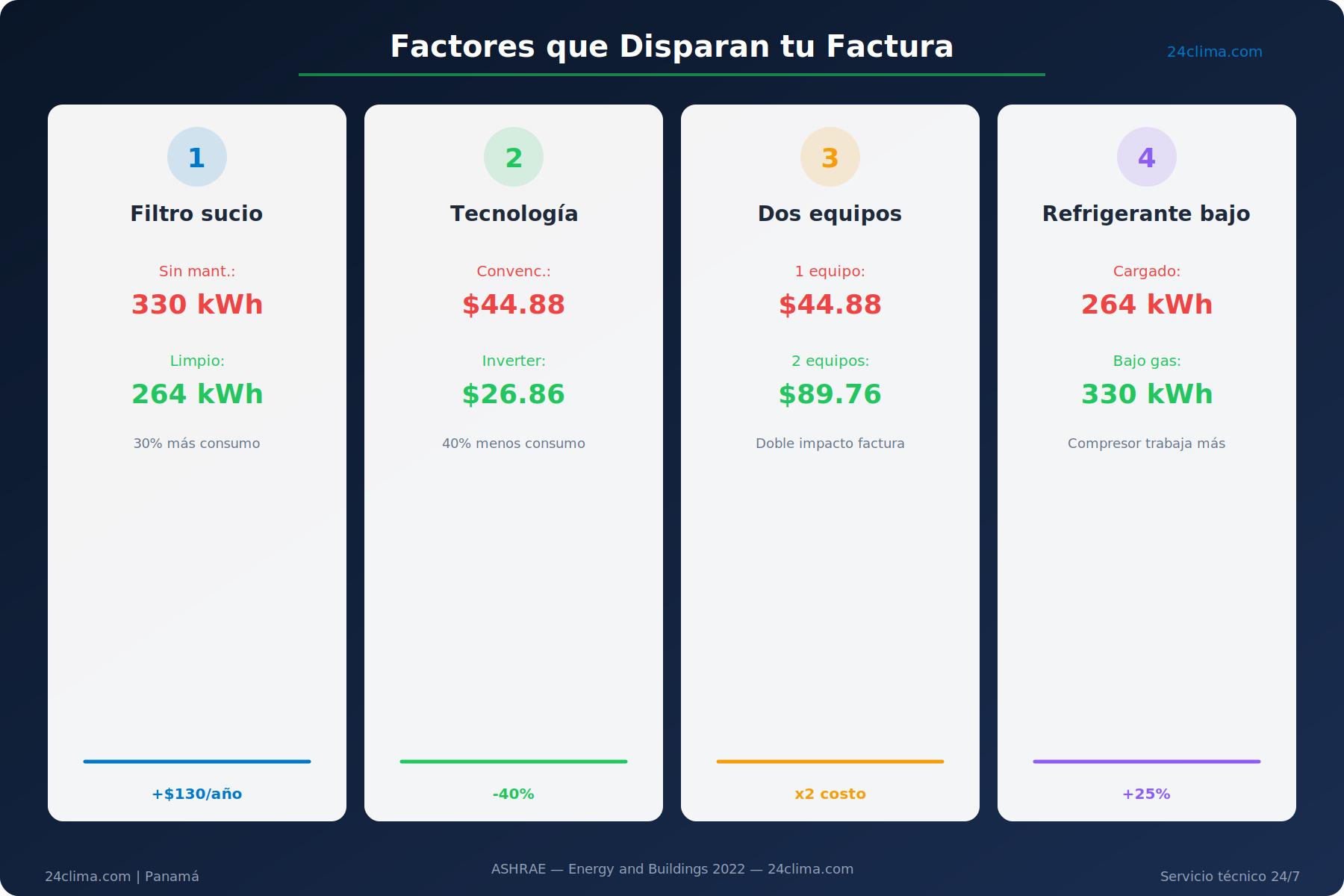
An air conditioner's energy consumption isn't fixed. Four factors can push it 15% to 40% higher without the unit showing any obvious signs of trouble.
Dirty filters and a fouled evaporator coil. A filter carrying three months of dust buildup restricts airflow and forces the compressor to run longer cycles. ASHRAE puts the efficiency penalty at 5% to 15% for every three months without cleaning in tropical environments with high dust and humidity — which describes every city in Panama.
Low refrigerant. A unit running with just 10% less refrigerant than its optimal charge consumes approximately 20% more energy to reach the same temperature, because the refrigeration cycle is operating outside its design parameters. In my experience, this is the most common finding in Panama units that haven't had preventive maintenance in more than 18 months.
Incorrect sizing. An oversized unit short-cycles — it starts and stops too quickly without properly dehumidifying the room. An undersized unit runs continuously and never quite reaches the target temperature. Both scenarios drive up consumption. If you're unsure whether your unit is correctly sized, the preventive maintenance service at https://24clima.com/servicios/mantenimiento/ includes a capacity verification.
Air sealing. A room with leaky doors or windows can increase the effective thermal load by 20% to 35%, making the unit work longer than necessary to compensate for the heat constantly entering the space.
How Much Does AC Add to an Electric Bill in Panama?
A single 12,000 BTU unit running 8 hours a day adds between $33 and $55 per month to your electric bill in Panama, based on the 2025 residential rate of $0.16 to $0.18/kWh from Naturgy/ENSA and Union Fenosa. With two units running overnight in separate bedrooms, the combined impact reaches $80 to $120 per month on top of the rest of your household consumption.
Do Inverter Air Conditioners Actually Reduce Electricity Use?
Yes, and the reduction is measurable. In tropical conditions equivalent to Panama's, inverter units consume between 30% and 45% less than conventional units of the same BTU rating, according to measurements published in Energy and Buildings (2022). In real money, that's between $15 and $22 in monthly savings per unit at 8 hours of daily use under current Panama electricity rates.
How to Calculate Your Exact Monthly AC Cost in Panama
Take the wattage listed on your unit's label or manual, multiply by your daily hours of use, multiply by 30 to get monthly kWh, then multiply by $0.17 (2025 average rate). Example: 1,100 W × 8 hours × 30 days = 264 kWh × $0.17 = $44.88 per month. If the unit is old or hasn't been serviced recently, add 15% to 30% to that figure.
Maintenance as a Savings Tool, Not an Expense
Here's the perspective that changes the math most dramatically for homeowners in Panama: preventive maintenance isn't a cost. It's a savings mechanism with a quantifiable return.
A complete service visit — evaporator cleaning, filter cleaning, condenser unit cleaning, refrigerant check, and electrical adjustment — typically runs $60 to $90 per unit in Panama. If that service recovers 20% of lost efficiency on a unit consuming 300 kWh per month, the savings come to 60 kWh, or $10.20 per month at current rates. The service pays for itself in under 9 months, and the savings keep coming after that.
For units that have gone more than 18 months without service, the efficiency recovery can be even greater. We've documented cases in San Francisco and Albrook where conventional 18,000 BTU units dropped from 380 kWh to 290 kWh per month after a full service — a savings of $15.30 per month, which adds up to $183.60 per year per unit.
If you're not sure what's going on with your equipment, use our diagnostic tool at https://24clima.com/diagnostico/ to identify the most common symptoms before calling a technician.
Remember that Naturgy bill that stopped you cold. It wasn't inevitable. Behind that number are variables you can actually control: the condition of your equipment, how regularly it gets serviced, and whether it makes financial sense to switch to inverter. At 24Clima we work with homes and businesses across the Panama metro area to turn that monthly bill into a predictable number — not a monthly surprise. If you'd like us to inspect your unit, calculate your real consumption, and walk you through your actual options, reach out on WhatsApp at https://24clima.com/contacto/. No fine print. No inflated diagnoses.
Last updated: May 2025.