AC Refrigerant Recharge — How Often Does It Actually Need One in Panama?
It's 2 PM in Costa del Este. The sun is hammering your apartment windows like it's trying to collect rent. You hit the AC button, hear the startup beep, feel the fan kick on... and the air coming out is warm. Not cold. Warm. Like the unit is exhaling disappointment instead of cool air.
Your first thought: "It's out of refrigerant." Your first move: call someone to recharge it. Logical. Reasonable. And almost always incomplete.
Because there's one critical fact that most technicians in Panama won't tell you — and it changes every decision you're about to make.
What Everyone Believes (And Why They're Wrong)
The most common belief about refrigerant is that it gets used up. That over time your AC gradually burns through it like engine oil or a water filter. That every so often you need to top it off as part of routine maintenance. This idea is so widespread in Panama that plenty of people schedule annual recharges the same way they renew their car insurance.
The technical reality is different: a properly sealed air conditioning system never loses refrigerant. It doesn't get consumed. It doesn't disappear. It doesn't evaporate over time. It circulates in a closed loop between the evaporator, compressor, and condenser — shifting between liquid and gas states 60 to 90 times per minute — without ever leaving the circuit.
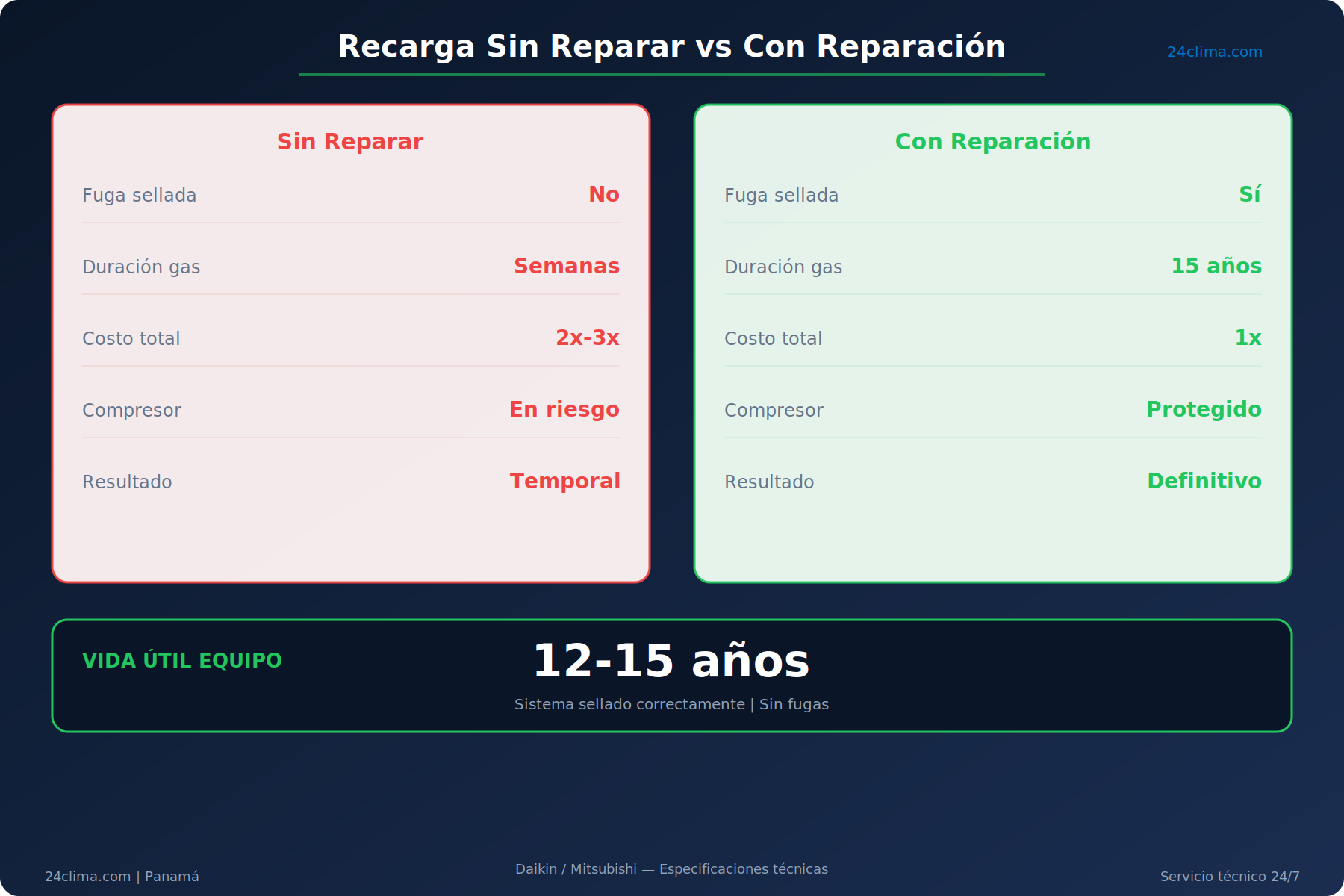
If your AC needs a refrigerant recharge, there is one specific reason: it has a leak. Full stop. This isn't a maintenance issue. It's a diagnosis. Recharging refrigerant without fixing the leak is exactly like filling a bucket that has a hole in the bottom — in weeks or months, you're right back to the same heat, the same problem, and the same expense.
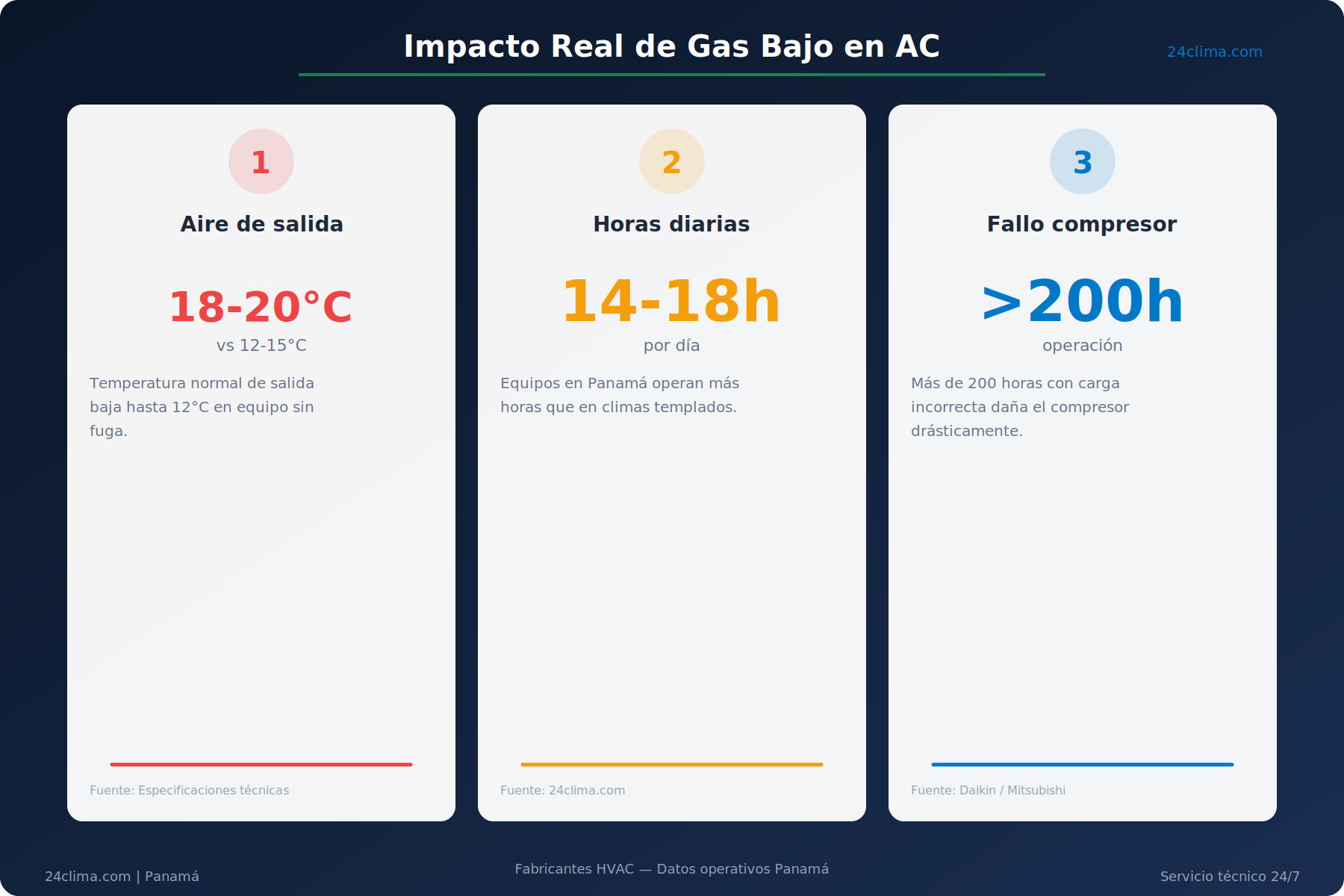
This distinction matters especially in Panama. A residential unit here runs 14 to 18 hours a day for much of the year, with outdoor temperatures hovering around 88-91°F (31-33°C) and relative humidity above 85% during rainy season. That kind of operating load accelerates wear on seals, connections, and valves — and makes it more likely that a small leak develops earlier than it would in a milder climate.
How Often Should Refrigerant Be Recharged? The Direct Answer
A properly installed air conditioner with no leaks does not need a refrigerant recharge at any point during its useful life — which averages 12 to 15 years. If you need a recharge before that, your system has a leak that must be diagnosed and repaired by a certified technician before any refrigerant is added.
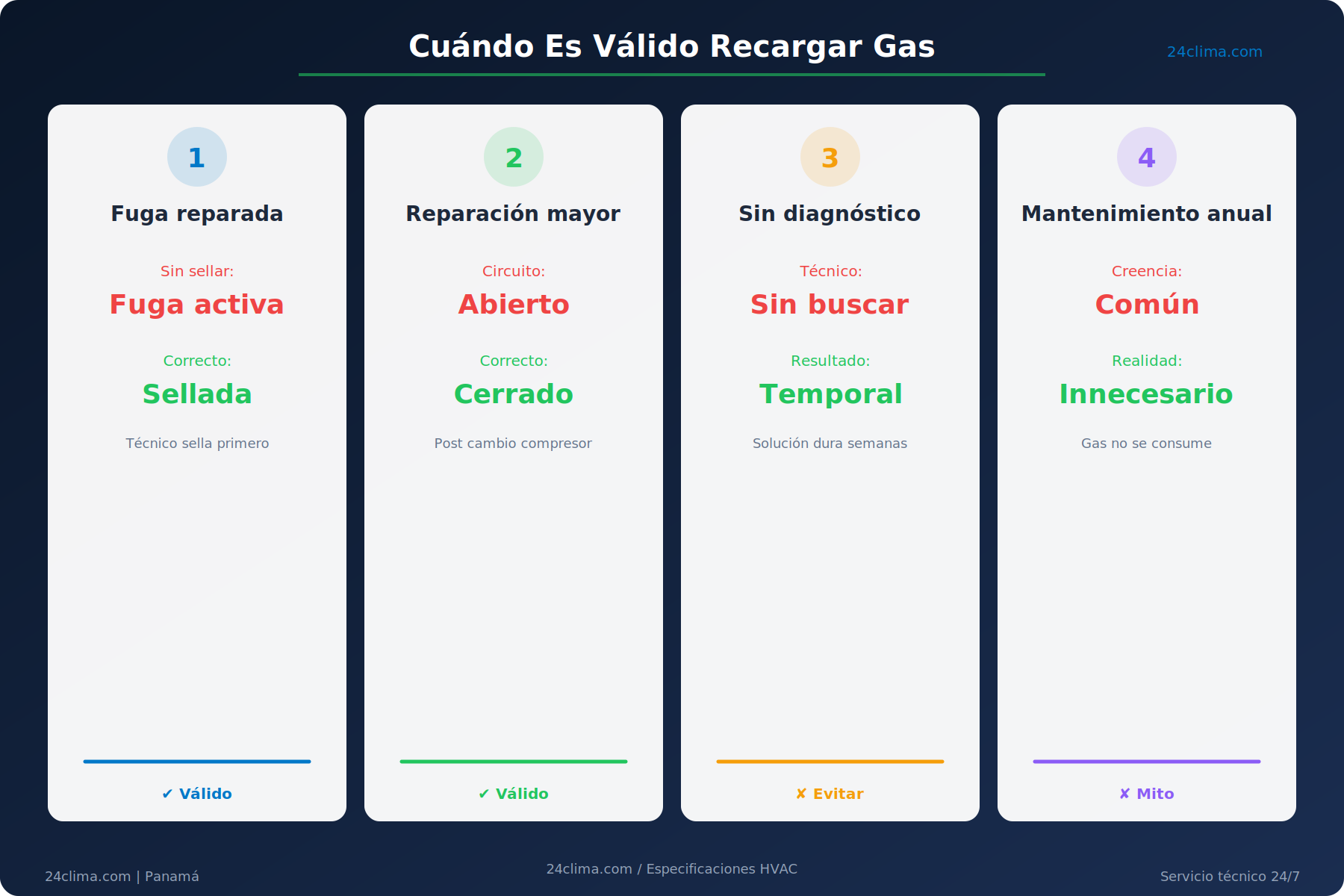
That said, there are two legitimate scenarios in Panama where a recharge is genuinely necessary:
After a repair — If the refrigerant circuit was opened to replace the compressor, evaporator, or another component, the system loses pressure and must be recharged. This isn't refrigerant loss from wear — it's a standard part of the repair process.
A confirmed and repaired leak — If the technician found and sealed the leak (by brazing, valve replacement, or line repair), recharging is the correct next step to restore the system to its proper operating pressure and refrigerant charge.
Everything else — a technician who shows up, adds refrigerant without looking for a leak, and leaves — is a temporary fix that will cost you twice.
You can find more in our guides and tips at https://24clima.com/consejos-y-guias/ to better understand what real preventive maintenance looks like for an AC unit running in the tropics.
The Real Warning Signs of Refrigerant Loss
An AC with low refrigerant shows specific symptoms. Catching them early lets you act before the compressor suffers irreversible damage — which is the most expensive outcome of ignoring a leak.
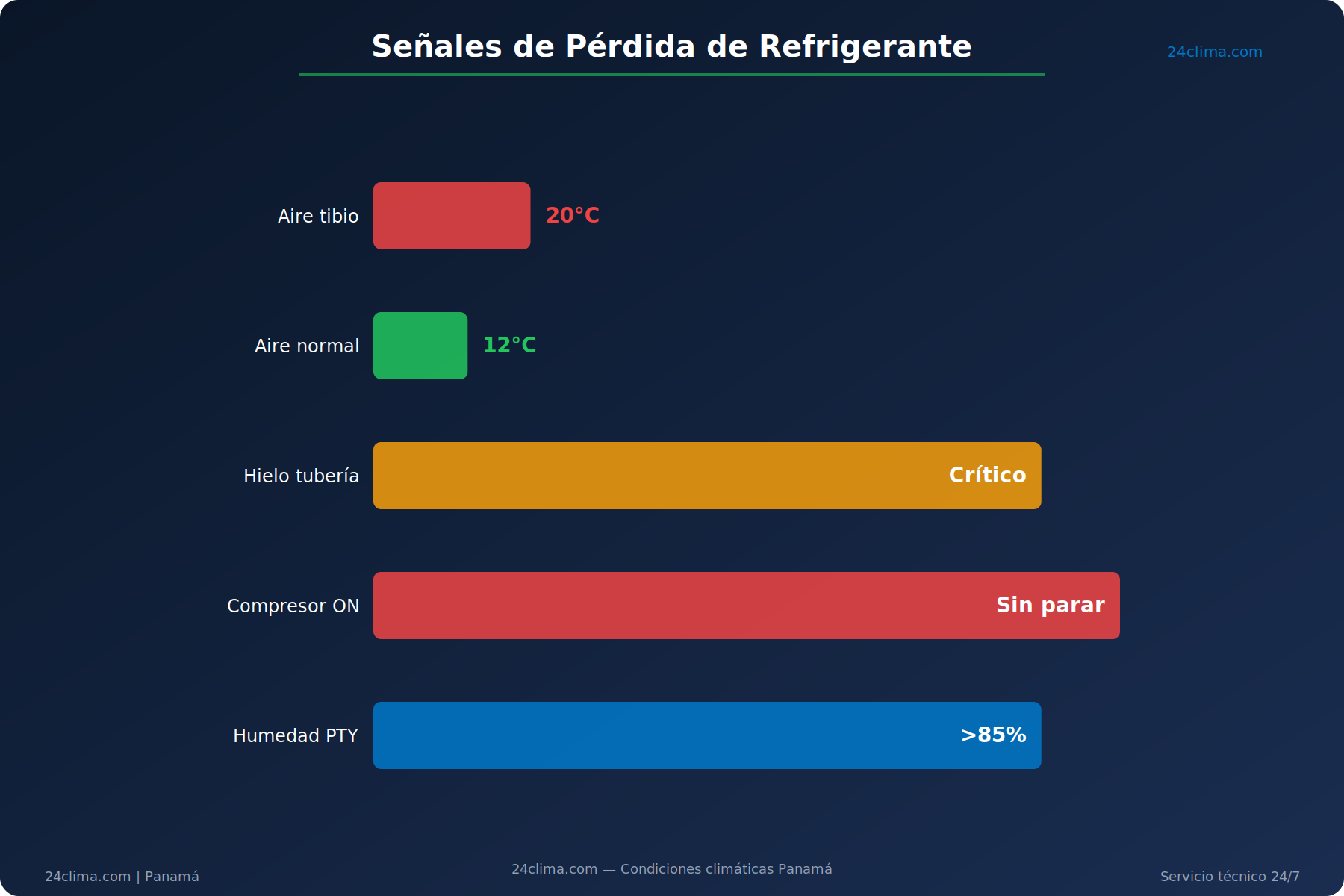
The air comes out warm or noticeably less cold than before. The unit starts, the fan runs, but the air temperature from the indoor unit doesn't drop below 64-68°F (18-20°C). Under normal operating conditions, the air coming out of the diffuser should be between 54 and 59°F (12-15°C). If you hold your hand in front of the vent and the air just feels slightly cool, something is wrong in the refrigeration cycle.
Ice on the evaporator or copper lines. This seems counterintuitive, but it's one of the clearest signs of low refrigerant. When refrigerant pressure drops below the correct level, the evaporator temperature falls too low at certain points, causes excessive condensation, and that condensation freezes. You'll see ice or frost on the copper lines connecting the indoor and outdoor units. The AC runs but doesn't cool the room.
The compressor runs hot and never shuts off. The compressor operates in cycles — it cools, reaches the target temperature, rests, then kicks back on. With low refrigerant, it never reaches the cutoff point because its heat-extraction capacity is insufficient. It runs continuously, overheats, and that dramatically shortens its lifespan. According to data from manufacturers including Daikin and Mitsubishi, running a compressor with incorrect refrigerant charge for more than 200 hours can reduce its service life by up to 40%.
Your electricity bill climbs without any change in usage. An AC running on low refrigerant consumes more electricity because the compressor never stops and never operates efficiently. If your bill jumped $20-35 per month with no changes in your habits, it's worth checking refrigerant pressure alongside filter and condenser cleaning.
The compressor sounds different. A compressor working outside its normal pressure parameters sounds off — not the knocking of a compressor about to fail, but a higher-pitched or more continuous hum than you're used to. If you know what your unit normally sounds like, you'll notice.
What is not a sign of refrigerant loss: water sounds, musty smells, or excessive dripping from the indoor unit. Those point to cleaning or drainage issues, not refrigerant.
How Much Does a Refrigerant Recharge Cost in Panama in 2025?
The real cost of a refrigerant recharge in Panama depends on three variables: the type of refrigerant, the amount needed, and whether the technician also locates and repairs the leak.
Here are the actual market rates in Panama for 2025:
R-22 (Freon): This refrigerant is being phased out globally under the Montreal Protocol. In Panama, availability is limited and the price keeps rising year over year. A full recharge for a 12,000 BTU unit can run $120 to $200 for the refrigerant alone. If your unit uses R-22, it's worth seriously evaluating whether to keep maintaining it or replace it with a modern system.
R-410A: The standard for over a decade. Recharge cost runs $60 to $100 for a residential split unit of 1 to 1.5 tons. Widely available from distributors across Panama. Most units installed between 2010 and 2022 use this refrigerant.
R-32: The current standard in newer equipment (2020 and onward), especially brands like Daikin, Midea, LG, and Samsung. It carries a lower global warming potential, runs more efficiently, and costs $50 to $85 per recharge for a standard residential unit in Panama. This is the refrigerant specified for new installations today.
On top of the refrigerant itself, add: Technical visit and diagnostic: $25 to $45 Leak detection (with gauges or electronic detector): $30 to $60 Leak repair depending on type and location: $40 to $150
In total, a properly done recharge — with leak diagnosis, repair, and refrigerant charge — runs $100 to $250. A quick recharge without diagnosing the leak might cost $60 today and another $60 in three months when the refrigerant escapes again.
For this work, the technician needs calibrated manifold gauges, knowledge of the correct operating pressures for your specific refrigerant type, and ideally an electronic leak detector. You can review our maintenance service at https://24clima.com/servicios/mantenimiento/ to understand what a complete technical inspection actually includes.
R-22, R-410A, or R-32? The Breakdown You Need
The type of refrigerant in your system isn't something you can choose freely. Every unit is engineered to operate with a specific refrigerant at a specific pressure. Mixing types or substituting without proper modification will destroy the compressor.
R-22: Obsolete. Production for new equipment was banned in most countries by 2020. In Panama, if your unit runs on R-22, you're buying recycled refrigerant at rising prices or evaluating a full replacement. Supply will keep shrinking and costs will keep climbing.
R-410A: Current and available. If your unit is between 3 and 12 years old, it most likely uses this. Efficient, well-documented, no supply issues in the Panamanian market right now.
R-32: The direction the industry is moving. Lower environmental impact (GWP of 675 versus 2,088 for R-410A), better efficiency in hot climates, and increasingly accessible. New units from premium brands in Panama already use it as standard.
The refrigerant label is always on the side of the outdoor unit. If you can't find it, the equipment manual specifies it clearly.
Frequently Asked Questions
How often does an AC need a refrigerant recharge in Panama?
In a leak-free system, never. A properly installed and sealed air conditioner holds its refrigerant charge for its entire service life of 12 to 15 years. If your unit needs frequent recharging, it has a leak that must be identified and repaired before refrigerant is added again.
What are the signs that my AC needs a refrigerant recharge?
The clearest signs are: air coming out warm even when the unit is running, visible ice or frost on the copper lines, a compressor that runs nonstop, and an electricity bill that rises without any change in usage. Any of these symptoms justifies a technical inspection with manifold gauges.
How much does an AC refrigerant recharge cost in Panama in 2025?
A proper recharge — including leak diagnosis, repair, and refrigerant charge — costs between $100 and $250 depending on refrigerant type and the scope of the repair. A recharge without diagnosis might run $60-100 but does not solve the underlying problem.
Is it normal for an AC to lose refrigerant over time?
No. Refrigerant loss always indicates a leak in the system. There is no normal wear process that consumes refrigerant. Units that always need recharging have a leak that no one has properly tracked down — and each recharge without repair progressively damages the compressor.
What type of refrigerant do modern AC units use in Panama?
Units installed from 2020 onward mostly use R-32. Units from the previous decade use R-410A. R-22 (Freon) is found only in older equipment, and its availability in Panama is increasingly limited and expensive.
Your AC Doesn't Need a Drink — It Has a Wound
Back to that apartment in Costa del Este. Warm air, spinning fan, that nagging feeling that something isn't right. Now you know the problem isn't that the unit ran out of refrigerant like a dead battery. Somewhere in that closed circuit, there's a leak — and that leak needs a proper diagnosis before it needs refrigerant.
Recharging without repairing is putting a bandage on something that needs stitches. It works for a while. Then you're back to the same heat, with a more worn-out compressor and less money in your pocket.
At 24Clima, we diagnose the real cause before we touch the refrigerant. We use calibrated manifold gauges, electronic leak detectors, and recharge protocols matched to the manufacturer specifications for each refrigerant type. If your unit isn't cooling the way it should, contact us on WhatsApp at https://24clima.com/contacto/ and we'll tell you exactly what's going on, what it costs, and whether it makes more sense to repair it or replace it. No commitment required — just answers.
Last updated: June 2025