Your Air Conditioner Is Making Noise — What It's Trying to Tell You Before It Breaks Down
It's 11 pm in San Francisco, Panama City. The temperature never dropped below 84°F all day and humidity is sitting at 87%. You turn on the bedroom split, wait for that familiar confirmation beep... and then you hear it. A rattling sound. A strange hum. Something that definitely wasn't there last week.
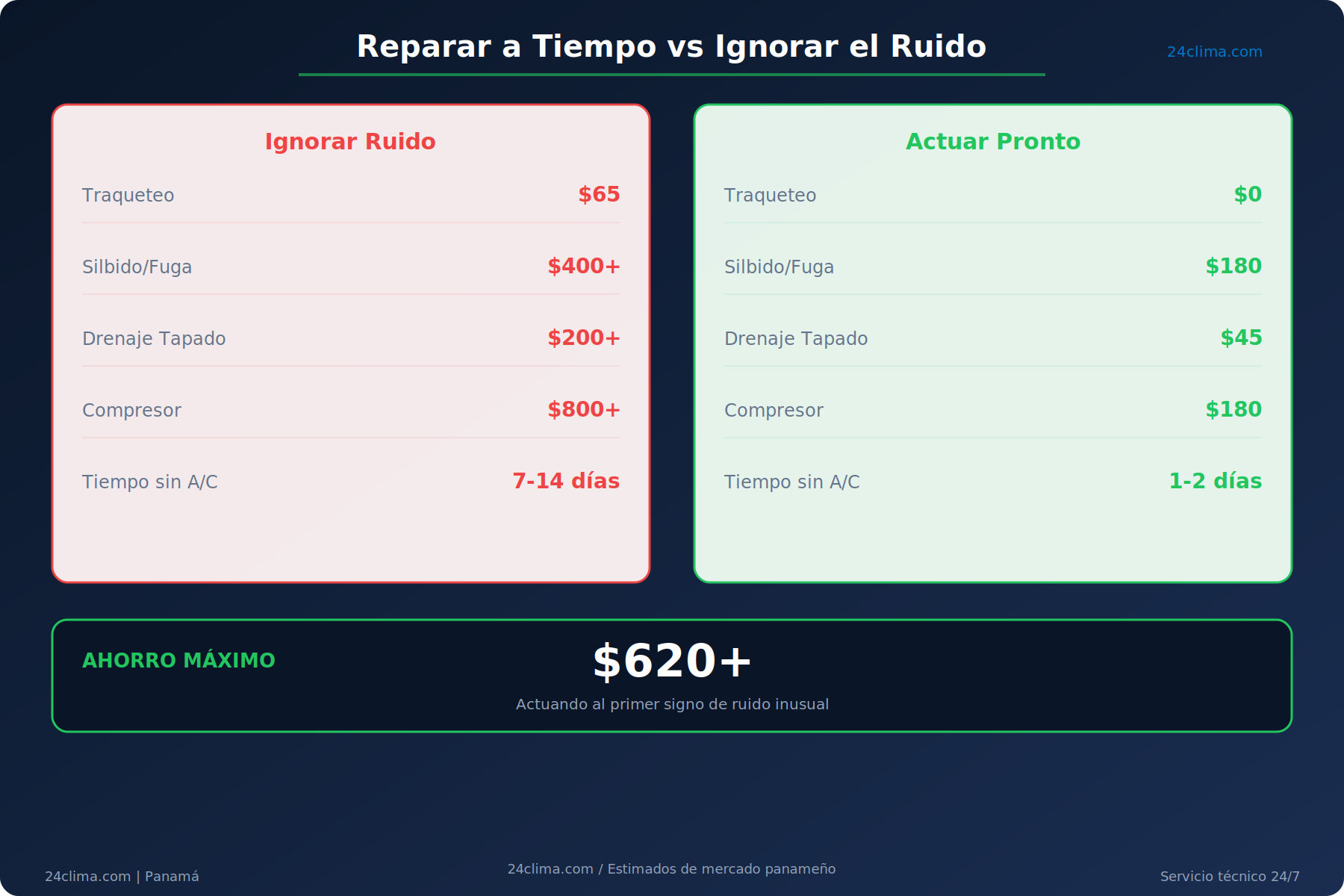
Your first instinct is to ignore it. "Probably normal. It's still cooling, right?" That's exactly the thinking that turns a $45 repair into a $400 one. Noises from an air conditioner aren't background ambiance — they're signals. And in Panama, where extreme heat, constant humidity, and urban dust all accelerate wear on critical components, ignoring an unusual noise can mean a burned-out compressor before the next dry season.
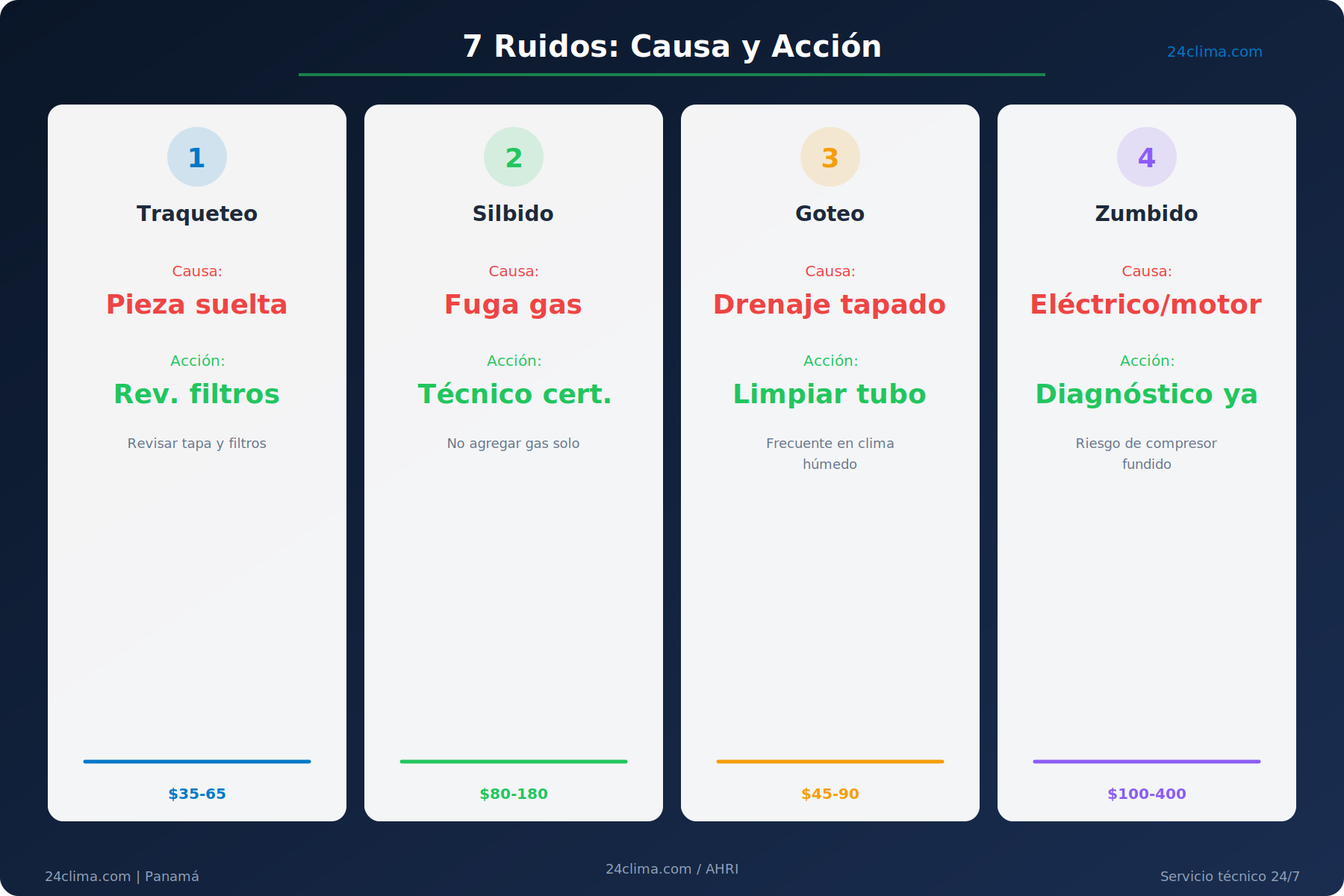
Below: the 7 most common noises in split systems, what causes each one, and what to do about it. No jargon, no unnecessary panic. For more on keeping your equipment running in Panama's climate, check out the guides and tips at https://24clima.com/consejos-y-guias/.
What Most People Believe (And Why They're Wrong)
The most common assumption is that noise from an air conditioner is just normal aging — and as long as it's still cooling, there's no real problem. That logic works with some appliances. With a split system in a tropical climate, it doesn't.
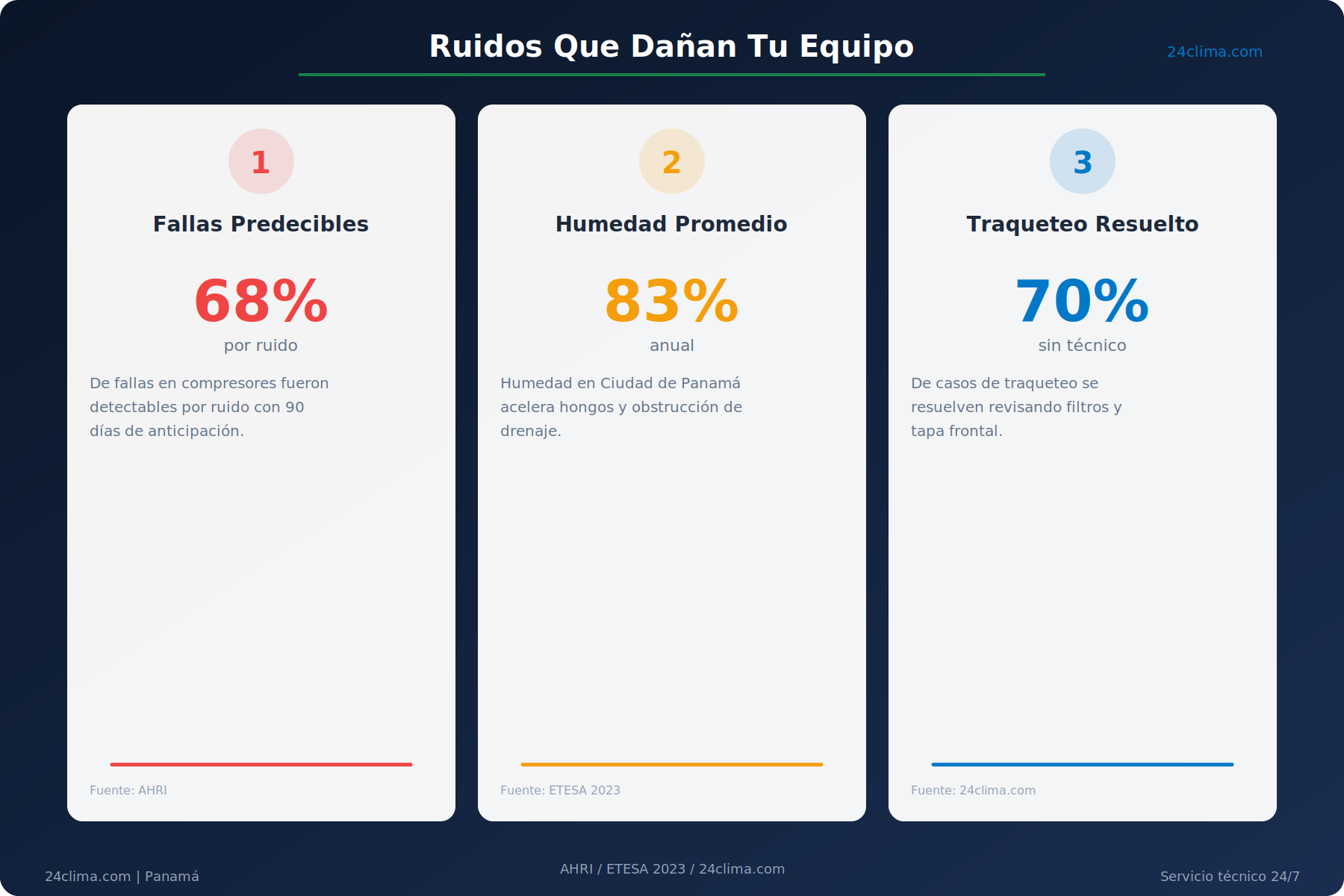
A unit that cools but makes strange noises is working harder than it should. That means higher electricity consumption, accelerated mechanical wear, and in almost every case, a major failure within 3 to 6 months. According to the Air-Conditioning, Heating, and Refrigeration Institute (AHRI), 68% of residential compressor failures originate from problems that were detectable by unusual noise 90 days or more in advance.
In Panama, that window shrinks fast. Average annual humidity of 83% (ETESA data for Panama City, 2023) means drain lines clog faster, fungal growth on the evaporator coil is exponentially more aggressive, and electrical components are under constant stress. Ignoring a strange noise for one month here is the equivalent of ignoring it for three months in a drier climate.
The 7 Most Common Noises and What They Mean
Every noise has a signature. Learning to recognize them is the difference between calling a technician at the right time and calling one when it's already too late.
Rattling
Direct cause: a loose object inside the unit, or a misaligned mechanical part — usually in the indoor unit (fan coil).
Rattling is the most common noise in systems that have been running in Panama for more than 2 years. Something is vibrating against the casing or another component. The usual suspects: filters that weren't reseated properly after a DIY cleaning, screws on the front cover that have worked loose from constant vibration, or insect debris and dust that got in through the return grille.
The good news is that 70% of rattling cases can be fixed without specialized tools. Turn off the unit, open the front cover, make sure the filters are properly seated, and look for any visible foreign objects. If the noise continues with everything in order, the problem is likely an unbalanced fan blade — and that requires a technician.
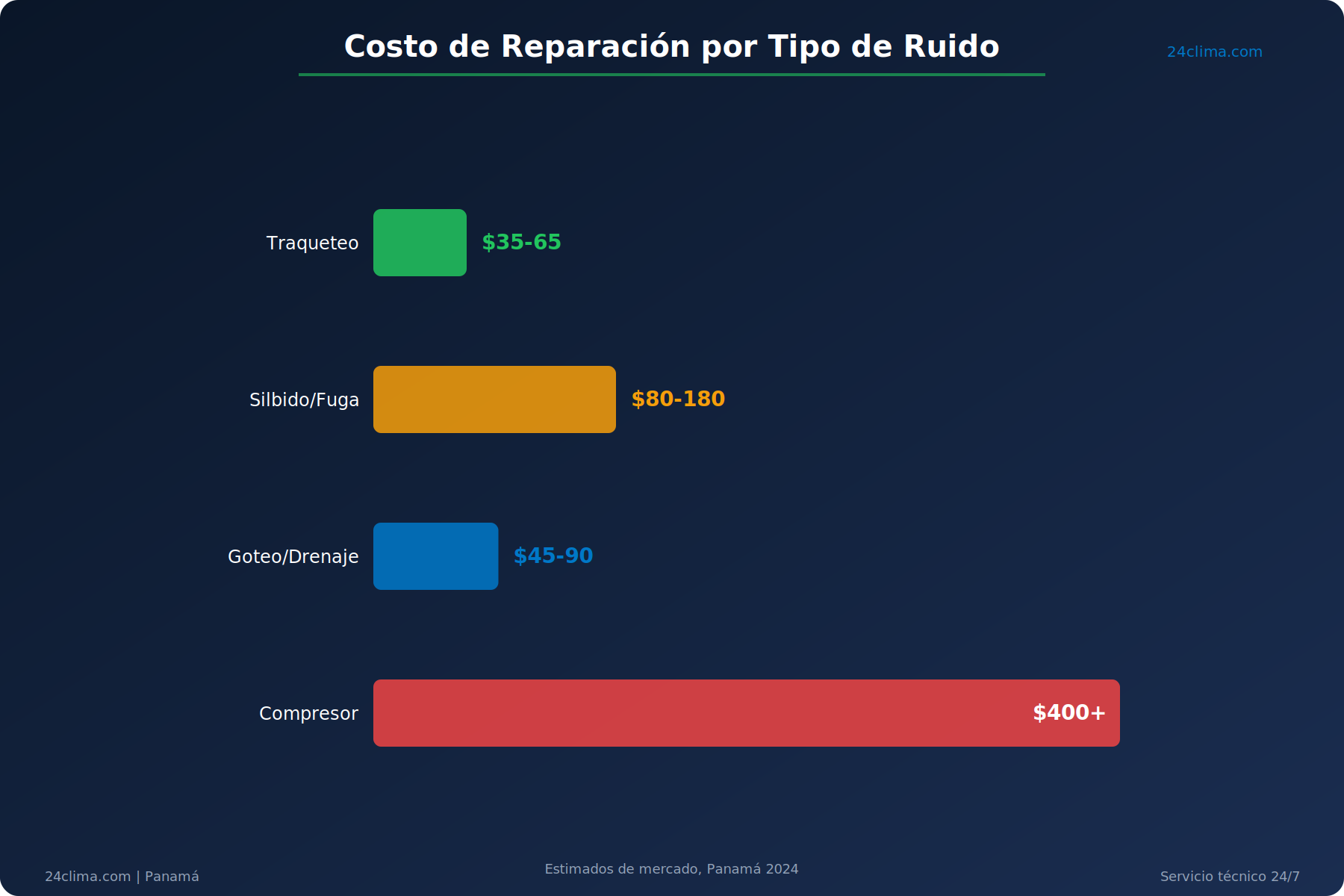
Estimated repair cost if a technician is needed: $35 to $65.
High-Pitched Whistling or Squealing
Direct cause: abnormal pressure in the refrigeration system, or a refrigerant leak.
A sharp, continuous whistle is a high-priority warning. In most cases it means refrigerant gas (R-410A in modern units, R-22 in units made before 2015) is escaping through a micro-crack in the line or at a connection point. It can also mean a filter so clogged that the unit is straining to pull in more air than it physically can.
Check the filter first. If it's black with dirt, clean or replace it. If the whistling continues with a clean filter, the most likely diagnosis is a refrigerant leak. Don't attempt to add gas yourself — handling refrigerants requires certified equipment, and in Panama, R-22 is being regulated under the Montreal Protocol. An improperly done recharge can permanently damage the compressor.
Estimated cost: $80 to $180, depending on the type of refrigerant and the size of the leak.
Audible Dripping
Direct cause: a saturated condensate pan or a blocked drain line.
Dripping inside the indoor unit during the first few minutes of operation is normal. The unit extracts moisture from the air as condensation, and that water drains through a tube to the outside. The problem starts when that tube gets blocked.
In Panama, mold spores and urban dust create blockages in drain tubes far more frequently than in dry climates. Research on indoor air quality in tropical buildings (International Journal of Environmental Research and Public Health, 2022) found that air conditioning systems in humid tropical climates accumulate biofilm in drain lines up to 4 times faster than in temperate zones. If the dripping is persistent or the unit starts leaking water into the room, the drain is blocked.
The fix is straightforward: a technician clears it with a blower and antifungal solution in about 30 minutes. Leave it for weeks, though, and you're looking at ceiling damage, short circuits in the control board, or mold growing in the air you're breathing every night.
Estimated drain cleaning cost: $45 to $75. This is included as part of the deep cleaning service at https://24clima.com/servicios/limpieza/.
Electrical Humming or Buzzing
Direct cause: an electrical issue with the capacitor, contactor, or compressor motor.
A deep, steady hum that wasn't there before usually comes from the outdoor unit. The capacitor is what starts and keeps running the compressor motor and fan. When it begins to fail, the motor has to work much harder to start — and that strain is exactly what you're hearing.
In Panama, voltage spikes are common, particularly during electrical storms in rainy season. A single spike without adequate surge protection can degrade a capacitor within months. Watch for a second warning sign alongside the hum: if the unit takes longer than usual to start, or cycles power several times before it kicks on, the capacitor is failing.
The part itself is inexpensive ($15 to $40), but replacement requires a qualified technician because the capacitor retains a dangerous electrical charge even when the unit is powered off.
Total replacement cost including labor: $65 to $120.
Repeated Clicking
Direct cause: a failing start relay or a problem with the control board.
One click when you turn the unit on or off is completely normal — that's the relay connecting or disconnecting the circuit. Repeated clicking during normal operation, as if the unit is trying to start and can't quite get there, is a different story.
Something in the startup system is failing. In units older than 5 years, it's usually the relay or contactor in the outdoor unit. In newer units with complex electronic boards, it could be a control board fault. Either way, this diagnosis requires a multimeter and technical knowledge — it's not something to troubleshoot without proper measurement tools.
Estimated cost: $80 to $250, depending on whether the issue is the relay or the full board.
Gurgling
Direct cause: refrigerant in an abnormal state in the suction line, or water in a partially blocked drain.
Gurgling is the sound of a liquid moving through where gas should be, or the reverse. In the refrigeration system, refrigerant should travel from the compressor as high-pressure gas. Gurgling in the lines can indicate incorrect refrigerant charge — too much or too little — or moisture contamination inside the system.
It can also be water moving through a partially blocked drain tube. The difference: drain gurgling is intermittent and sounds shallow. Gurgling within the refrigeration system is deeper, and sometimes comes with fluctuations in the air temperature coming out of the unit.
Either way, sustained gurgling calls for a technical inspection within 2 weeks.
Estimated cost: $45 to $180, depending on the source.
Metallic Screeching or Grinding
Direct cause: a worn fan motor bearing, or metal-on-metal contact.
This is the most urgent noise on this list. A sharp metallic screech — especially one that gets worse over time — means the fan motor bearing is dry or damaged. In Panama, bearing wear accelerates due to constant vibration and moisture entering the outdoor unit during rainy season.
If you hear this, turn off the unit immediately. A completely failed bearing stops the fan, which means the compressor runs without adequate heat dissipation and can burn out within minutes. A burned compressor is the most expensive repair in a split system, with costs ranging from $350 to $800 or more depending on the unit's capacity.
Bearing or motor replacement: $95 to $200. The cost of waiting: a full compressor replacement.
What Does It Actually Cost to Repair a Noisy Air Conditioner in Panama?
Real market ranges for Panama in 2024–2025:
— Filter and drain cleaning (minor noise from blockage): $45 to $75 — Capacitor replacement: $65 to $120 — Refrigerant recharge (minor leak): $80 to $180 — Fan motor or bearing replacement: $95 to $200 — Control board replacement: $150 to $300 — Compressor replacement: $350 to $800+
Acting on the first noise versus waiting for a complete failure is typically the difference between a $65 repair and a $600 one. Annual preventive maintenance in Panama runs between $60 and $95, and statistically reduces the probability of a major failure by 73%, according to ASHRAE Tropical Chapter HVAC maintenance data (2023).
To see what a complete maintenance visit in Panama actually includes, check out the air conditioning maintenance service at https://24clima.com/servicios/mantenimiento/.
Frequently Asked Questions
Why does my air conditioner make a loud noise when it starts up?
A brief noise at startup — a short rattle or thud — is normal for the first 2 to 3 seconds while the compressor and fans reach operating speed. If the noise lasts more than 5 seconds or gets more intense each time, that points to a problem with the start capacitor or motor. Get a technical inspection before the unit fails completely.
Is it normal for air conditioners to make more noise in Panama because of the humidity?
Humidity itself doesn't directly create noise, but it accelerates every process that does. Excessive condensation can overwhelm the drain, fungal growth on the evaporator coil creates irregular surfaces that disrupt airflow, and oxidation on metal components in the outdoor unit causes vibration. In Panama, where humidity exceeds 80% for most of the year, a unit without regular maintenance starts generating abnormal noises on average 40% faster than in drier climates. It's not inevitable — but it does require more frequent maintenance than most other countries.
How much does it cost to repair a noisy air conditioner in Panama?
It depends on the type of noise and its cause. Minor repairs like drain cleaning, tightening loose parts, or replacing a capacitor run between $45 and $120. Mid-range repairs like a refrigerant recharge or motor replacement go from $80 to $200. The worst-case scenario is compressor replacement, which can reach $800 or more in higher-capacity units. A professional diagnosis — which many companies offer at low cost or included with the service visit — is the first step to knowing exactly which category you're dealing with.
Not sure what your unit's symptoms are pointing to? Use the online diagnostic tool at https://24clima.com/diagnostico/ to get some direction before you call.
Back to That Night in San Francisco
That rattling at 11 pm doesn't have to end in a week without air conditioning and a $600 repair bill. The noises a split system makes follow a clear technical logic once you know how to listen. A whistle is different from a hum, and a hum is different from a screech. Each one points to a specific component, a specific process, a specific fix.
At 24Clima, we've spent more than 5 years diagnosing systems across every condition Panama's climate can throw at equipment — from the salt air in Punta Pacífica to the industrial dust out in La Chorrera. If your unit is making a noise you don't recognize, or if you want a checkup before the hottest months hit, reach out on WhatsApp at https://24clima.com/contacto/ and we'll tell you exactly what your unit has and what it costs to fix — no runaround.
Last updated: May 2025