Sankey Air Conditioners in Panama — Is It Worth Buying in 2025?
It's 2 p.m. in San Miguelito. The sun is hammering down on a zinc roof, 34°C outside, 87% humidity. You walk into the living room, grab the remote for your new Sankey 12,000 BTU split you picked up last weekend at Rodelag for $299, and wait. The room starts to cool down. So far so good.
Then the next month arrives. You open your Naturgy bill and the number doesn't add up. You're paying more than you did with the old unit you replaced. And the question starts nagging at you: did I buy the wrong equipment, or did I just not know what I was actually buying?
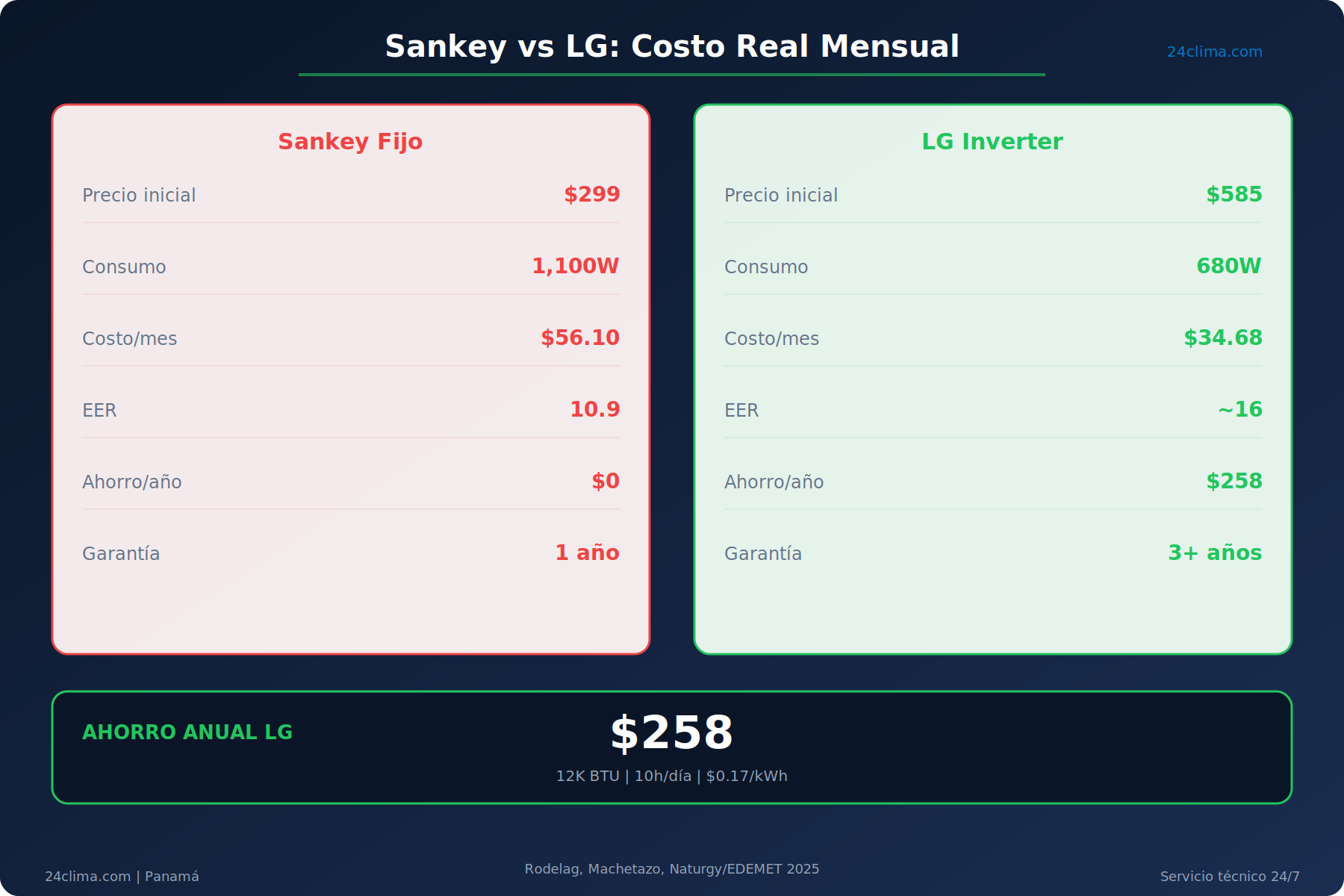
That story plays out more often than you'd think. The sticker price on a Sankey is genuinely tempting — and understandably so. When an LG Inverter starts at $550, a working air conditioner at $299 looks like an obvious deal. But buying an AC in Panama isn't won or lost at the register. It's won or lost on your electricity bill over the next five years. Below, 24Clima breaks down the Sankey models available in Panama, what they actually consume, how they stack up against LG, Samsung, and Carrier, and whether in 2025 they still make sense to buy.
What Most People Get Wrong About Budget Air Conditioners
The most common assumption among buyers in Panama is that all air conditioners with the same BTU rating consume the same electricity. "It's 12,000 BTU, same as the LG," people say. That's simply incorrect, and the mistake costs real money every single month.
The difference comes down to compressor type. A conventional fixed-speed unit — what the vast majority of Sankey models in the $250 to $350 range use — switches the compressor on at 100% capacity and shuts it off once it hits the target temperature, then cranks back up to 100% again. That constant start-stop cycle drives the highest electricity consumption, because motor startup draws the biggest surge of power.
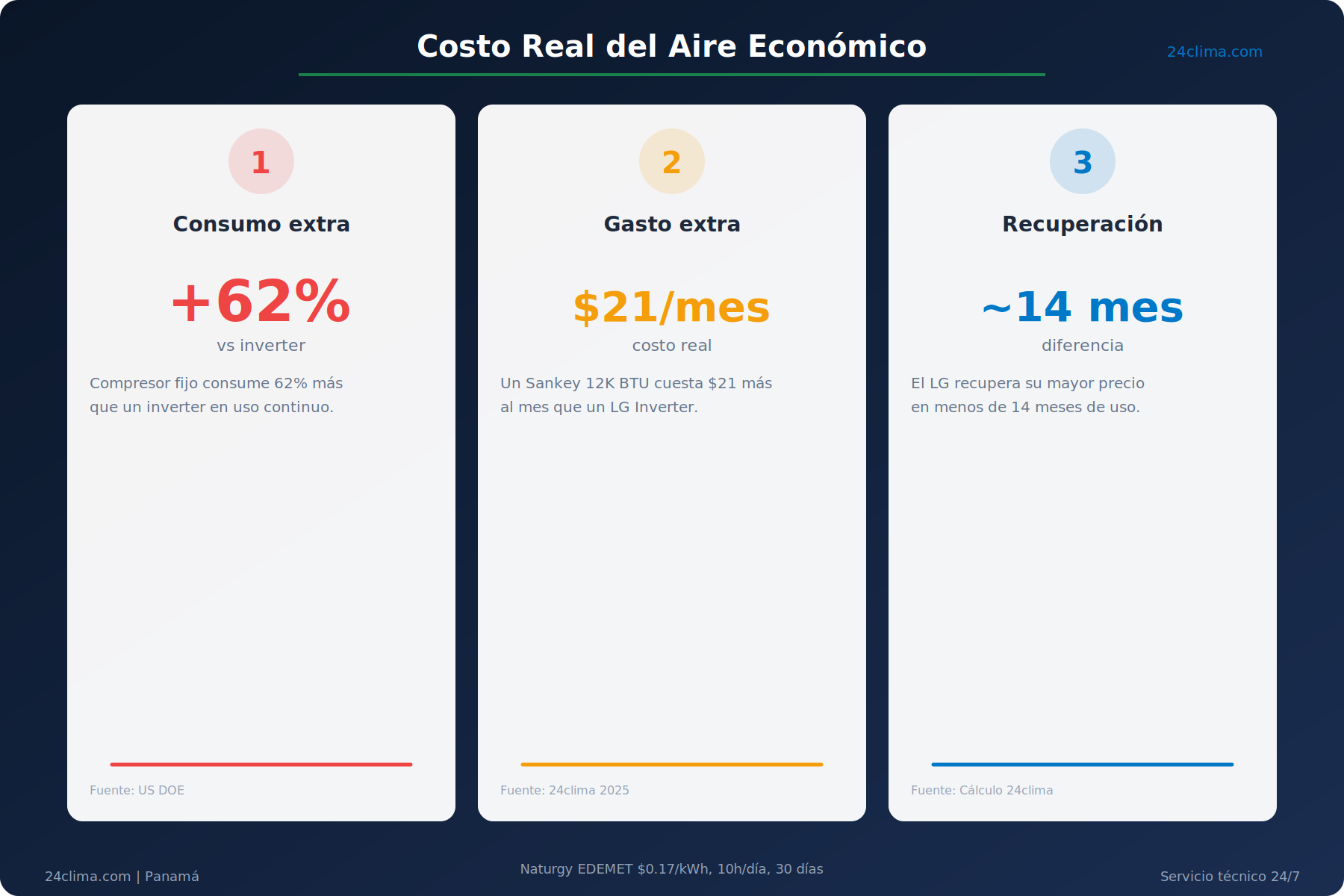
An inverter unit works differently. It modulates compressor speed — running at 30%, 50%, or 70% depending on what the room actually needs. U.S. Department of Energy data shows an inverter compressor can consume 30% to 50% less electricity than a fixed-speed unit under continuous operating conditions. In Panama, where AC units run 8 to 12 hours a day for most of the year, that gap translates to $20 to $45 less per month depending on the model and your electricity rate.
The majority of Sankey models available in Panama in 2025 are fixed-speed units. That doesn't automatically make them bad, but it completely changes the math on whether they're actually economical.
Sankey Models Available in Panama: BTU, Voltage, and Real Consumption
Sankey in Panama is distributed primarily through Rodelag and at some Do It Center locations. The highest-volume models in 2025 are wall-mounted split units, cooling only:
— Sankey 9,000 BTU / 110V: approximate price $249 to $275. Nominal compressor consumption: 850W. Startup current draw: 4 to 5 amperes above nominal.
— Sankey 12,000 BTU / 110V: approximate price $289 to $320. Nominal compressor consumption: 1,050W to 1,150W. Top-selling model at Rodelag based on search result positioning.
— Sankey 18,000 BTU / 220V: approximate price $380 to $420. Nominal consumption: 1,700W. Requires 220V electrical installation — add $80 to $150 if that circuit doesn't already exist.
— Sankey 24,000 BTU / 220V: approximate price $450 to $490. Nominal consumption: 2,200W to 2,400W. Suitable for large living areas or small commercial spaces.
All of these models run on R-410A refrigerant, the current standard in Panama. None of the low-to-mid range Sankey models include true inverter technology. Some distributors advertise "inverter" Sankey models for 2025, but the actual technical data sheets show an EER of 10 to 11 BTU/W — that's a standard conventional unit, not a real inverter.
Price, Efficiency, and Real Monthly Cost: Sankey vs LG vs Samsung vs Carrier
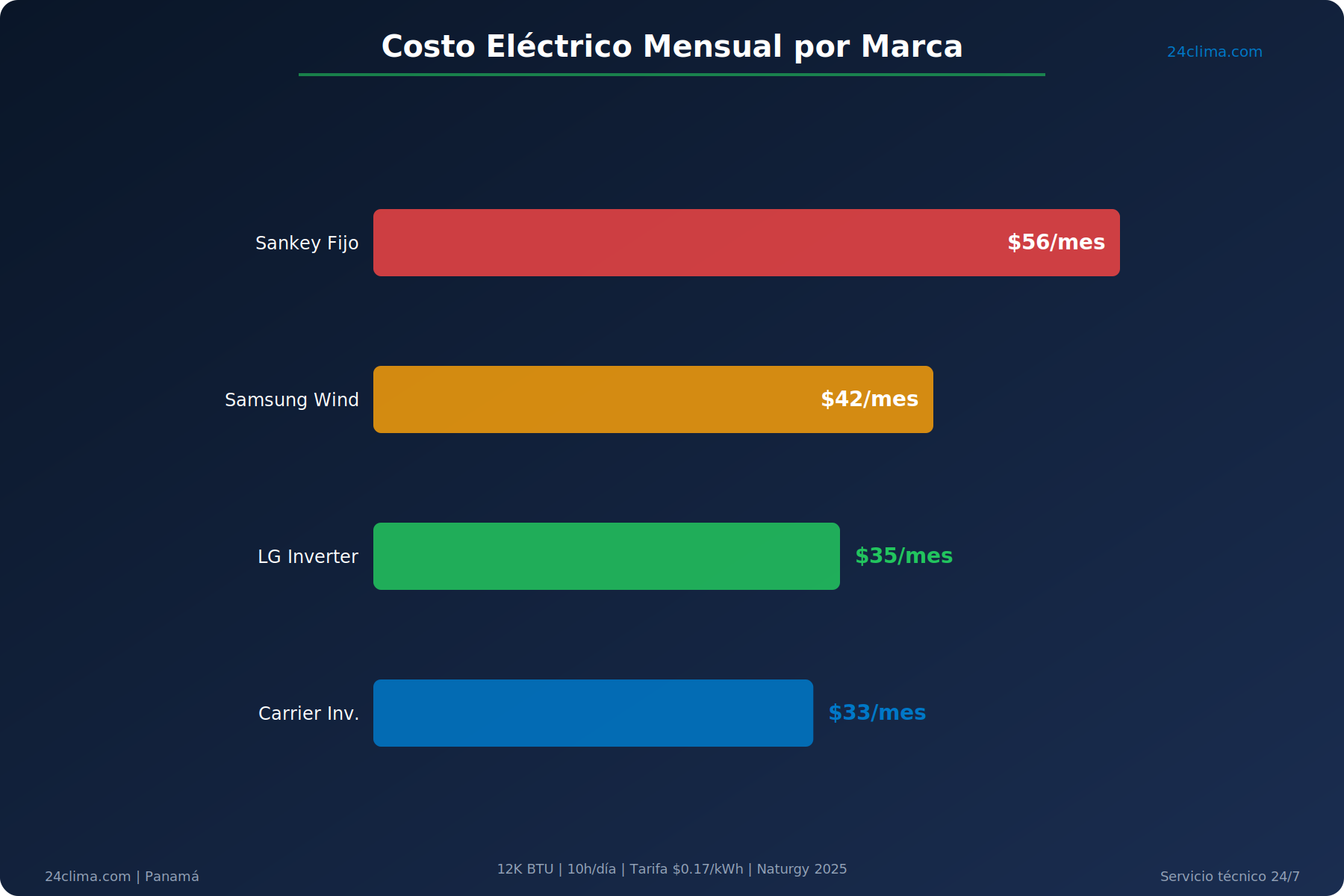
This is the comparison you need to see before signing the receipt. Prices reflect list prices observed at Rodelag, Machetazo, and authorized distributors in Panama during the first quarter of 2025. Monthly cost calculations use the Naturgy/EDEMET residential rate of $0.17 per kWh — the average rate in the 300 to 500 kWh monthly consumption range, the most common tier for Panamanian households that already run air conditioning.
The calculation assumes 10 hours of daily use over 30 days, which reflects actual usage patterns across both dry season and rainy season in Panama.
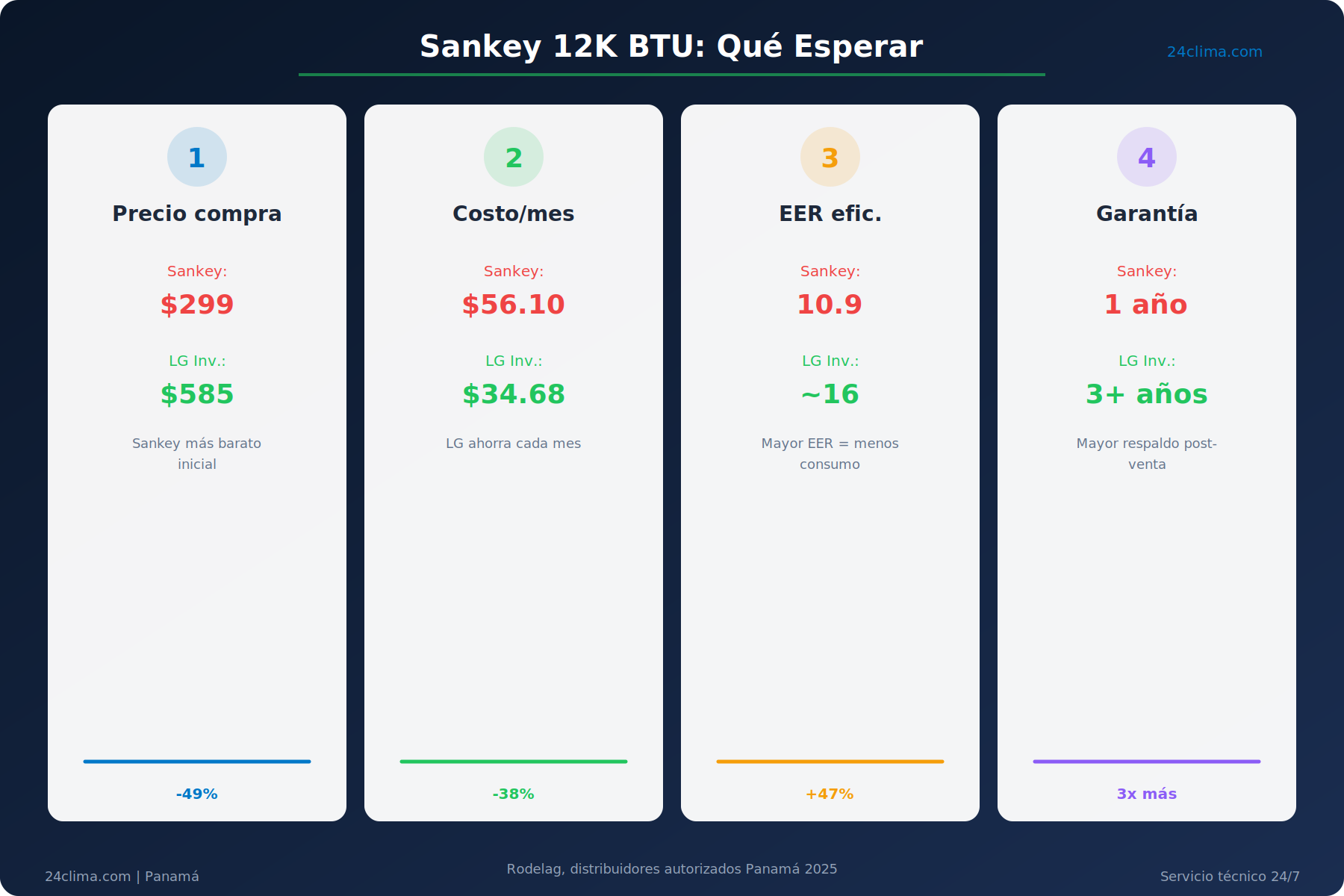
Sankey 12,000 BTU (fixed speed) — Initial price: $299 — Nominal consumption: 1,100W — Estimated monthly electricity cost: $56.10 — EER: 10.9 — Typical warranty: 1 year on compressor
LG 12,000 BTU Dual Inverter (S4-W12JA3WB or similar) — Initial price: $550 to $620 — Average consumption under continuous operation: approximately 680W — Estimated monthly electricity cost: $34.68 — Real-world EER equivalent: 17.5 to 19 — Compressor warranty: 10 years
Samsung 12,000 BTU WindFree Inverter — Initial price: $580 to $650 — Real average consumption: 700W — Estimated monthly electricity cost: $35.70 — Real EER: 17 to 18 — Compressor warranty: 5 years
Carrier 12,000 BTU (standard line available in Panama) — Initial price: $480 to $540 — Nominal consumption: 900W to 950W — Estimated monthly electricity cost: $45.90 — EER: 12 to 13 — Compressor warranty: 5 years
The electricity cost difference between the Sankey and the LG Dual Inverter is $21.42 per month. Over 12 months, that's $256.80. Over three years, $770 in electricity alone. The price gap between the Sankey ($299) and the LG ($580) is $281 — meaning the LG pays for itself through electricity savings in roughly 13 months, then keeps generating net savings for years after that.
That's the calculation Rodelag doesn't put on the price tag.
How Panama's Climate Actually Hits Fixed-Speed Units
An air conditioner in Panama doesn't face the same conditions as one running in Europe or California. The tropics present a specific combination of factors that directly affects how a fixed-speed unit performs and how long it lasts.
Sustained outdoor temperatures. In Panama, outdoor temperatures hold between 30°C and 35°C (86°F to 95°F) for 8 to 10 hours a day during dry season. A fixed-speed compressor runs at maximum load almost constantly because the thermal gap between outside and inside demands continuous effort. That accelerates wear on internal components — bearings, valves, motor windings — faster than the spec sheet suggests.
High relative humidity. With average humidity running 80% to 90%, the unit's evaporator carries a heavy dehumidification load on top of the cooling load. Budget units typically use smaller coils with lower fin density, which reduces actual moisture extraction capacity. The result: the room drops in temperature but still feels damp — especially on rainy nights when humidity spikes above 90%.
Voltage fluctuations. In areas like Colón, La Chorrera, and parts of San Miguelito, grid voltage swings more frequently than in neighborhoods like Costa del Este or Punta Pacífica. Budget-tier units have more basic electrical protection, making them more vulnerable to damage from those swings.
Panama's Ministry of Energy (MICI) data from its 2023 residential energy efficiency report shows air conditioning accounts for 40% to 60% of total electricity consumption in Panamanian households that run AC regularly. A low-efficiency unit in that context isn't a minor expense — it's the single largest electricity cost in your home.
Where to Buy Sankey in Panama and What Installation Actually Costs
Sankey is available primarily at Rodelag, which carries the widest stock. It also appears at Do It Center and occasionally at El Machetazo depending on season and inventory. The shelf price covers the equipment only — installation is separate.
Professional split AC installation in Panama runs $120 to $200, depending on:
— Length of copper line set (base price typically covers up to 3 linear meters) — Whether a new electrical circuit is required (add $80 to $150 for a 220V point) — Floor level and access difficulty for the outdoor condenser unit — Whether the installer includes the metal bracket for the condenser — some charge this separately
A 24Clima technician can handle installation and inspection for any brand. If you buy a Sankey at Rodelag, make sure whoever installs it offers a written labor warranty — not just a verbal mention from the salesperson on the floor.
Our maintenance service covers units from all brands, including Sankey, and catches problems before they become expensive repairs. Full details at https://24clima.com/servicios/mantenimiento/.
10 Questions to Ask Before Buying a Budget AC in Panama
Before you sign the receipt at Rodelag or anywhere else, get clear answers on these — either from the salesperson or directly from the product spec sheet:
— Is the compressor inverter or fixed-speed? (Check the EER: below 14 means conventional) — What is the nominal watt consumption of the compressor? (You need this number to estimate your bill) — Is the compressor warranty 1 year or longer? (Less than 3 years is a warning sign) — Who handles warranty service in Panama? (Is there a local service center, or does everything go overseas?) — Does the unit include an antibacterial air filter or just a dust filter? — Does the required voltage match your existing electrical setup? (110V vs 220V matters) — Does the price include installation or just the unit? — Does the installer have hands-on experience with that specific model? — Does the unit use R-410A or R-32? (R-32 is more efficient and already available in premium models in Panama) — Can you review the technical manual before buying to confirm the real specifications?
Frequently Asked Questions About Sankey Air Conditioners in Panama
Is Sankey a good AC brand for Panama's climate?
Sankey works as a basic solution in small spaces on a tight budget. For Panama's conditions — outdoor temperatures above 31°C (88°F) and humidity at 85% — a fixed-speed unit carries a heavier workload than it would somewhere more temperate. That doesn't make it incapable, but it does cut the expected service life from the 10 to 12 years you'd get from a premium inverter down to 5 to 7 years under intensive tropical use. If the budget genuinely doesn't stretch to an inverter, Sankey is a viable option — just not the optimal one.
How much electricity does a Sankey air conditioner use per month in Panama?
A Sankey 12,000 BTU with a 1,100W compressor, running 10 hours a day for 30 days, consumes approximately 330 kWh per month. At the Naturgy/EDEMET residential rate of $0.17 per kWh in the 300 to 500 kWh range, that one unit runs around $56 per month in electricity. If other loads in the home push consumption above that tier, the effective rate rises — and the real monthly cost for that unit alone can reach $60 to $68.
Where can you buy a Sankey air conditioner in Panama and what does it cost?
Sankey is distributed primarily through Rodelag, with locations across Panama City, Chiriquí, and Colón. It also appears at Do It Center and occasionally at El Machetazo. In 2025, prices range from $249 for the 9,000 BTU model up to $490 for the 24,000 BTU unit. Installation adds $120 to $200 depending on the complexity of the job.
The Final Call: Sankey in 2025 or Wait a Little Longer?
Back to San Miguelito. That living room at 2 p.m. If your available budget today is $299 and there's genuinely no room to stretch it, a properly installed Sankey gives you real thermal relief. It's not a trap — it's a tool with clearly defined limitations.
But if you can pull together $550, the math changes completely. An LG Dual Inverter pays back the price difference through electricity savings in just over a year, then keeps working for a decade with a compressor warranty behind it. In Panama, where air conditioning runs 12 months a year as a daily necessity rather than a seasonal comfort, efficiency isn't a technical footnote — it's a financial decision that shows up on your bill every single month.
At 24Clima, we assess your space, calculate the exact capacity you need, and give you real numbers on what you'll pay in electricity with each option — no equipment sales, no commission driving the recommendation. If you have questions about which AC makes sense for your home, apartment, or office in Panama, reach out on WhatsApp at https://24clima.com/contacto/ and we'll respond with data, not marketing language.
Last updated: May 2025. Prices and electricity rates based on Panama market conditions as of the first quarter of 2025.