SEER Rating in Air Conditioning — The Number That Decides How Much You Pay for Electricity Each Month in Panama
It's 2 PM in Costa del Este. The sun drops straight down onto the concrete. The thermometer reads 33°C (91°F), but with the sticky Pacific humidity it feels closer to 40°C (104°F). You get home, hit the remote, and hear that familiar sound — the compressor kicking in, the rush of cold air starting to pull the temperature down.
Instant relief. But somewhere across the city, inside the offices of ENSA or Naturgy, a meter spins a little faster with every hour your unit runs.
At the end of the month, you open the bill and the number hits you. You don't understand why it's so high when the room feels cold. Here's the problem: the cold you feel and the efficiency with which your unit produces that cold are two completely different things. That difference has a technical name almost nobody knows when they buy their air conditioner — SEER. At 24Clima's guides and tips section you'll find more on choosing and maintaining your equipment, but this article zeroes in on that one rating. In Panama, it can mean a difference of $200 or more on your electricity bill every single year.
What Most People Believe — And Why They're Wrong
Most people in Panama choose their air conditioner by looking at two things: BTU capacity and purchase price. Room around 150 square meters? Find an 18,000 BTU unit and buy the cheapest one in that range. Done.
That logic holds up the first month. The room gets cold. Everything seems fine.
The problem shows up in month three, month six, year two. A unit with the right BTU rating but a low SEER runs longer, consumes more electricity, and generates more heat in the external compressor — all to produce exactly the same cooling as an efficient unit. You don't see it. You feel the same cold air. But the ENSA meter sees it clearly and bills you for it every thirty days.
The real trap: that cheap low-SEER unit might cost $150 less at the point of sale, but you pay that "savings" back within 8 to 14 months of operation. After that, you're losing money every single month for the remaining life of the equipment — somewhere between 12 and 18 years.
What SEER Actually Means in an Air Conditioner
SEER stands for Seasonal Energy Efficiency Ratio. It measures how many units of cooling energy (in BTU) a unit produces for every unit of electrical energy it consumes (in watt-hours). The higher the number, the more efficient the unit.
The math is straightforward: SEER = total seasonal BTU of cooling output divided by total watt-hours of electricity consumed in the same period.
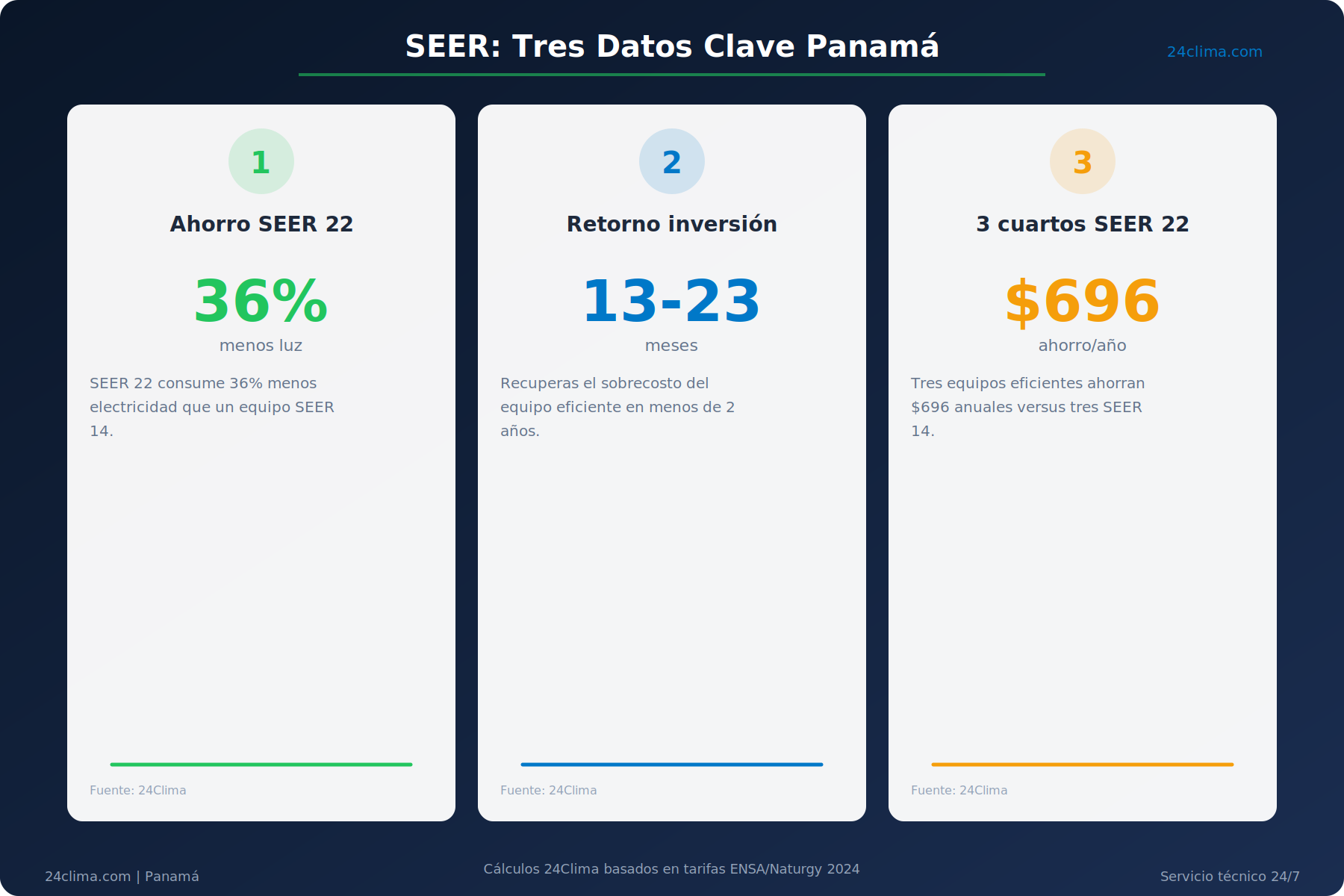
A SEER 14 unit produces 14 BTU of cooling per watt-hour consumed. A SEER 22 unit produces 22 BTU for that same watt-hour — which means it does the same cooling job using approximately 36% less electricity.
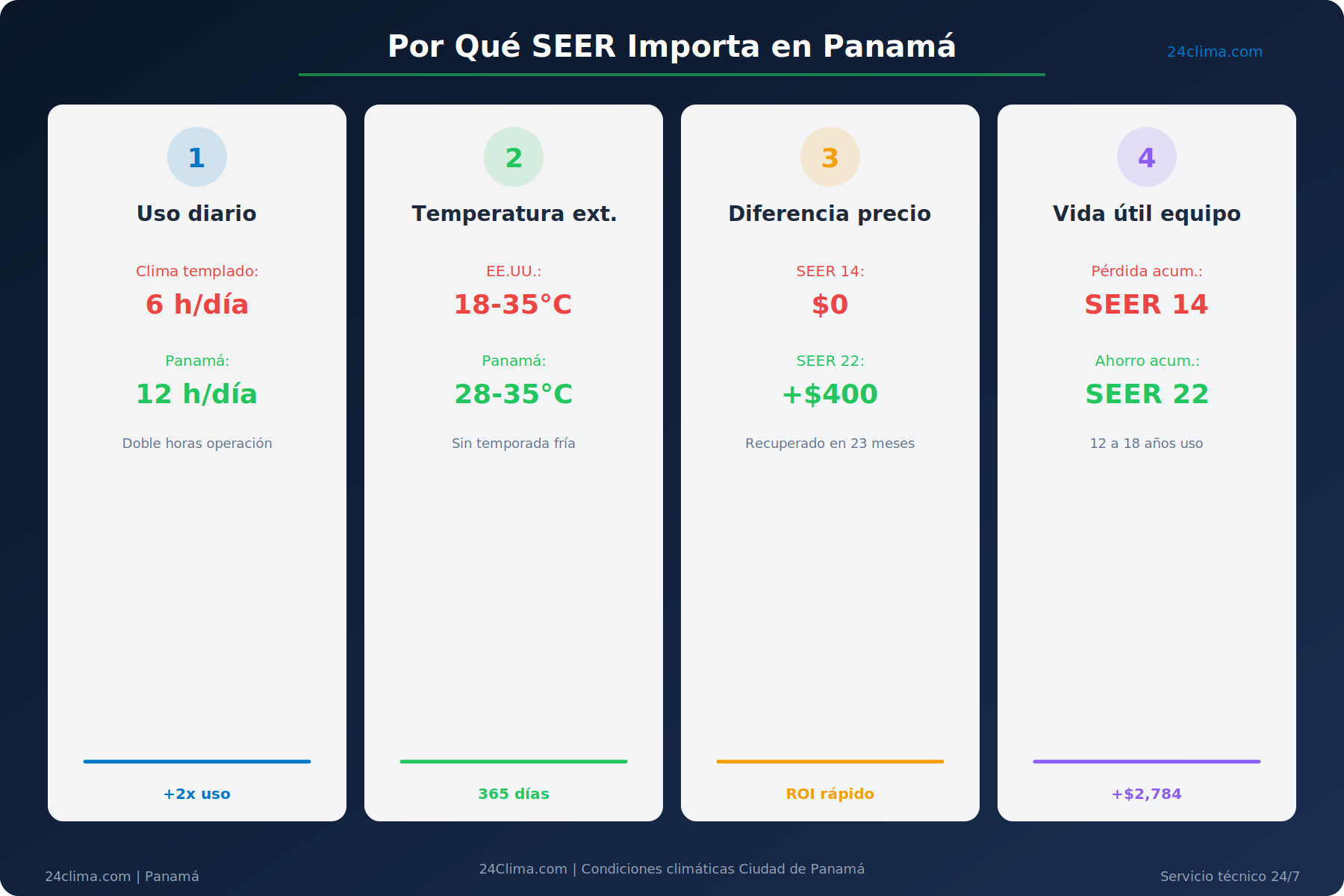
One thing most sellers won't tell you: the SEER rating was originally calculated for US climate conditions, where equipment runs across seasons with real temperature swings. Panama has none of that. Your unit runs at maximum load for 10 to 14 hours a day, 365 days a year, with outdoor temperatures that rarely drop below 28°C (82°F). The inefficiency of a low-SEER unit accumulates far faster here than in any market this rating was originally designed for.
SEER 14 vs SEER 18 vs SEER 22 — What It Actually Means for Your Wallet
Real numbers, real Panama conditions. A 12,000 BTU (1-ton) unit running 12 hours a day, 365 days a year. Residential rate from ENSA/Naturgy at roughly $0.17 per kWh — where most Panama City households land in the mid-to-high consumption block.
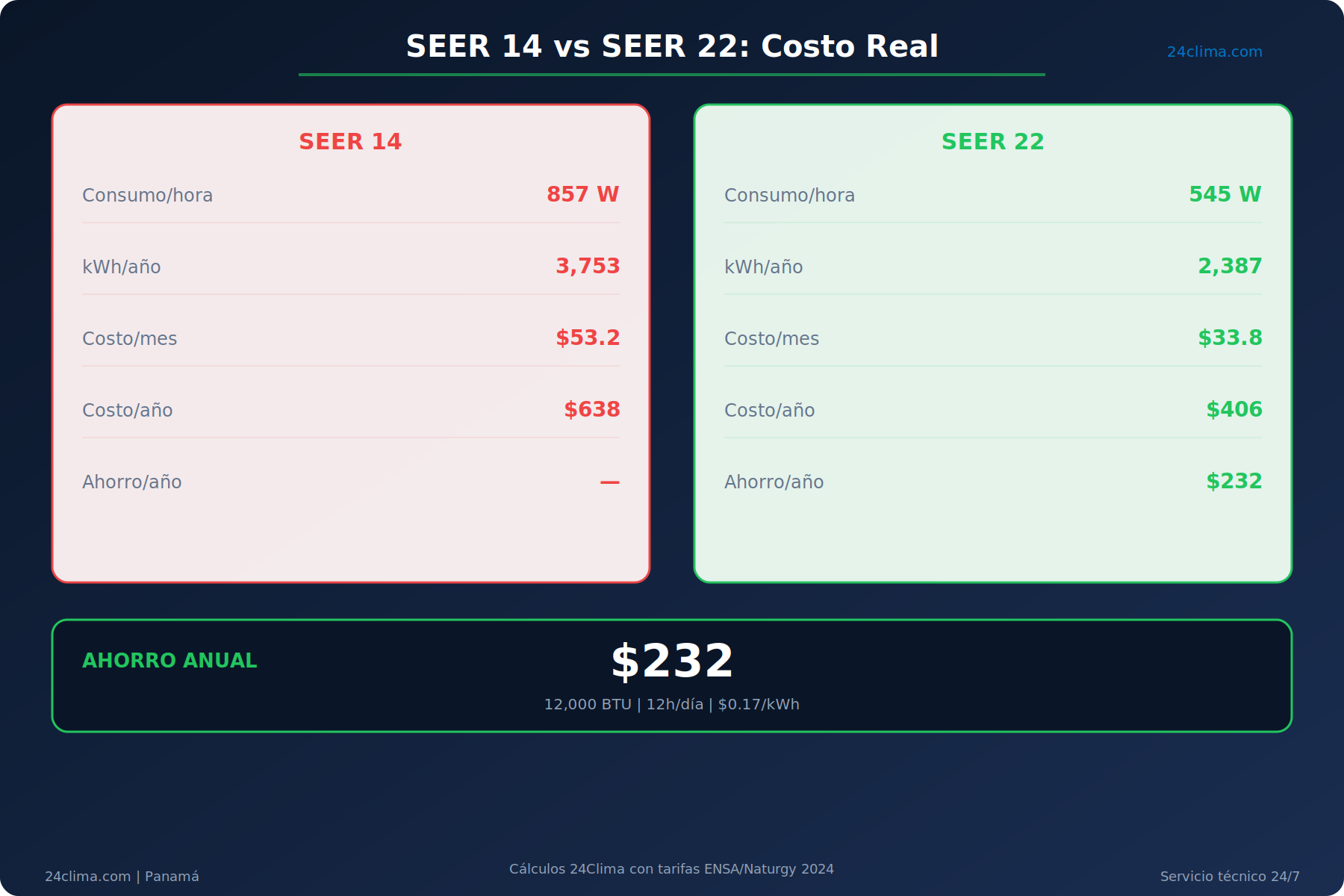
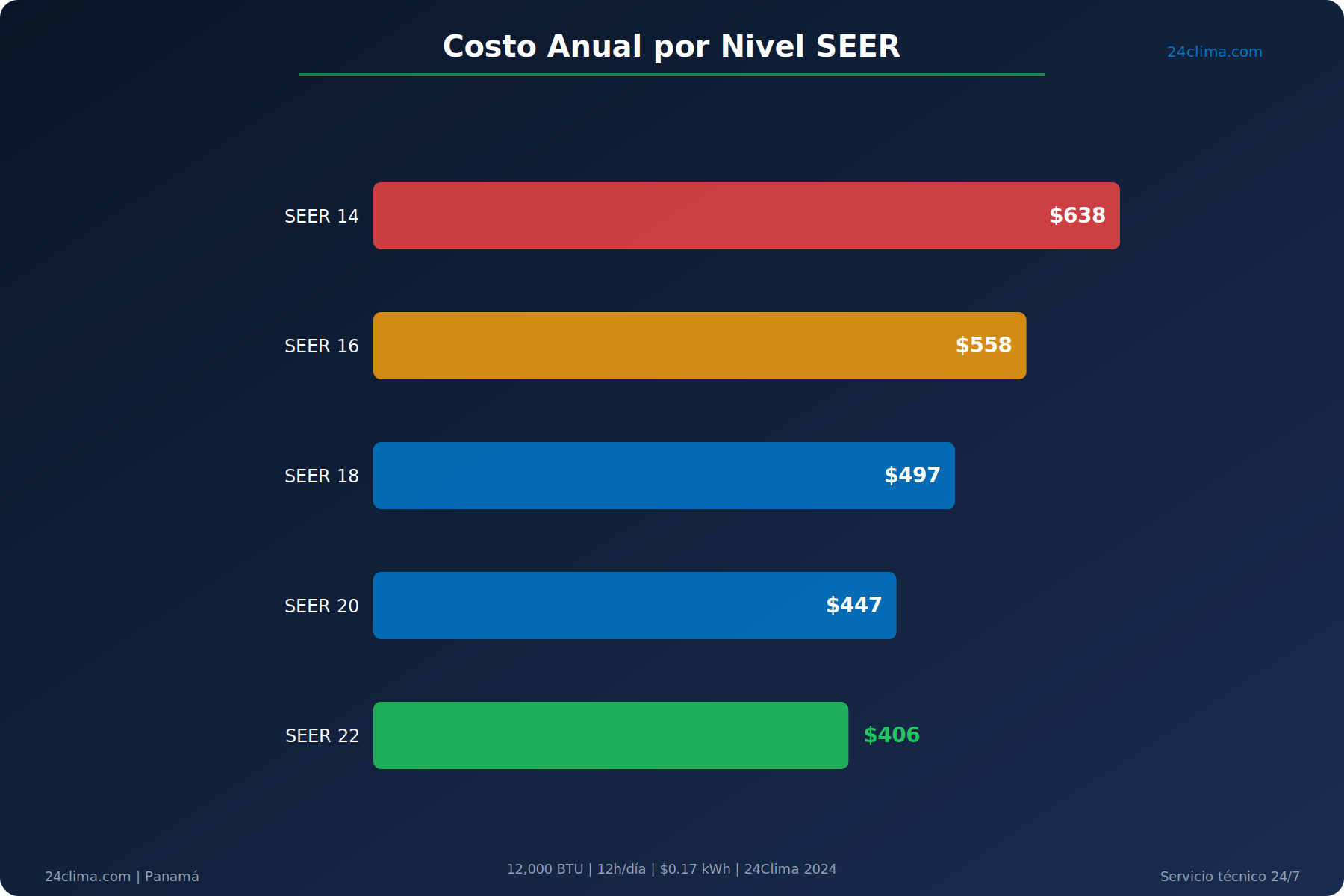
A SEER 14 unit at 12,000 BTU consumes approximately 857 watts per hour. Over 12 hours daily, that's 10.3 kWh per day, 308 kWh per month, 3,753 kWh per year. At $0.17/kWh, that single room costs you approximately $638 per year in electricity just for air conditioning.
A SEER 18 unit with the same 12,000 BTU consumes approximately 667 watts per hour. Annual consumption: 2,922 kWh. Annual cost: $497. Savings versus SEER 14: $141 per year.
A SEER 22 unit consumes approximately 545 watts per hour. Annual consumption: 2,387 kWh. Annual cost: $406. Savings versus SEER 14: $232 per year. Savings versus SEER 18: $91 per year.
Three bedrooms? Multiply by three. A household running three SEER 22 units instead of three SEER 14 units saves approximately $696 per year on their ENSA bill.
The price gap between a SEER 14 and a SEER 22 unit of the same capacity runs $300 to $450 in Panama. At $232 in annual savings per unit, the payback period on that investment is 13 to 23 months. After that break-even point, the efficient unit generates net savings every month for the rest of its operating life.
The Brands Available in Panama and Their Real SEER Ranges
Not every brand offers the same efficiency ranges in the Panamanian market. Here's what you actually find on local shelves.
LG — Their Dual Inverter series ranges from SEER 16 to SEER 22. The Art Cool line and premium models reach SEER 22. Standard entry-level units typically sit at SEER 16-17. LG has solid local parts availability.
Samsung — Wind-Free models available in Panama reach SEER 18 to SEER 21. Wind-Free technology distributes cold air without direct airflow, which cuts the "draft" sensation without sacrificing efficiency. Entry-level lines sit at SEER 15-16.
Carrier — Present in both residential and commercial segments. Residential inverter models in Panama range from SEER 16 to SEER 20. Carrier maintains a network of certified technicians in the country, which makes specialized maintenance more accessible.
Panasonic — Their Nanoe and Econavi units available locally range from SEER 17 to SEER 22. Panasonic is well regarded for compressor durability in tropical climates. According to internal data from distributors in Panama, Panasonic inverter units have a repair rate below 8% in the first 5 years of operation under tropical conditions.
One technical detail few distributors mention: the SEER rating on the label is measured under standard AHRI (Air Conditioning, Heating, and Refrigeration Institute) laboratory conditions. Under real Panama conditions — outdoor temperatures of 31-34°C (88-93°F) and relative humidity of 80-90% — actual performance runs 5% to 12% below that number. That's not manufacturer deception; it's physics. Higher-SEER units still outperform each other significantly even after applying that real-world discount.
The Minimum Recommended SEER for Panama — And When Higher SEER Really Pays Off
For any unit operating more than 8 hours per day, the minimum recommended SEER for residential use in Panama is 18. Units in master bedrooms or work areas running continuously are best served by SEER 20 or higher — that's where the balance between purchase price and monthly savings makes the most sense.
SEER 14 and 15 are only worth considering in two specific situations: occasional use (guest rooms or climate-controlled storage running less than 4 hours a day), or cases where the initial budget is genuinely tight and the plan is to replace the unit within 4 to 5 years.
Above SEER 22, the additional efficiency gains shrink in pure economic terms. The difference between SEER 22 and SEER 24 is real, but the higher equipment cost pushes the payback period to 4 or more years under Panama conditions. Those units make sense for commercial projects or homes with extremely intensive AC use.
According to analysis by the Lawrence Berkeley National Laboratory on energy efficiency in tropical climates, each additional SEER point above the regulatory minimum represents a 7% to 8% reduction in annual electricity consumption for that unit. That proportion holds in markets with usage patterns similar to Panama's — Costa Rica and Puerto Rico are the closest comparisons.
Your unit's maintenance directly affects its real-world SEER as well. A SEER 20 unit running with dirty filters for 6 months can operate at actual efficiency equivalent to SEER 16 or lower — which means you paid for a high-efficiency unit and you're running a mediocre one. Professional cleaning and regular maintenance preserve the performance you paid for. You can learn more through our professional cleaning service and our maintenance service.
Frequently Asked Questions About SEER and Energy Efficiency in Panama
What does SEER mean in an air conditioner?
SEER (Seasonal Energy Efficiency Ratio) measures how many units of cooling a unit produces per unit of electricity consumed. A SEER 18 unit produces 18 BTU of cooling per watt-hour consumed — the higher the number, the lower your electricity bill for the same cooling result. In Panama, with 10 to 14 hours of daily operation year-round, this number shows up directly on your monthly ENSA or Naturgy statement.
What is the minimum recommended SEER for Panama?
For normal residential use with more than 8 hours of daily operation, the minimum is SEER 18. SEER 14 or 15 units consume up to 36% more electricity than a SEER 22 unit of the same capacity — which under Panama's continuous-use conditions means $140 to $230 in extra costs per year, per unit.
Does a higher SEER always make financial sense?
In Panama, yes — up to SEER 22. At $0.17/kWh and 10 to 14 hours of daily use, the payback period on a higher-SEER unit is 13 to 23 months in most residential cases. Above SEER 22, the additional equipment cost recovers more slowly and only makes economic sense for intensive commercial use or buildings with special thermal characteristics.
The Number That Changes Everything
Two o'clock in the afternoon in Costa del Este will keep being just as brutal every year. The sun has no interest in going easy on Panama. But what you pay ENSA to stay comfortable in that apartment — that can change. And it starts with understanding a two-digit number that no salesperson explains to you, partly because the profit margin on low-SEER units tends to be higher for the store.
SEER isn't a secondary technical detail. In Panama's climate, with units running year-round at full load, it's probably the most important economic factor in buying an air conditioner — more important, even, than the purchase price itself.
At 24Clima we evaluate the real SEER performance of your current unit, compare options based on your actual usage patterns and current consumption, and calculate the specific payback period for your situation before recommending anything. If you want to know how efficient your current unit actually is, or you're thinking about replacing it, contact us on WhatsApp at 24clima.com/contacto/ — no-obligation analysis, just straight numbers.
Last updated: January 2025