Solar Air Conditioning in Panama — Is It Worth It in 2025?
Two in the afternoon in Costa del Este. The sun hammers the concrete, the outdoor thermometer reads 91°F (33°C), and the humidity hits you like a warm, wet towel the moment you step outside. Inside, the mini split has been running for five hours straight. When the ENSA bill arrives at the end of the month, the number isn't a surprise — but it still stings.
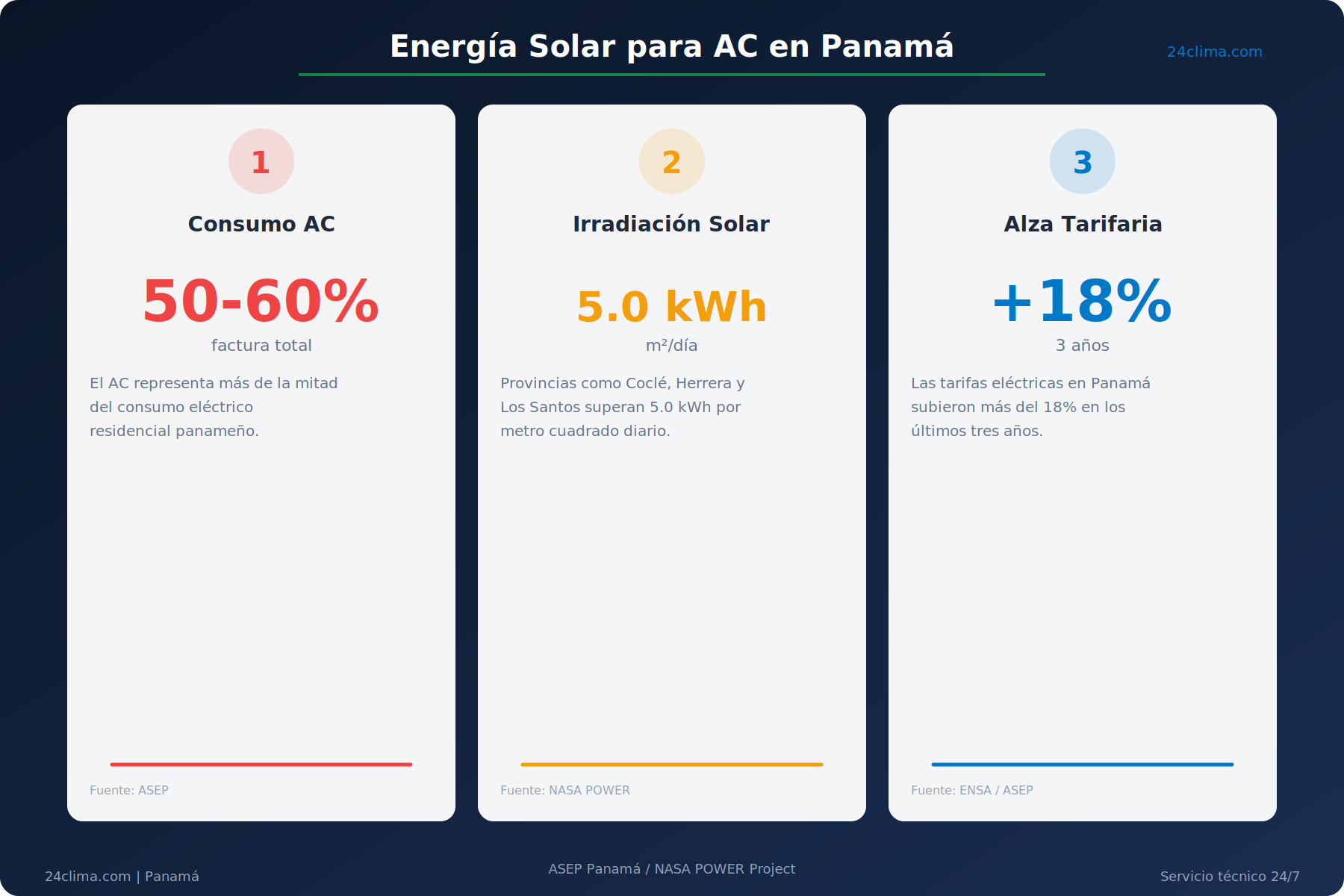
That cycle repeats in thousands of homes across Panama every single month. Air conditioning accounts for between 50% and 60% of residential electricity consumption here, according to the Autoridad Nacional de los Servicios Públicos (ASEP). With electricity rates up more than 18% over the past three years, the question we get most often on WhatsApp is always the same: can solar power actually fix this?
The short answer is yes — but with conditions. Not all solar systems are created equal, not every roof is suitable, and the upfront cost sounds frightening when nobody takes the time to break it down properly. Before you buy anything, you need to understand how solar air conditioning actually works in Panama, what it costs, and when you get your money back. That's what this article covers. If you want to browse more technical guides on cooling and climate control first, visit our expert tips and guides at https://24clima.com/consejos-y-guias/
What Most People Get Wrong About Solar AC
There's a widespread belief that goes: "with solar panels, I'll stop paying for electricity." Over the long run, that can be true. In the short term, reality is more complicated.
The most common mistake is assuming that panels eliminate your AC costs from the very first month. They don't. Panels generate power during the day — roughly between 6:00 a.m. and 5:00 p.m. If your AC runs mostly at night, as it does in many Panama bedrooms where people sleep with the unit on, you either need battery storage or you stay connected to the grid. Without understanding that distinction, a solar system marketed as "for your AC" will disappoint you.
The second mistake is over-sizing. A lot of people buy more panels than they need, thinking more is better. The result: a bigger installation bill with no improvement in return on investment, because the grid has injection limits and idle panels save you nothing.
The third mistake is underestimating installation quality. A poorly installed solar system — undersized cables, cheap inverters, panels mounted at the wrong angle — can deliver up to 30% less energy than advertised. In Panama, where solar irradiation exceeds 5.0 kWh/m²/day in provinces like Coclé, Herrera, and Los Santos (NASA POWER Project data), throwing away that resource through a sloppy installation is money you simply don't get back.
The Three Types of Solar AC Systems
A solar mini split is not simply an AC unit plugged into a panel. There are three distinct system architectures, and the right one depends on your usage patterns, your budget, and whether you want to stay connected to the public grid.
On-Grid System (Grid-Tied)
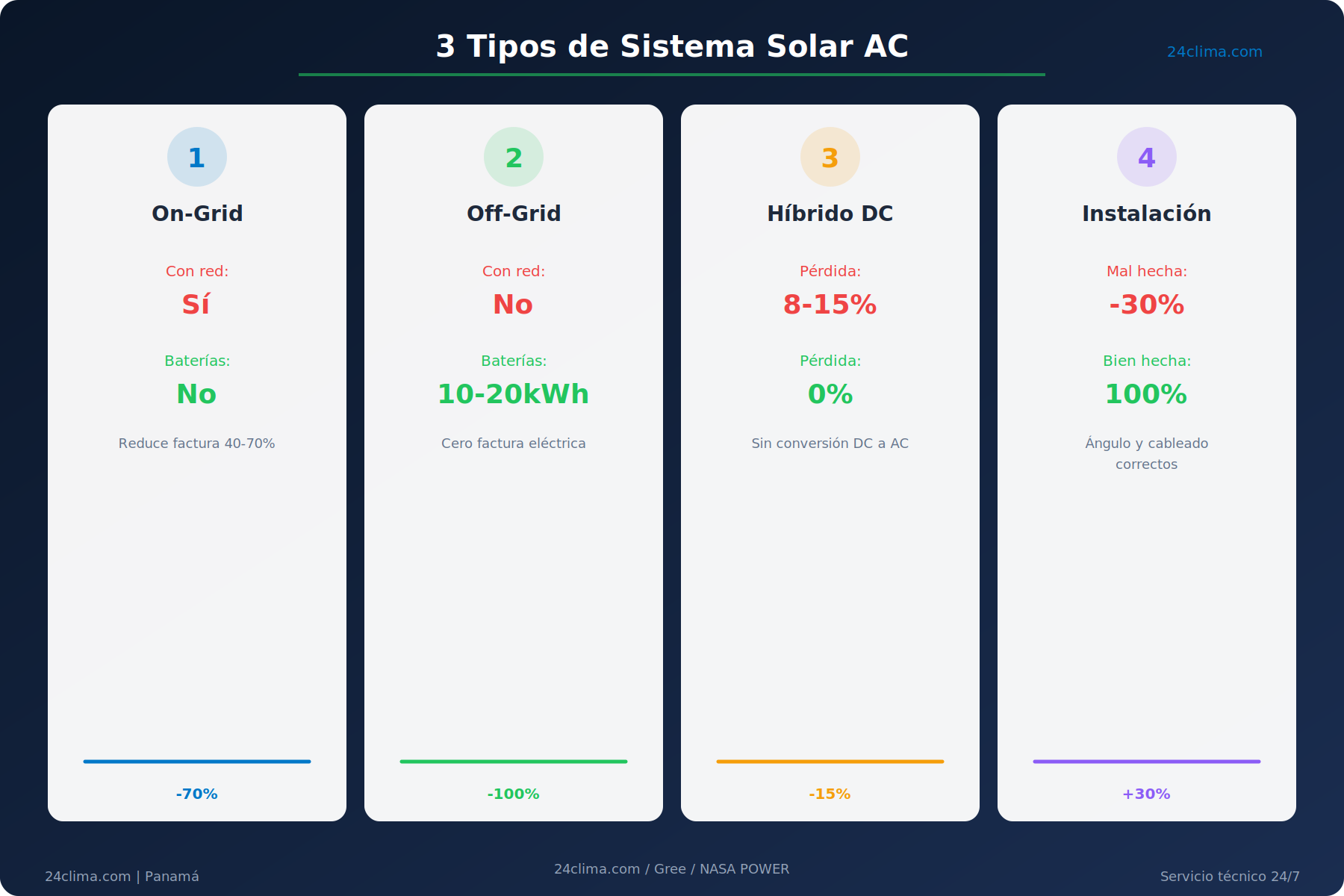
This is the most common setup for urban residential installations in Panama. The solar panels generate electricity during the day, the inverter converts DC power to AC, and that energy feeds your air conditioner and the rest of the house directly. When the panels produce more than you consume, the surplus goes to the grid through net metering. When they produce less — at night or on cloudy days — the grid fills the gap. No batteries, no interruptions.
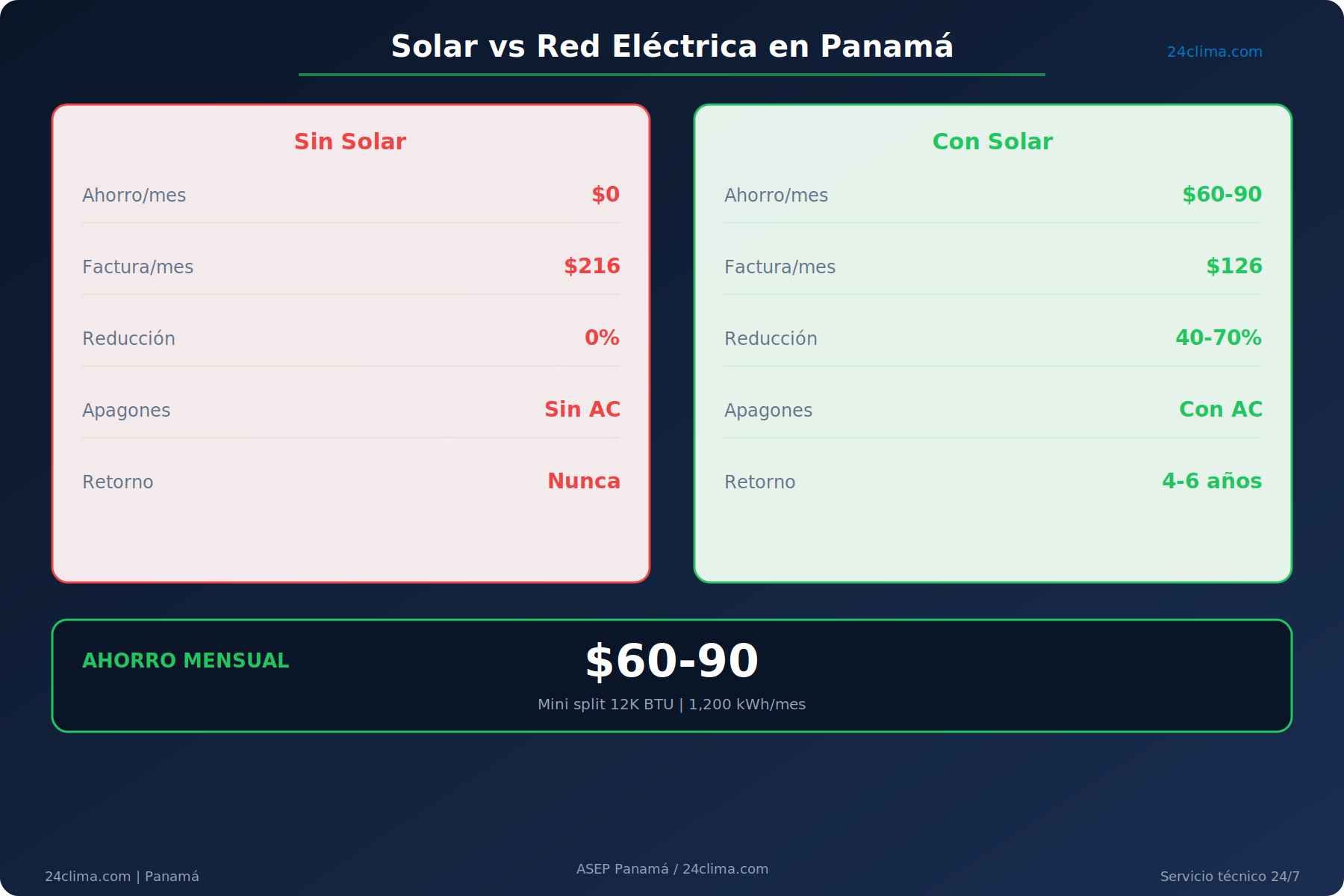
This system won't eliminate your electricity bill entirely, but it can cut it by 40% to 70% depending on your load and system sizing. For a home in San Francisco with a 12,000 BTU mini split consuming approximately 1,200 kWh per month, that reduction translates to $60 to $90 less on your ENSA bill every month.
Off-Grid System (Battery-Based, Autonomous)
This is the setup for anyone who wants complete independence from the grid, or who lives in a rural area without reliable electricity access. The panels charge lithium or AGM batteries, and the AC runs exclusively on that stored energy. Autonomy depends on your battery bank capacity — typically 10 to 20 kWh for a 9,000 to 12,000 BTU mini split running 8 hours a day.
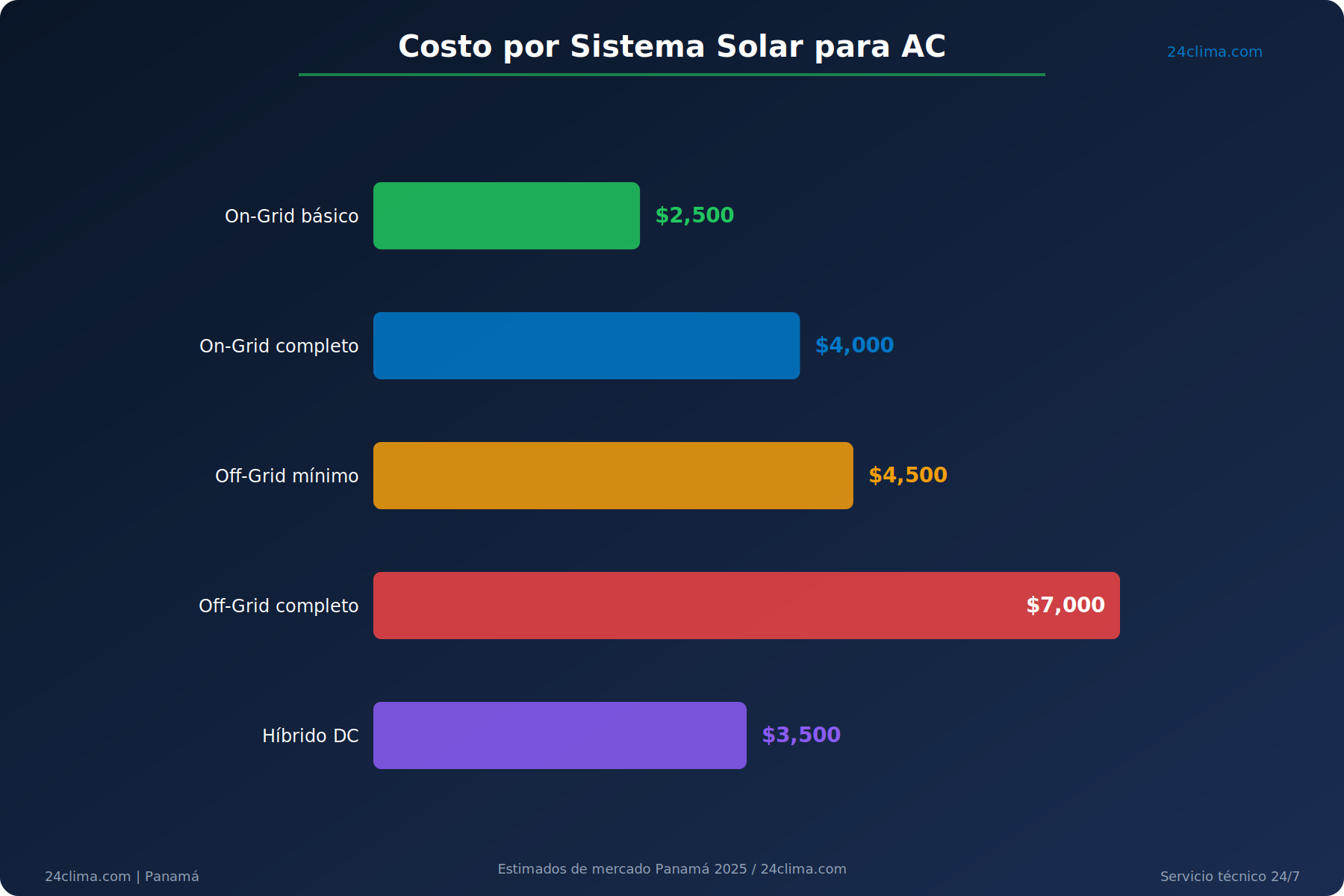
The cost is considerably higher. A complete off-grid system for a mini split in Panama can run between $4,000 and $7,000 USD including batteries. The payoff: zero electricity bill and continuous operation even during blackouts, which in some interior provinces remain a regular occurrence.
Hybrid DC System (Direct Current Mini Split)
This is where more specialized technology enters the picture — units like the Gree Solar DC Inverter and certain AUX models. These mini splits are engineered to run directly on direct current, meaning they operate straight from the panels without needing an AC inverter. They're more efficient because they cut out the DC-to-AC-to-DC conversion, which wastes between 8% and 15% of energy in a conventional system.
Units like the Gree LVNH12DB-N3NNA1A include an integrated controller that manages both solar input and grid power simultaneously. When the sun is out, it draws from the panels. When it isn't, it switches automatically to the grid — no batteries, no extra cost. In Panama, this type of system starts at around $1,500 USD for a 9,000 BTU unit with two 400W panels, fully installed.
How Many Solar Panels Do You Need for an AC in Panama?
For a 12,000 BTU mini split drawing approximately 1,000 to 1,200 watts during operation, you need between 3 and 4 solar panels rated at 400W peak, assuming an average of 5.0 peak sun hours per day. That produces between 4.8 and 6.4 kWh daily — enough to cover 6 to 8 hours of runtime.
The more precise calculation factors in three variables: the unit's actual power draw in kilowatts (not the same as BTU cooling capacity), its efficiency rating (COP or EER), and the peak sun hours for your specific province. A modern 12,000 BTU inverter unit actually consumes between 700W and 900W in real-world use — not 1,200W — because the compressor doesn't run at full capacity all the time. That means 3 panels at 400W can cover the full daytime load of that unit.
For an 18,000 BTU unit, real consumption rises to roughly 1,400 to 1,600W, requiring 4 to 5 panels at 400W. For a 24,000 BTU unit, plan for 6 to 7 panels.
Panama has a genuine climatic advantage here. According to the solar irradiation atlas published by the Inter-American Development Bank for Central America, Herrera, Los Santos, and Coclé receive between 5.2 and 5.8 peak sun hours per day on an annual average. Panama City and the Pacific coastal provinces average 4.8 to 5.2 PSH. Bocas del Toro and Darién have more cloud cover and average 4.2 to 4.5 PSH — still workable, but systems in those areas should be oversized by about 15% to compensate.
What Does a Solar AC System Cost in Panama?
Costs range from $1,500 to $5,000 USD depending on the unit's capacity, the system type, and the brand. Below are real market price ranges for Panama in 2025.
Basic Hybrid DC System — 9,000 BTU Includes: Gree or AUX Solar DC mini split, 2 panels at 400W, integrated controller, mounting structure, and installation. Total cost: $1,500 to $2,200 USD Estimated monthly savings: $35 to $55 (based on ENSA residential rate of $0.18/kWh) Payback period: 2.5 to 3.5 years
On-Grid System with Inverter — 12,000 BTU Includes: conventional inverter mini split, 3 panels at 400W, 1.5 kW grid-tie inverter, bidirectional meter, wiring, and certified installation. Total cost: $2,200 to $3,200 USD Estimated monthly savings: $55 to $80 Payback period: 3 to 4 years
Premium On-Grid System — 18,000 BTU Includes: high-efficiency inverter mini split, 5 panels at 400W, 2.5 kW grid-tie inverter, remote monitoring, certified installation. Total cost: $3,500 to $5,000 USD Estimated monthly savings: $80 to $120 Payback period: 3.5 to 5 years
Off-Grid System with Batteries — 12,000 BTU Includes: everything above plus a 10 kWh lithium battery bank. Total cost: $4,500 to $7,000 USD Monthly savings: electricity bill effectively eliminated Payback period: 5 to 7 years (depending on battery costs at time of purchase)
One thing worth understanding: Panama's Decreto No. 998 of 2010 and its amendments allow residential customers with systems up to 500 kW to export surplus energy to the grid under net metering. The excess kWh you produce during the day are credited against what you consume at night — a direct financial benefit that meaningfully improves the ROI on on-grid systems.
Can a Standard Inverter AC Run on Solar Power in Panama?
Yes. A conventional inverter mini split — including the one you may already have at home — runs perfectly well on an on-grid solar system, with no modifications. The grid-tie inverter converts DC power from the panels into standard AC at 120V or 220V, and your air conditioner operates exactly as if it were plugged into the public grid. The difference is that some or all of that energy is now coming from your roof.
A modern 12,000 BTU inverter unit with a SEER rating of 21 or higher is particularly well-matched to solar, because its variable power draw — the compressor adjusts speed rather than cycling on and off — makes it easier to balance solar production against real demand. When the sun peaks at noon, so does the heat load. Panama's climate creates a natural alignment between when your panels produce the most and when your AC needs it most.
Available Brands in Panama — Gree Solar and AUX in the Local Market
Gree and AUX are the two brands with DC solar systems designed to operate with or without grid power that have active distribution in Panama as of 2025.
Gree Solar offers its LIVS line (Low Inverter Voltage System), which operates on DC voltages between 30V and 370V directly from the panels. These units include an integrated MPPT controller that optimizes solar energy extraction in real time. Available in 9,000, 12,000, and 18,000 BTU. The 12,000 BTU model has an EER of 12.5 and can run on just 2 panels at 400W under low-load conditions.
AUX Solar carries the ACF-H line, similar in concept — available in 9,000 and 12,000 BTU with hybrid grid compatibility. Import pricing runs 10% to 15% lower than Gree, though the technical service network in Panama is more limited. That's a relevant factor when you're thinking about long-term maintenance and warranty support, not just the upfront price.
For on-grid systems using grid-tie inverters, SolarEdge, Fronius, and Growatt all have distribution in Panama and are compatible with any conventional mini split. The Growatt 1500TL-X at 1.5 kW is a cost-effective option for smaller residential installations.
If you're considering pairing an existing unit with solar, get a professional maintenance check first. A unit running below peak efficiency before integration will drag down your solar returns from day one. You can review our maintenance service at https://24clima.com/servicios/mantenimiento/
Frequently Asked Questions
How many solar panels do I need for an air conditioner in Panama?
For a 12,000 BTU mini split, you need between 3 and 4 solar panels rated at 400W, based on an average of 5 peak sun hours per day. For 9,000 BTU, 2 to 3 panels are sufficient. For 18,000 BTU, plan for 4 to 5 panels. These figures apply to daytime operation on a hybrid or on-grid system without batteries.
Can a standard inverter AC run on solar power in Panama?
Yes, any conventional inverter mini split is compatible with an on-grid solar system. The grid-tie inverter converts DC power from the panels into standard alternating current, and the AC unit operates without any modification. Inverter-type units are especially well-matched to solar because their variable power draw naturally adapts to the fluctuating output of the panels.
How much does it cost to install a solar AC system in Panama?
Costs range from $1,500 to $5,000 USD depending on the unit's capacity and system type. A basic 9,000 BTU hybrid DC system starts at $1,500. A complete on-grid setup for 12,000 BTU with a grid-tie inverter runs $2,200 to $3,200. Off-grid systems with batteries start above $4,500. Payback periods in Panama, at current ENSA/ENEL rates, range from 2.5 to 5 years.
So — Is It Worth It in 2025?
Back to that afternoon in Costa del Este. The bill arrives, the number hurts, and the same sun baking the concrete outside is hitting your roof — generating enough energy to cool every room in your house at no cost during the hottest hours of the day.
Panama has one of the best solar resources in Central America. Electricity rates are not going down. Photovoltaic systems for AC have never been more accessible or more efficient than they are right now. If you're spending more than $80 a month on electricity and your roof has south or southwest-facing exposure, the financial case for installation is solid in almost every scenario.
At 24Clima, we look at your actual consumption, the equipment you have, and your roof conditions before recommending anything. We don't sell panels — we tell you whether the investment makes sense for your specific situation, with real numbers, no pressure. Reach out through WhatsApp at https://24clima.com/contacto/ and our technical team will give you an honest assessment.
Last updated: May 2025