Window AC Units in Panama — Still Worth It in 2025?
Last updated: May 2025
It's 2 PM in San Francisco — the Panama City neighborhood, not California. The sun is hammering the concrete, the outdoor thermometer reads 91°F (33°C), and your guest room feels even worse. Your rental has no wall penetrations for a split system. The landlord said no. A full installation isn't in the budget. And in the building's WhatsApp group, someone just asked the exact question you've been sitting with: do those window AC units at Panafoto actually work?
The answer isn't yes or no. Most people searching "cheap AC Panama" buy the first thing they find without understanding what it actually costs to run — electricity consumption, real cooling capacity, how long the unit survives at 85% relative humidity. That mistake routinely costs more than whatever you saved at the register.
Below you'll find current prices from local stores, real kWh consumption under Panamanian conditions, and an honest comparison of all three options available when major construction isn't on the table. For more guides like this, visit 24Clima's tips and guides section.
What Almost Everyone Gets Wrong
There's a widespread assumption that window AC units are the budget option for people who can't afford a split system. That's partly true. The trap is thinking "cheap to buy" also means "cheap to run." In Panama, where the climate means running your AC 8 to 12 hours a day for most of the year, operating cost matters just as much — often more — than the purchase price.
The second common mistake: assuming a 110V window unit automatically uses less electricity than a 220V model. Voltage doesn't determine real energy consumption in kWh — wattage and refrigeration cycle efficiency do. A 110V unit rated at 8,000 BTU can consume exactly the same electricity as a 220V unit with identical capacity, depending on the Energy Efficiency Ratio (EER).
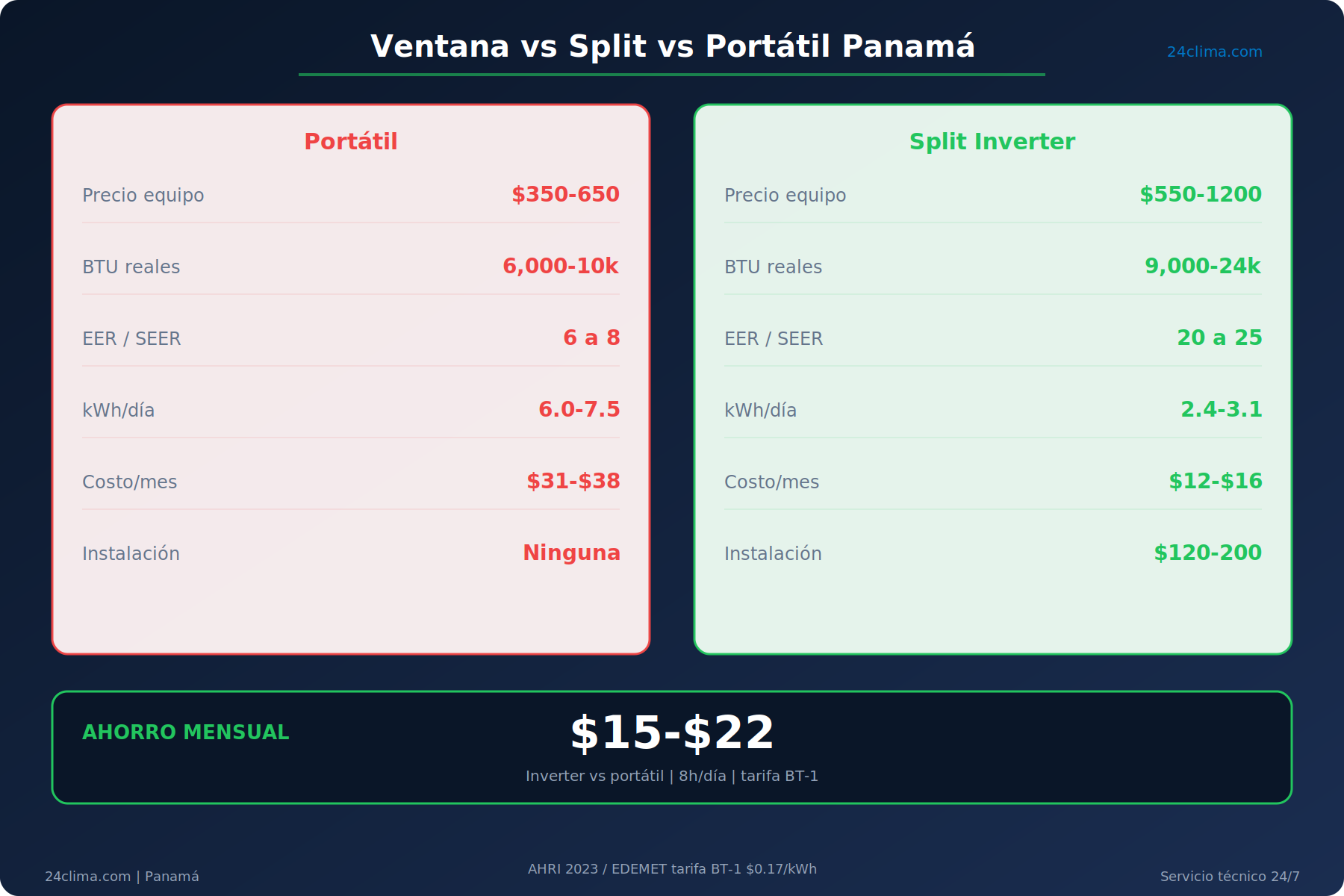
The third misconception is that portable AC units are the logical fallback when neither a split nor a window unit is installable. In almost every real-world situation in Panama, portables are the least efficient of the three options. The numbers make that clear.
Window Unit vs. Split vs. Portable — The Real Comparison
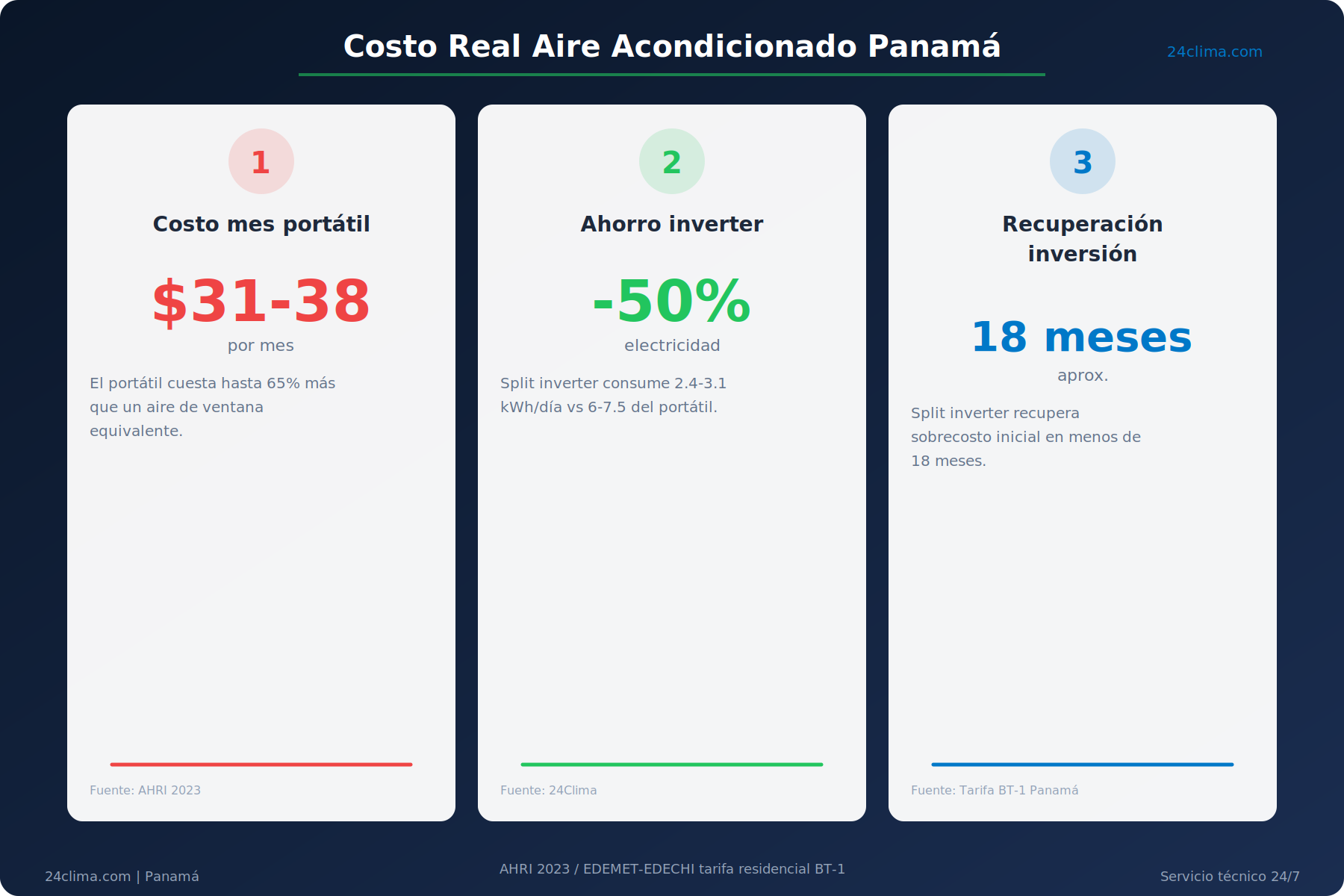
The question HVAC technicians hear most in Panama: window unit or split, which makes more sense? It comes down to three things — your upfront budget, what your space actually allows, and how many hours per day the unit will run. Run it more than 6 hours daily, and a split inverter recoups its higher purchase price through electricity savings in under 18 months, based on current Panama utility rates (Unión FENOSA / EDEMET-EDECHI, residential tariff BT-1 at an average of $0.17 per kWh in 2024-2025).
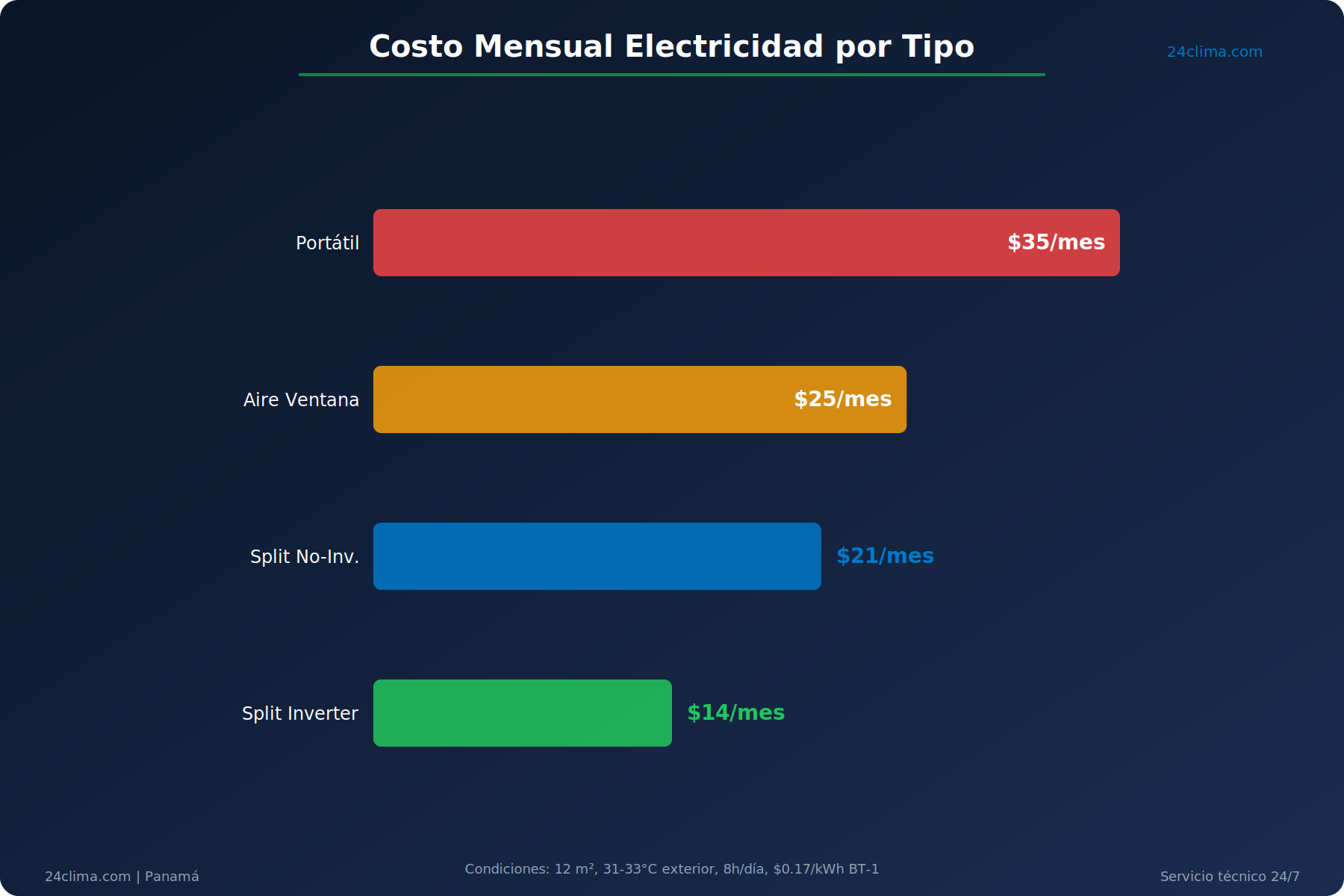
The comparison below uses real data from the Panamanian market under typical operating conditions: 130 sq ft room, outdoor temperature 88-91°F (31-33°C), 8 hours of daily use.
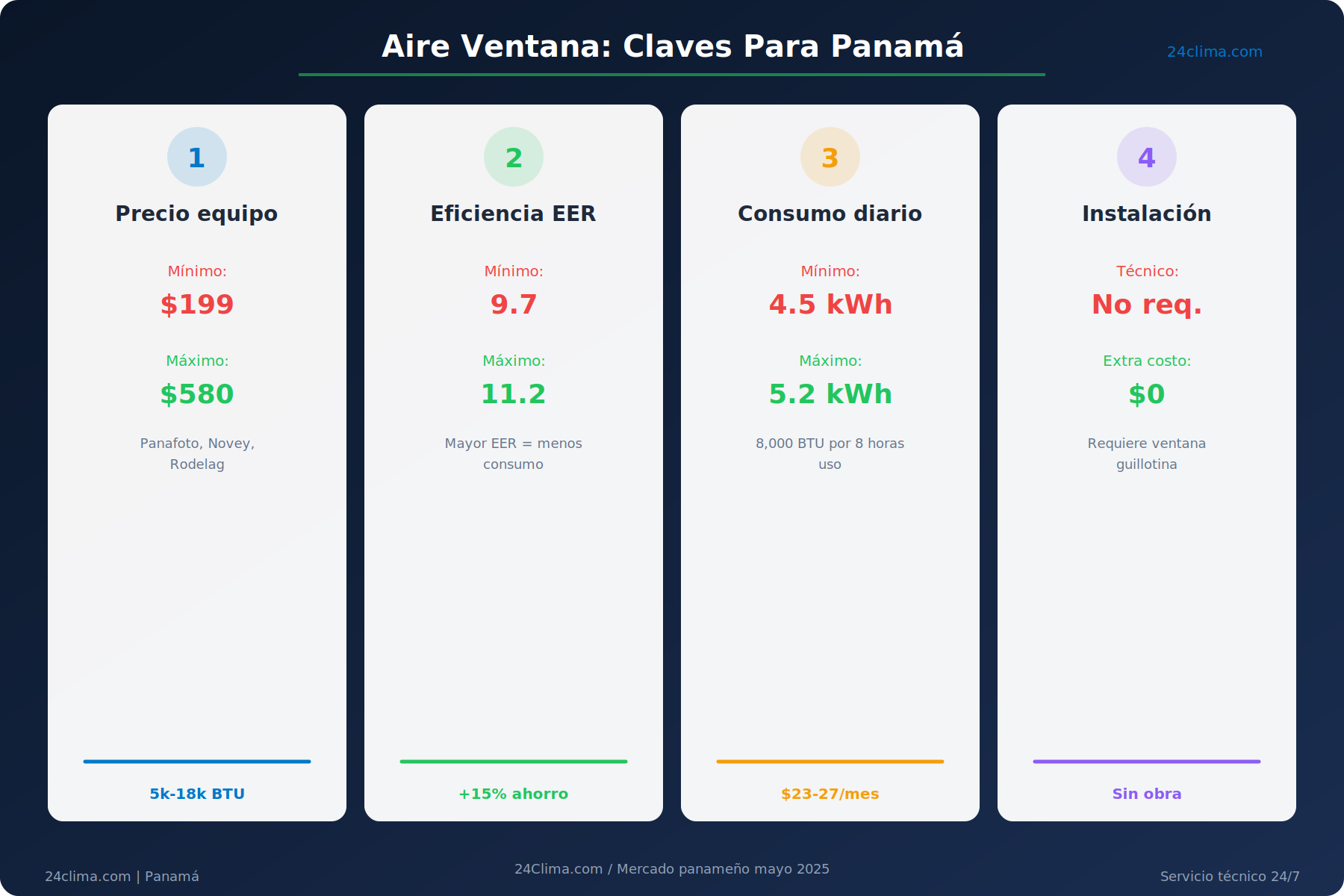
Window AC Typical capacity in Panama: 5,000 to 18,000 BTU Price at local stores (Panafoto, Novey, Rodelag): $199 to $580 Average EER in locally available models: 9.7 to 11.2 Estimated consumption at 8,000 BTU, 8h/day: 4.5 to 5.2 kWh daily Approximate monthly electricity cost: $23 to $27 Installation: no outside technician needed, user can install Requires window opening or slot: yes
Non-Inverter Mini-Split Typical capacity: 9,000 to 24,000 BTU Price at local stores: $380 to $750, installation not included Average SEER: 13 to 15 Estimated consumption at 9,000 BTU, 8h/day: 3.8 to 4.4 kWh daily Approximate monthly electricity cost: $19 to $23 Installation: certified technician required, wall penetration, $120 to $200 additional
Inverter Mini-Split Typical capacity: 9,000 to 24,000 BTU Price at local stores: $550 to $1,200, installation not included Average SEER: 20 to 25 Estimated consumption at 9,000 BTU, 8h/day: 2.4 to 3.1 kWh daily Approximate monthly electricity cost: $12 to $16 Installation: certified technician required, $120 to $200 additional
Portable AC Typical capacity: 8,000 to 14,000 BTU (actual SACC ratings are lower) Price at local stores: $350 to $650 Real EER in tropical conditions: 6 to 8 Estimated consumption at 8,000 BTU, 8h/day: 6.0 to 7.5 kWh daily Approximate monthly electricity cost: $31 to $38 Installation: none required, but needs a hot air exhaust outlet
The direct takeaway: portable AC units cost 35% to 65% more to run than an equivalent window unit, according to comparative consumption data from the AHRI (Air-Conditioning, Heating and Refrigeration Institute, 2023). At Panama's residential BT-1 tariff, that's $8 to $15 extra per month you're paying purely for the convenience of zero installation. Over two years, that difference adds up to $192 to $360.
How Much Does a Window Unit Actually Consume in Panama?
An 8,000 BTU window AC unit with EER 10 draws approximately 800 watts per hour of active compressor operation. In Panama, where outdoor temperatures keep the compressor running 75 to 85% of operating time due to the tropical heat load, that unit will pull between 4.5 and 5.0 kWh over an 8-hour cycle.
At the current residential average of $0.17/kWh, that works out to $0.77 to $0.85 per day — roughly $23 to $26 per month. Run it year-round: $276 to $312 in electricity for that single room.
The same room cooled by a 9,000 BTU inverter split with SEER 22 would consume 2.5 to 3.0 kWh over those same 8 hours, costing $12 to $15 per month. The monthly difference is $8 to $14. If the inverter split costs $700 fully installed and the window unit costs $300 with no installation required, that $400 gap closes through electricity savings in 28 to 50 months. Planning to stay more than three years? The split wins on total cost.
Where to Buy and What You'll Actually Pay
Prices collected directly from Panamanian retailers in May 2025. Expect some variation based on promotions and stock.
Panafoto (physical stores and panafoto.com): LG 5,000 BTU 110V (LW5016): $219 to $239 LG 8,000 BTU 110V (LW8017): $289 to $319 LG 10,000 BTU 115V: $349 to $379 LG 18,000 BTU 230V: $499 to $549
Novey (physical stores and novey.com): Midea 6,000 BTU 115V: $199 to $229 Midea 8,000 BTU 115V: $269 to $299 Midea 12,000 BTU 115V: $389 to $429
Rodelag: GE 5,000 BTU 115V: $209 to $245 GE 8,000 BTU 115V: $299 to $335 Friedrich 10,000 BTU 115V: $399 to $449 — EER 12.2, one of the most efficient models available locally
One practical note for expats: most residential buildings in Panama City have standard 110V to 115V outlets in every room, so models in the 5,000 to 12,000 BTU range in that voltage are the most straightforward choice — no electrical modifications required. Units rated 220V to 230V need a dedicated outlet or circuit adaptation, which adds both cost and time.
Installing a Window Unit in a Rental Apartment — What You Need to Know
A window AC can go in without touching the building structure, as long as the apartment has double-hung (guillotine-style) windows that slide vertically. Most buildings constructed before 2010 in El Cangrejo, Marbella, Bella Vista, and San Francisco have exactly this type of window.
Four steps to get it done:
Measure the interior width of the window opening. Standard window AC units come with extendable side panels that cover openings from 23 to 36 inches wide.
Check that the window frame can take the weight. An 8,000 BTU unit weighs 48 to 62 lbs (22 to 28 kg). Lightweight aluminum frames — common in 1980s and 90s construction in San Francisco and Betania — need a support bracket underneath, available for $15 to $25 at Novey or EPA.
Set the unit with a slight outward tilt, 3 to 5 degrees, so condensate drains outside and doesn't pool inside the room.
Seal the side gaps with the included panels plus foam weatherstripping. In Panama's climate, this step matters — the indoor-outdoor temperature difference can exceed 18°F (10°C), and any gap turns into a constant heat leak.
Newer buildings post-2010 in Costa del Este, Santa María, and parts of San Francisco typically have fixed glass or horizontal sliding windows that don't work with standard window AC units. In those cases, you're down to a portable unit or written authorization from the building administrator to install a mini-split permanently. Our AC installation service can assess your specific situation and handle the full process if the administrator approves.
Frequently Asked Questions
Is a window AC or a split system better in Panama?
For more than 6 hours of daily use, an inverter split is more efficient and cheaper over time. An inverter mini-split consumes 40% to 55% less electricity than a comparable window unit in BTU output, per AHRI efficiency comparisons (2023). A window unit makes more sense in three specific cases: wall penetration isn't permitted, the upfront budget is under $300, or the installation is temporary — under 12 months.
How much electricity does a window AC use in Panama?
An 8,000 BTU unit with EER 10 consumes 4.5 to 5.2 kWh per 8 hours under Panama's climate conditions — 88-91°F outdoors, 80 to 85% humidity. At the current residential rate of $0.17/kWh, that's $23 to $27 per month running 8 hours daily. A higher-EER model rated 11 or 12 — like the Friedrich at Rodelag — cuts that consumption by 8% to 16%.
Where can you find affordable window AC units in Panama?
Panafoto, Novey, and Rodelag carry the widest selection of budget models, starting at $199 for 6,000 BTU units. Panafoto offers no-down-payment financing. Rodelag has the Friedrich models with the best local EER ratings. pty.marketplace.com and OLX Panamá are worth checking for used units in good condition — they typically go for $80 to $150. Before buying used, confirm the EER is at least 10 and the unit is no more than 5 years old.
The Verdict for 2025
Back to that room in San Francisco. Two in the afternoon, 91°F outside, and the landlord is still saying no to drilling. An 8,000 BTU window unit for $289 at Panafoto, installed in 45 minutes without outside help, is a completely valid solution. Not the most efficient option. Not the quietest. But it works, it cools, and it's running for under $300.
Pick a model with an EER of at least 10, clean the filter and coils every 3 months, and accept that you'll pay $8 to $14 more per month in electricity than you would with an inverter split. With that on the table, the decision is yours. Not sure what capacity your space needs, or want us to check whether a split installation is possible in your apartment without violating your lease? Contact 24Clima on WhatsApp at https://24clima.com/contacto/ — we respond the same day.