110V vs 220V for Air Conditioning — Which One Do You Need in Panama?
2 PM in Costa del Este. The sun is hammering concrete at 91°F with 80% humidity. You walk into your apartment, flip on the new AC you just bought, and wait. Air blows. Twenty minutes later, the room is still stuffy, the compressor sounds strained, and the breaker trips with a sharp click. Dead silence.
The equipment wasn't defective. The outlet was wrong.
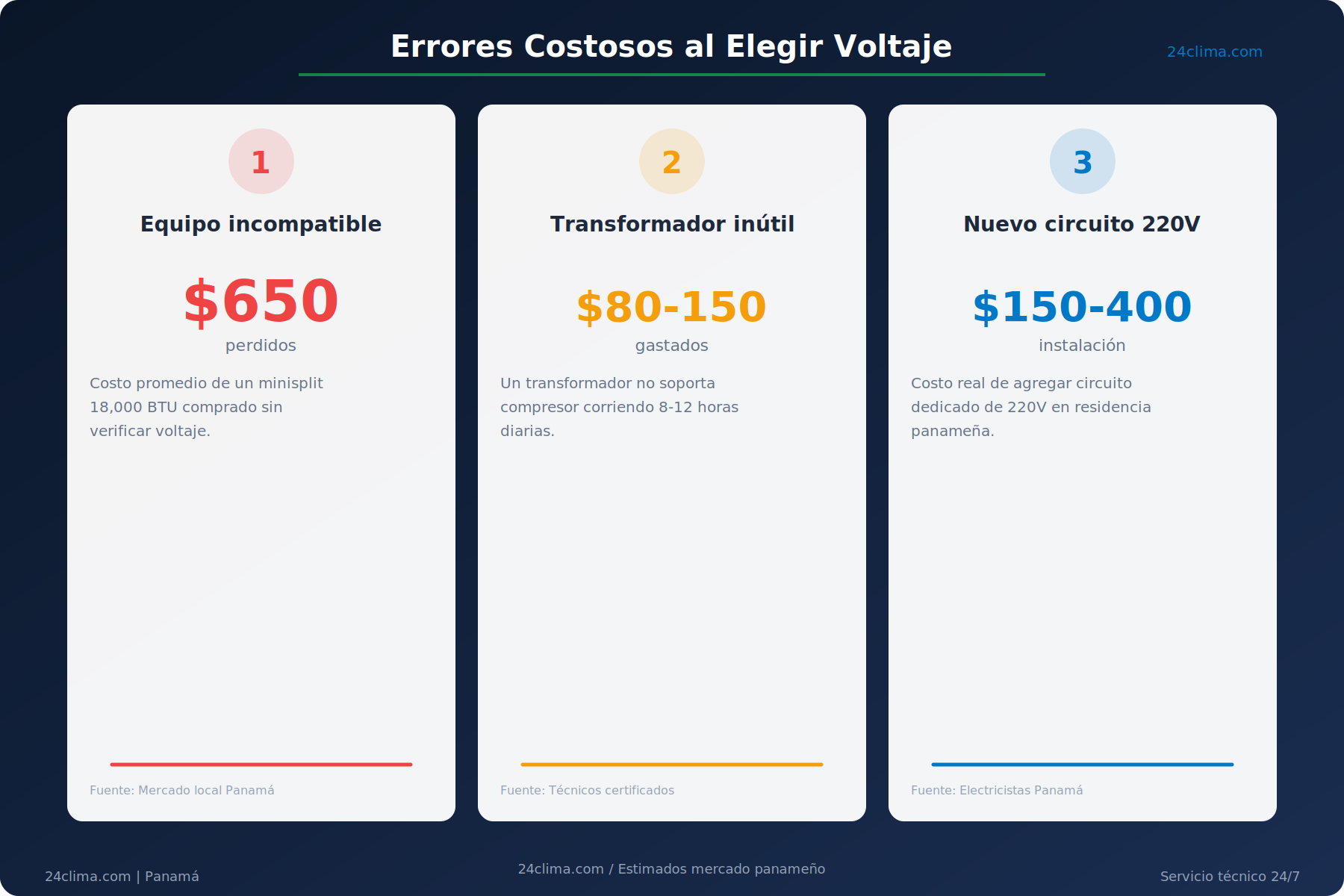
You bought an 18,000 BTU mini-split that needs 220V, but your 1990s building in San Francisco only has 110V circuits in the bedrooms. Nobody explained this at the store. The salesperson didn't ask. Now you're holding a $650 unit you can't run without rewiring part of your electrical system.
That scenario plays out more often than it should in Panama. Here's what you need to know before you buy — or what to do if you're already in that situation.
What Most Buyers Assume — and Where That Gets Expensive
Most people treat voltage like the color of the remote. It's not. Voltage determines which equipment you can install, what you'll pay on your electricity bill each month, and whether your wiring handles the load safely or becomes a fire risk.
The outdated mental model goes like this: all residential air conditioners plug into the same outlet as a television. That was roughly true twenty years ago, when 9,000 BTU window units dominated the market. Today the best-selling mini-splits in Panama run from 12,000 to 24,000 BTU — and at 18,000 BTU and above, almost every unit on the market requires 220V on a dedicated circuit.
The other mistake I see constantly: buyers assume a voltage transformer fixes the problem. It doesn't. A transformer can step voltage up or down, but it's not built to sustain the continuous current draw of an AC compressor running 8 to 12 hours a day in Panama's climate. The result is an overheated transformer, premature equipment failure, and $80 to $150 spent on something that was never going to work.
The Technical Difference Between 110V and 220V in Panama
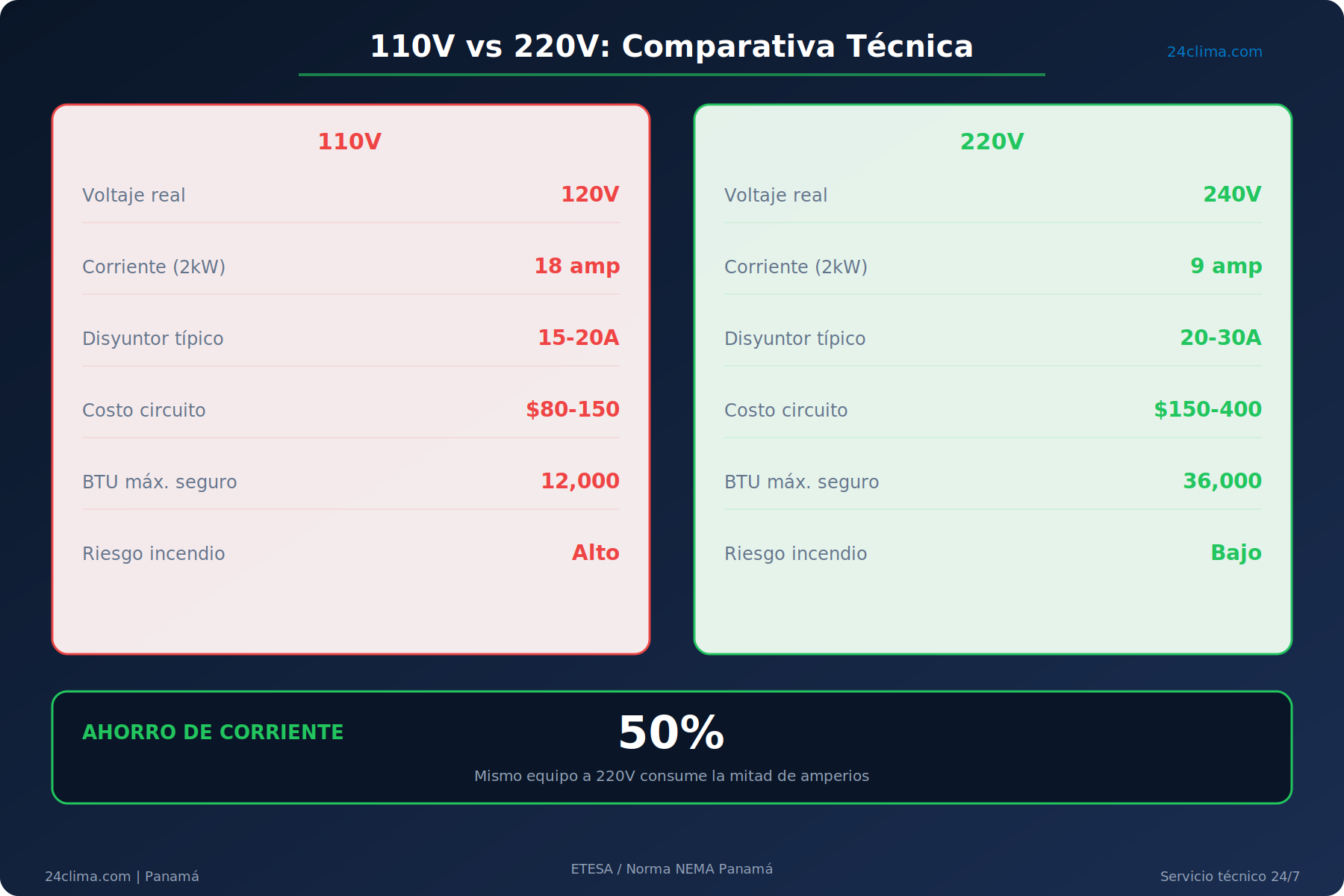
Panama's residential grid runs at 120V/60Hz for single-pole circuits and 240V/60Hz for double-pole circuits, under standards overseen by ETESA (Empresa de Transmisión Eléctrica S.A.). In everyday conversation — and on virtually every spec sheet sold locally — technicians and salespeople call these "110V" and "220V." Those are the nominal values on any equipment sold in the country.
The core difference: a 110V circuit uses one active conductor plus neutral and ground. A 220V circuit uses two active conductors on opposite phases, generating double the voltage between them. That voltage difference directly affects how much current the equipment needs.
The physics is straightforward. Power (watts) = voltage × current (amps). A unit drawing 2,000 watts on 110V needs roughly 18 amps. That same unit on 220V needs only 9 amps — which means less heat in the wiring, less energy lost in transmission, and less stress on the breaker. Under the NEMA standard applied in Panama, 110V circuits in typical residential installations are protected by 15 to 20 amp breakers. That's an uncomfortably thin margin for an 18,000 BTU mini-split that can pull up to 17 amps at startup.
BTU and Voltage Compatibility — The Brands Most Sold in Panama
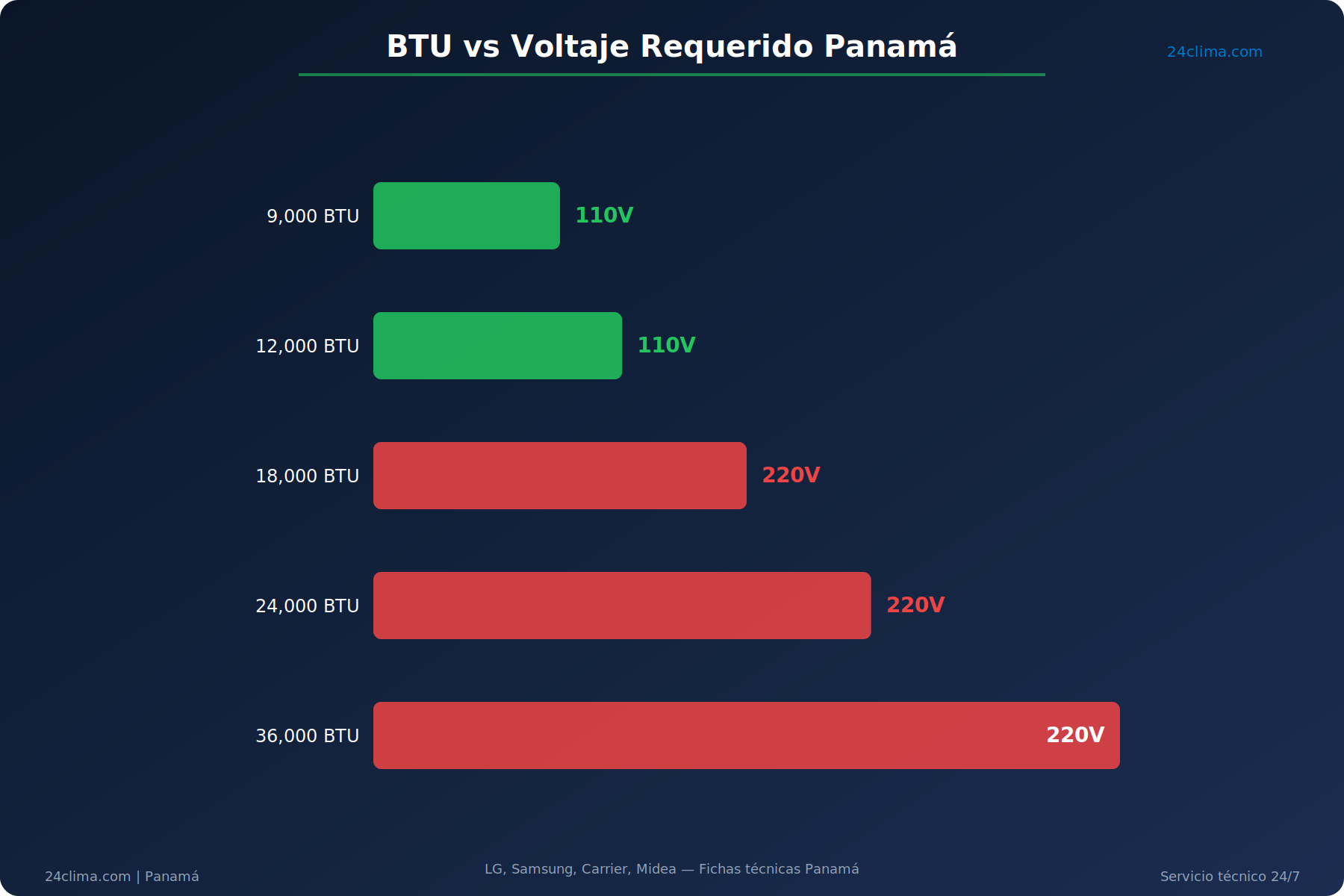
Before buying, check this compatibility table against the published spec sheets from LG, Samsung, Carrier, and Midea for their product lines sold in Panama:
9,000 BTU: 110V (draws 7 to 9 amps) 12,000 BTU: 110V (draws 9 to 12 amps) 18,000 BTU: 220V required (draws 7 to 9 amps at 220V) 24,000 BTU: 220V required (draws 9 to 11 amps at 220V) 36,000 BTU: 220V required (draws 13 to 16 amps at 220V)
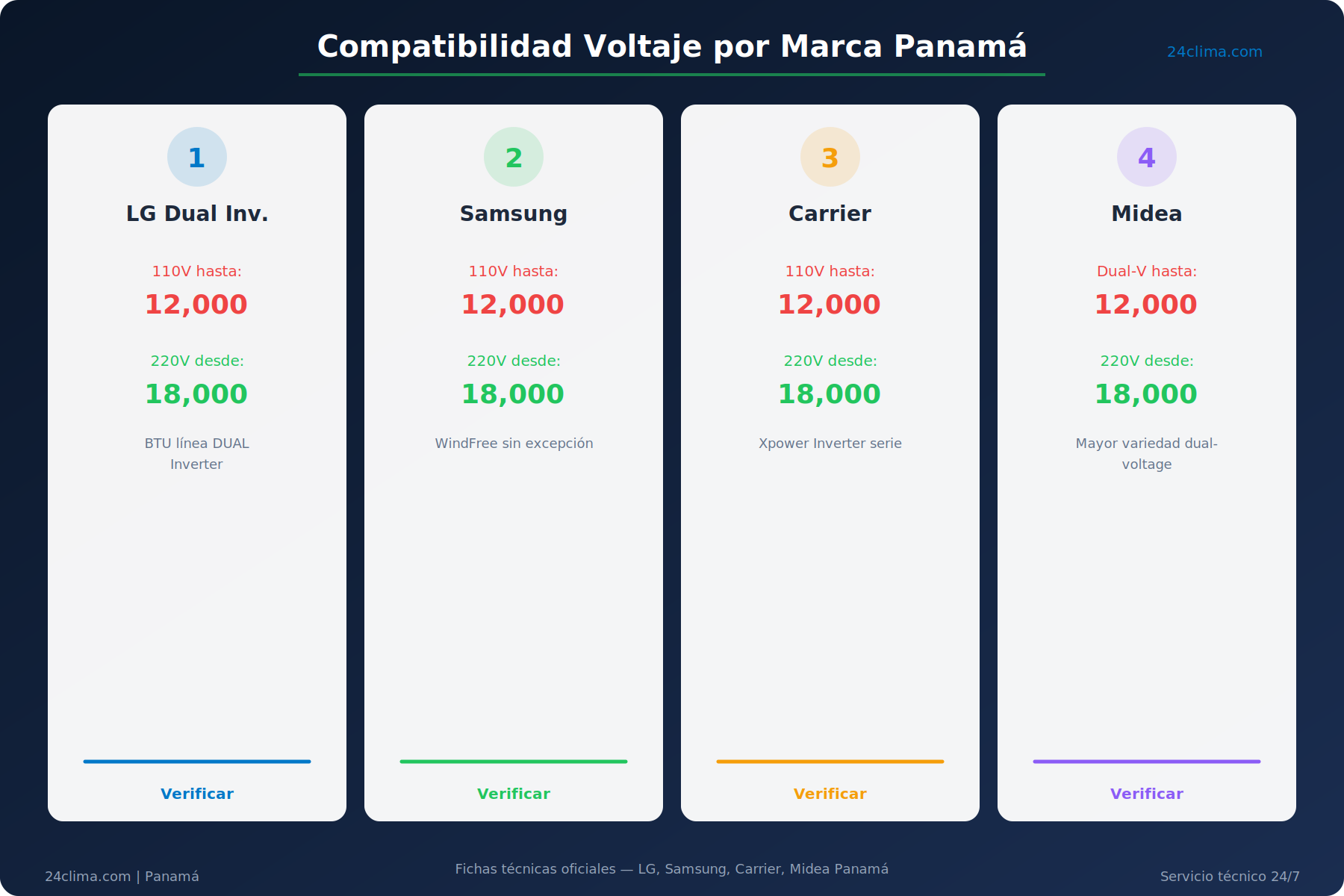
One important detail: some 12,000 BTU models from Midea and LG come in dual-voltage versions (110/220V). That's the exception. Always check the label on the unit or the spec sheet before you buy. The model number matters more than the brand name on the box.
LG: their DUAL Inverter line offers 12,000 BTU models in 110V and goes exclusively to 220V at 18,000 BTU and above.
Samsung: the WindFree 12,000 BTU runs on 110V. The 18,000 BTU and larger units are 220V without exception.
Carrier: their Xpower Inverter line covers 9,000 and 12,000 BTU on 110V, then moves to 220V from 18,000 BTU up.
Midea: has the widest dual-voltage selection at 12,000 BTU, but all higher-capacity units are 220V only.
How Much Does Adding a 220V Circuit Cost in Panama?
Adding a dedicated 220V circuit in a Panamanian home runs between $150 and $400, depending on the distance between the main electrical panel and the AC installation point, the wire gauge required (typically 12 AWG or 10 AWG), and whether the panel has room for an additional double-pole breaker.
Typical cost breakdown in Panama (2024–2025):
Double-pole 20 or 30-amp breaker: $25 to $50 AWG 12 or 10 wire (per meter): $2.50 to $4.50 Licensed electrician labor: $80 to $200 NEMA 6-20 or 6-30 outlet (220V): $15 to $35 Conduit or wire casing if needed: $20 to $60
In Panama City apartments with older construction — buildings from the 1980s and 90s in Bella Vista, El Cangrejo, or Marbella — the electrical panel sometimes has no room for an additional breaker. In that case, the electrician may need to install an auxiliary sub-panel, pushing the total to $400 or $500. It's less common, but it happens. Have the electrician inspect the panel before you buy the equipment, not after.
In houses in areas like Altos del Golf, Clayton, or La Chorrera with post-2000 construction, panels typically have open slots and the cost stays in the $150 to $250 range.
This work must be done by an electrician with a valid ACODECO/MICI license. That's not negotiable. According to data from the Panama Fire Department, faulty 220V installations for air conditioning units are the leading cause of residential electrical fires in climate control equipment. If you need help coordinating professional installation, our AC installation service covers Panama City and surrounding metro areas.
Do 220V Units Actually Use Less Electricity?
Yes — but not for the reason most people think. A 220V unit doesn't consume less energy because of the voltage itself. It consumes the same wattage for the same cooling output. The difference is in how efficiently the overall system operates.
At 220V, the same compressor runs on lower current, which produces less resistive loss in the wiring — losses that translate into kilowatts you pay to ENSA or EDEMET without getting any additional cooling in return. According to efficiency research from the Lawrence Berkeley National Laboratory, conduction losses in low-voltage circuits can represent 3% to 8% of total consumption in residential installations where the panel is far from the equipment.
Projected over 12 months at current ENSA/EDEMET residential rates in Panama (approximately $0.17 to $0.21 per kWh for usage between 301 and 750 kWh/month), an 18,000 BTU inverter mini-split running 8 hours a day consumes roughly:
On properly installed 220V: 1,800 to 2,000 kWh/year → $306 to $420/year On forced 110V or poorly installed circuits with losses: 1,950 to 2,300 kWh/year → $331 to $483/year
The real-world gap is $25 to $60 per year — not dramatic on its own. Stretched across the equipment's lifespan of 10 to 15 years for a well-maintained inverter unit, that adds up to $250 to $900. More importantly, a unit running on the correct voltage fails less often, needs fewer repairs, and keeps its manufacturer warranty intact.
To get the most out of your unit regardless of voltage, regular maintenance matters. You can find guidance in our consejos y guías section.
What Happens If You Plug a 220V AC Into a 110V Outlet — or Vice Versa?
220V unit into a 110V outlet: the compressor tries to start on half the voltage it needs. It spins slowly, draws more current than it's rated for, overheats, and within minutes triggers its thermal protection or burns out the motor windings. Best case, the unit fails to start and the damage is recoverable. Worst case, the compressor is destroyed — repair cost of $300 to $600, or total equipment loss.
110V unit into a 220V circuit: this is the more dangerous mistake. Double voltage instantly destroys the capacitors and the electronic control board, and can cause an electrical arc. The unit doesn't survive. The manufacturer warranty is voided without exception.
NEMA outlets in Panama have physically different configurations for 110V and 220V specifically to prevent these errors. When the correct outlet is installed, the confusion isn't physically possible. The problem happens when someone uses adapters or modifies the plug — a practice that exists in the field and one you should never allow.
Frequently Asked Questions
What is the difference between a 110V and 220V air conditioner in Panama?
The main difference is the electrical circuit each one requires. 110V units plug into standard single-pole outlets — the same ones used for everyday appliances. 220V units need a dedicated double-pole circuit with a special NEMA outlet. In terms of capacity, 110V units top out at 12,000 BTU across most brands available in Panama. For larger spaces, 220V is the only viable option.
Do I need to hire an electrician to install a 220V AC in Panama?
Yes, and it's not optional. Installing a 220V circuit means opening the main electrical panel, fitting a double-pole breaker, and running correctly gauged wire to the installation point. In Panama, this work must be performed by an electrician with a current license to comply with Ministry of Commerce and Industry (MICI) regulations. An improper installation voids the equipment warranty and creates a genuine fire risk.
Do 220V air conditioners use less electricity in Panama?
Not because of voltage alone, but they operate with better electrical efficiency by reducing conduction losses. At ENSA/EDEMET rates in Panama ($0.17 to $0.21 per kWh), the difference works out to $25 to $60 per year on an 18,000 BTU unit running 8 hours daily. Over a 10 to 15-year lifespan, those savings are real and cumulative.
What happens if I connect a 220V AC to a 110V outlet?
The compressor tries to run on half the voltage it requires, overheats the motor, and triggers its thermal protection or burns out the windings. The unit stops working, the warranty is voided, and repair costs can exceed $400. If the low voltage is continuous, the damage is permanent.
How much does it cost to add a 220V circuit in a Panama home?
Between $150 and $400 for most residential installations in Panama City and the surrounding metro area. The cost depends on the distance from the panel to the unit, the wire gauge needed, and the condition of the existing panel. In older buildings where the panel has no room for an additional breaker, costs can reach $400 to $500 if a sub-panel is required.
The Right Choice Depends on Your Space and Your Existing Wiring
Back to that apartment in Costa del Este. A well-insulated bedroom around 200 square feet with no direct sun exposure can work fine with a 12,000 BTU unit on 110V — no rewiring, no electrician, no extra cost. But a living area of roughly 380 square feet with west-facing windows and bare concrete walls (the reality in most Panamanian buildings built before 2010) needs 18,000 BTU or more. That means 220V, with no practical alternative.
The right sequence before buying any AC in Panama: first, measure the space and calculate the BTUs you need. Then check whether your existing installation already has a 220V circuit available. If it doesn't, get an electrician's quote before you go to the store — not after. That sequence saves you between $150 and $650 in avoidable mistakes.
At 24Clima, we evaluate your space and your current electrical setup and recommend the right equipment before you make any purchase. No commitment required — we work through the numbers with you first. If you have questions about your installation's voltage or want to coordinate a 220V circuit alongside your new mini-split, contact us on WhatsApp at https://24clima.com/contacto/ — our team operates throughout Panama City, Panama Oeste, and surrounding metro areas.
Last updated: May 2025. Electricity rates referenced from the current ENSA/EDEMET residential tariff structure for 2024–2025.